 |
| I made this! |
"It's not the girl, Peter, it's the building! Something terrible is about the enter our world and this building is obviously the door. The architect's name was Ivo Shandor. I found it in Tobin's Spirit Guide. He was also a doctor. Performed a lot of unnecessary surgery. And then in 1920 he founded a secret society...Not the introduction to a Call of Cthulhu adventure, but some of Egon's dialogue from the original Ghostbusters and highly pertinent to what I want to try and say here.
"After the First World War, Shandor decided that society was too sick to survive. And he wasn't alone. He had close to a thousand followers when he died. They conducted rituals up on the roof, bizarre rituals intended to bring about the end of the world, and now it looks like it may actually happen!"
Speaking as someone who has entertained the idea of running both a Red Dwarf RPG and a Ghostbusters campaign, I have strong feelings about the intersection of comedy and roleplaying games.
Where I feel the old Ghostbusters RPG went wrong - although I fully understand why they did it - was to establish a game world more inspired by the cartoons than the movie, full of bad puns, books with silly names, aliens in sports cars etc
The original Ghostbusters movie (a horror-comedy) worked because it was a seriously scary situation (just read the backstory, above, again) being handled by humorous characters (i.e. players in an RPG).
The humour comes from the approach of the characters (and their wildly variable skill checks) rather than the situation per se.
For me, that's where roleplaying game comedy comes from.

When a module (or game) tries to be funny, it has to take the simplest approach, and that's the most universal. Which usually means bad puns.
And, I don't know if it's my British "stiff-upper-lipness" but I'd be too embarrassed to read out a NPC's dreadful pun name (Ivor Clue, anyone?) to my group.
Humour is very personal, what's funny to one group may mean nothing to another.
I'd rather listen to me and my movie buddy Paul riff on a naff horror film than ever listen to something like Mystery Science Theatre 3000.
Not because I think we're better at it than MST3K, it's just we've developed our own in-jokes over years of watching crap movies and have our own points of reference that probably wouldn't mean anything to anyone else unfortunate enough to be listening in.
And it's the same for comedy in roleplaying games.
Of course, there are extreme comedy games, like the delightful Toon and Rocky & Bullwinkle, which are all about slapstick and establishing a cartoon verisimilitude, but they really lean into the craziness and are a whole 'nother kettle of fish.
However, take the set-up of Red Dwarf: the last surviving human (a bloke) who will never, ever, meet another human being in his life, have a family etc and knows he's doomed to die alone; a hologram of his priggish nemesis; an insane supercomputer; and an amoral creature evolved from a feral cat.
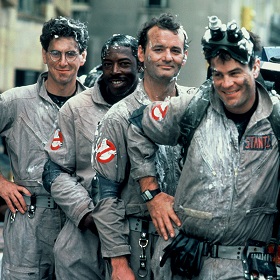 |
| Ghostbusters |
But, in the hands of most roleplayers, it's almost certainly going to degenerate into wonderful silliness, knob gags, and banter.
A good gaming group, especially one that has been together for years and knows each other's senses of humour, can - sometimes too easily - turn any "serious" gaming set-up into a comedy.
I'm not talking about totally taking the piss and trashing the campaign setting (that's just childish and idiotic behaviour), but having a laugh within the confines of the game can be very therapeutic.
There's always room for witty word play and the occasional actual joke written into the setting, but the players don't need to meet "NPCs with funny names".
They're gamers. Having fun.
If they have the imagination to play a roleplaying game, the chances are your players have a good sense of humour, so give them free rein to crack wise occasionally.
Sometimes, of course, this isn't appropriate for the setting or mood that the gamesmaster has carefully crafted, and he's quite within his rights to put his foot down, and remind the players that (imaginary) lives are at stake.
It's just telling the group that they're playing, say, a Ghostbusters or Red Dwarf campaign gives players licence to relax a little, not take their characters' serious jobs so seriously, and relish in their screw-ups.

As you know, the subject of Comedic/Humorous RPGs is one near and dear to me and I've discussed it extensively on my own blog. I think you hit the nail on the head; genre comedy in particular works best when the characters and their reactions are funny but what they're reacting to is serious (something my good friend Joseph V. told me back in high school).
ReplyDeleteThe threat of Sarris in Galaxy Quest is real. He is going to wipe out the Thermians. He did torture their previous leader. He is absolutely a very bad dude. Unfortunately, those opposing him are Actors mistaken for real Space Heroes.
Toon begins with a humorous, one could even say silly, premise. You are a cartoon character in a cartoon world. Teenagers from Outer Space is totally set in a world patterned after a Japanese Anime Sci-Fi High School Rom-Com. These games work well for long campaigns if, and only if, everyone is on the same page from the get go and understands, 'Yes, this is ridiculous'. You know what kind of game you're running and playing before you 'press start'. You know not to take it at all seriously.
While this can be true of Galaxy Quest, Ghostbusters, Paranoia (to some extent), Red Dwarf, Tales of the Floating Vagabond, and The Orville as well, all of these games benefit greatly from treating the setting and situations as legimately dangerous. It is the maladjusted PCs that make it a comedy.
Thank you, Adam. It's very reassuring to receive confirmation of my thesis from someone with such extensive, hands-on, experience of this style of gaming.
Delete