Showing posts with label Fritz Leiber. Show all posts

Tuesday, July 14, 2026

Night of the Eagle (1962)

Night of The Eagle will air in the UK on Talking Pictures TV, on July 25 at 9.05pm and July 28 at 9pm
The other year, one of my oldest online friends, John, announced he was having a clear-out and wanted to dispose of some of his old horror-themed Blu-Rays.

Never one to turn down a free movie, I offered to take a few off his hands and soon a package arrived with four discs in.

Among them was one I confess I'd never heard of: Night Of The Eagle (aka Burn Witch Burn).

So, naturally, that was the first to be taken for a spin in the Blu-Ray player.

Charming and charismatic psychology professor Norman Taylor (Peter Wyngarde aka Jason King of Department S) has it all: a great house, a career on the fast-track to success, and a beautiful wife, Tansy (Janet Blair).

Therefore, Norman is shocked to discover that his wife has been secretly practising witchcraft, she says to protect him from dangerous and jealous forces that would otherwise seek to derail his career or even harm him.

Angrily, he makes her destroy all her charms, fetishes, and witchy paraphernalia.

However, no sooner does she do this than their lives take a dramatic turn for the worse.

First, Norman is accused of sexually assaulting Margaret Abbott (Judith Stott), one of his students, at Hempnell Medical College, then some 'force' seemingly attacks his home.

The rational professor tries to deal with all these things logically, but Tansy starts to take increasingly wild, and potentially dangerous, steps to thwart this with - what she believes is - magic.

Night Of The Eagle is a fantastic, little, horror film, in a similar vein to 1957's Night Of The Demon and 1963's The Haunting.

It's oozing with atmosphere, relying on limited special effects and a strong amount of suggestion, so, like Norman, we're never 100 per cent sure if what's happening is co-incidence, feverish hallucinations, hypnosis or genuine black magic.

The ending is a bit sudden, given all the furore that has just unfurled, and certainly comes from the "karma is a bitch" playbook.

But, then, that was the style of films back in the day - they knew not to hang around and outstay their welcome. They had a story to tell, got in, told it, and got out. A trait seemingly lost on some filmmakers and their more recent overlong snorefests.

Based on Fritz Leiber's Conjure Wife (which first appeared in 1943 in Unknown magazine and then as novel in 1953), Night Of The Eagle's original New England setting was changed for 'old' England, instead.

This adaptation (there have been several) was penned by horror legend Richard Matheson with Twilight Zone writer Charles Beaumont, and some tweaking by George Baxt, at the behest of producer Albert Fennell.

A smart, tight, script, buoyed up by cracking performances from all concerned, Night Of The Eagle is definitely one for those who are happy to take their horror served without dollops of gore and jump scares.

Thursday, July 9, 2026

THROWBACK THURSDAY: The Whole World Is A Sourcebook!


As a creative, gaming-obsessed, pre-teen I sat in my corduroy shorts in prep school assembly seeking inspiration from the hymns we sang... just what was the to hit/damage bonus of a "bow of burning gold", what effect did "arrows of desire" have and just how fast was a "chariot of fire"?

In 1977, as well as discovering Star Wars, I had been introduced to Dungeons & Dragons and the whole world was suddenly "research material".

Everywhere I looked there were potential magic items or monsters for characters to contend with in dungeons drawn from every imaginable source.

My prep school co-dungeoneer, Tom, even ran me through a D&D adventure based on the first season of The Hitchhikers' Guide To The Galaxy (a radio serial he had introduced me to and also had a major impact on my life).

Television and books (particularly the sword and sorcery tales of Fritz Leiber, and a little later Harry Turtledove's first Elabon stories - Wereblood and Werenight) shaped many adventures and characters in those early years; then later comic books became a major source of inspiration as our games moved away from straight fantasy into the four-colour world of superheroes.

From these I still have three comic book standards that I would one day love to weave into a single, long-running roleplaying game: time travel, alternate dimensions, and cosmic entities.

Yet somehow, even in the games I've run for the Tuesday Knights in the past couple of decades, I have yet to squeeze all three of them in successfully; feeling that a campaign needs to progress at a steady pace for a considerable length of time before such contrasting, incredible elements can have their full, desired impact when introduced.

That said, all three feature heavily in The Sailor on The Seas of Fate, the second of Michael Moorcock's Elric books.

Even dreamier, more surreal and more psychedelic than Elric of Melniboné, this 190-page delight had me joining Elric on a ship sailing a strange ocean that linked not just islands, but worlds and planes of existence in time and space.

In a series of three adventures, Elric discovers he is but one face of The Eternal Champion, travelling to the Earth's future with three other incarnations of the Champion (Hawkmoon, Corum and Erekose) to battle two universe-threatening alien magicians; then he finds himself being chased by a Melnibonean sorcerer from history and swept up in a mythical love story; before finally taking a Heart of Darkness-style river journey to the legendary, lost birth place of his people.

These stories continue to leave me breathless, blown away by the absorbing text, the clever imagery and mental stimuli they spark in my enfeebled brain.

It also made me appreciate, perhaps, why I have never successfully tackled such cosmic themes as I desire to in my roleplaying games - they are best left to the master storytellers!

Wednesday, July 1, 2026

Deathstalker's Deeds Finally Set Down On Paper


Deathstalker - as portrayed in Steven Kostanski’s recent, excellent, movie - finally finds his way onto the written page, this September.

Bret Nelson's official adaptation of Deathstalker, published by Encyclopocalypse, will be available as a 190-page mass market paperback and and an e-book, with an audiobook following along later this year.

With a foreword by the great Patton Oswalt (who voices goblin-dwarf wizard Doodad in the film), the book - according to a recent article on Rue Morgue - will expand:
"...upon the film’s world of monsters, magic, mayhem, and adventure, bringing readers deeper into the war-torn realm of Abraxeon and the dangerous quest that places its reluctant hero at the centre of an unplanned adventure after accidentally unleashing a curse upon…himself."
Nelson, who has a solid track record with movie tie-ins, having penned adaptations of Plan 9 From Outer Space and Manborg, as well as numerous works of his own under his belt, says in the Rue Morgue piece that his was inspired by Conan The Barbarian comics and the works of Fritz Leiber and Michael Moorcock, as well as many hours of sword-and-sorcery roleplaying game campaigns.

I strongly suspect this is going to be delightfully pulpy and cannot wait to get my hands on the paperback.
"The legend returns... bloodier, bolder, and more outrageous than ever.

"Deathstalker is a thief, a mercenary, and a survivor with a talent for finding trouble wherever he roams. When a dying prince's mysterious amulet becomes bound to his soul, Deathstalker finds himself hunted by assassins, monsters, sorcerers, and creatures that should have remained buried in the darkest corners of the realm.

"Armed with an overwhelming desire to be left alone, Deathstalker embarks on a perilous quest across the war-torn kingdom of Abraxeon. Along the way he'll battle two-headed trolls, flesh-eating serpents, ancient curses, sinister magic, and an army of enemies determined to claim the amulet's deadly secret.

"Adapted from the screenplay by Steven Kostanski (Psycho Goreman, Frankie Freako) by Bret Nelson (Manborg, Plan 9 From Outer Space) and featuring a foreword by Patton Oswalt, Deathstalker is an epic journey into a world of gloriously old-school adventure.

"Sharpen your sword, and try not to get cursed along the way.

"Deathstalker rides again
."

Thursday, June 25, 2026

THROWBACK THURSDAY: Kickin' It Old School!


Supreme fantasy author Michael Moorcock admired pulp maven Robert E Howard's brutal barbarian Conan so much that when he set out to create his own swords and sorcery epic he wanted it to be as unlike the tales of the Cimmerian as possible.

And so, he created Elric: the doomed, feeble, albino sorcerer-king kept alive by, first, mysterious narcotics and later by the evil energy of his cursed sword, Stormbringer.

When I last reread the first of the Elric books - Elric of Melnibone - it took just about two days, I still couldn't put it down.

A combination of my insomnia and the power of the writing saw me reading at all hours of the day and night.

Moorcock proves you don't need a ponderous, phonebook-sized tome to tell a thrilling, memorable fantasy tale.

In a 'mere' 190-pages Elric goes from languishing on his Ruby Throne to dealing with elemental creatures, fighting off an invasion, crossing the Young Kingdoms to find his kidnapped sweetheart and finally journeying to another plane of existence to retrieve Stormbringer at the behest of the Chaos demon-god Aroich.

Outside of Tolkien's main Lord of The Rings' characters and Conan himself, Elric and his legendary sword must be two of the best known names in fantasy literature... their dreamy, nightmarish adventures seeping into all manner of related media (e.g. heavy influences on early roleplaying games from Dungeons & Dragons and Arduin to Chaosium's own Stormbringer game; to the prominent technomage in Babylon 5 universe called... Elric).

And next year, we're getting three different new Elric roleplaying games: one for Dragonbane, one for Dungeon Crawl Classics, and one for 5e!

Reading Elric of Melnibone again stirred in me nostalgic memories for the other books of my youth - Fritz Leiber's Nehwon tales with Fafhrd and the Gray Mouser or Harry Turtledove's stories of Gerin The Fox - and the old school fantasy roleplaying games of my teen years.

It filled me with a hankering for that '80s Dungeons & Dragons-style vibe, that feeling of wonder and "not knowing what's around the next corner".

To quote Wikipedia:
"Some fans of pencil and paper role playing games use [old school] to describe RPGs characterized by simple game mechanics and flexible rules. The character generation system in such RPGs tend to lack extensive lists of skills and abilities. Basic Dungeons & Dragons and the first edition of Advanced Dungeons & Dragons are often considered 'old school' role playing games."
All this hankering for past gaming glories was also been stoked back in the 2000's by several great rules-lite, war story-heavy fantasy gaming podcasts I listened to at the time. Sadly, these are now gone - swept aside by the tidal wave of "actual play" podcasts.

The pods I listened to eschewed the attitude of some of the more snobby or 'elitist' podcasts back then which looked down their virtual noses at "game stories" or the "tell me about your character" attitude.

Personally I believe that's a central element of roleplaying games - you are generating collective stories, so why not share them? Isn't this just another form of creating fantasy literature?

As long as the stories are interesting, they are as valid as any other anecdote you may care to tell.

Wednesday, May 13, 2026

More Blood and Souls For My Lord Arioch!


Michael Moorcock's Elric may not have been my (post-Tolkien) introduction to the sword-and-sorcery genre (that honour rests with Fritz Leiber's Fafhrd and The Gray Mouser), it was Moorcock's work that truly shaped my taste in reading.

I haven't read any Leiber in an age, but I often revisit the twisted, hallucinogenic, weird fantasy adventures of Elric of Melniboné and The Young Kingdoms.

There's something about the succinctness of Moorcock's early tales of Elric and his soul-devouring sword Stormbringer that I've always found more enchanting than the doorstop tomes so prevalent today.

It was after years of reading Moorcock that I instituted my "Moorcock Rule" (more of a guideline)  that stated that a book REALLY had to work hard to justify itself if it ran longer than 150-200 pages. 

That said, I've never used the Young Kingdoms - nor any of the trappings of Elric's adventures (even Stormbringer, itself) - in my own roleplaying games. 

I don't own a copy of Chaosium's Stormbringer/Elric of Melniboné RPGs (1981 - 2010). I've looked into it in the last couple of decades but those books generally command silly money on the secondary market.

However, in recent weeks, both Goodman Games and Free League have announced they will be releasing games based on this IP next year (after crowdfunding campaigns).

Goodman Games is planning two different iterations: one using Dungeons & Dragons 5e and one using Dungeon Crawl Classics. While I feel the latter system is probably more suited to emulating the demon-fuelled magic of Elric's world, neither of these systems really tickle my fancy at the moment.

However, my interest is well-and-truly piqued by Free League's offering, Legends of Stormbringer, which will run on the Dragonbane engine. 

I know I keep saying I'm out of the buying new games side of the hobby, but to quote Michael Corleone in The Godfather, Part III:
"Just when I thought I was out, they pull me back in."
Dragonbane isn't a game I'm particularly familiar with, except from second hand accounts which are a generally overwhelmingly positive... with a few minor niggles about some of the mechanics.

A translated version of Drakar och Demoner, a game system played in Scandinavia since 1982, Dragonbane's definitely been at the top of my "must check out the starter set" list since it was first released in English in 2023.

This recent announcement might be the nudge I "needed" to pull the trigger on yet another game that I may - or may not - run for the Tuesday Knights.

You can read about Free League's forthcoming Stormbringer offering (and a bit about Dragonbane) here.

Sunday, December 21, 2025

"The Golden Age of Sci-Fi/Fantasy is 14"

In an old article on his blog about a youthful passion for the Dragonlance novels, Timothy S Brannan shared the wise saying: "The Golden Age of Sci-Fi/Fantasy is 14."

And this is so true.

The things we discover at that age stay with us.

For me, this would be around 1980... the year Hawk The Slayer came out.

I've written often of my love for this most Dungeons & Dragons of all fantasy movies (and probably will continue to do so).

At the dawn of the '80s, I was already engrossed in the stop-motion worlds of Ray Harryhausen fantasy movies (his last, Clash of The Titans, would come out in 1981), and this was also the era of the original Star Wars and The Empire Strikes Back (which came out in 1980).

I was reading mainly sci-fi (Hitchhikers Guide to The Galaxy, Stainless Steel Rat etc), if I recall correctly (inspired by the galaxy far, far away), but my young gaming hobby had propelled me to the works of Fritz Leiber.

His Fafhrd and The Grey Mouser stories would come to influence my Dungeons & Dragons adventures as much as Harryhausen's Sinbad at that time.

I was always a player - rather than a Dungeon Master - in my early years, so was interested in character ideas, rather than grander plots and world-building (not that I didn't appreciate them at that time, but they just weren't as useful from a gaming perspective).

I had yet to stumble upon the stack of New Teen Titans in a second-hand book store in Tunbridge Wells and become a fully-fledged comic book collector, but I still dabbled in that medium.

2000AD was my publication of choice at that age.

And, of course, all these things still hold sway over me and continue to influence my gaming and broader hobby interests.

I don't think I realised, until just now, quite how important the art we discover at that particular age is in shaping the sort of person we grow into in our adult life and our hobbies, passions, and interests.

Thursday, September 4, 2025

THROWBACK THURSDAY: Conan and The Fox


Last week I wrote about how I encountered Conan The Barbarian in comic books (courtesy of the wonderful, old digest releases), but I reckon this must have also been around the same time I discovered him in literature as well.

This literary retrospection reminded me of the first Robert E Howard books I ever owned.

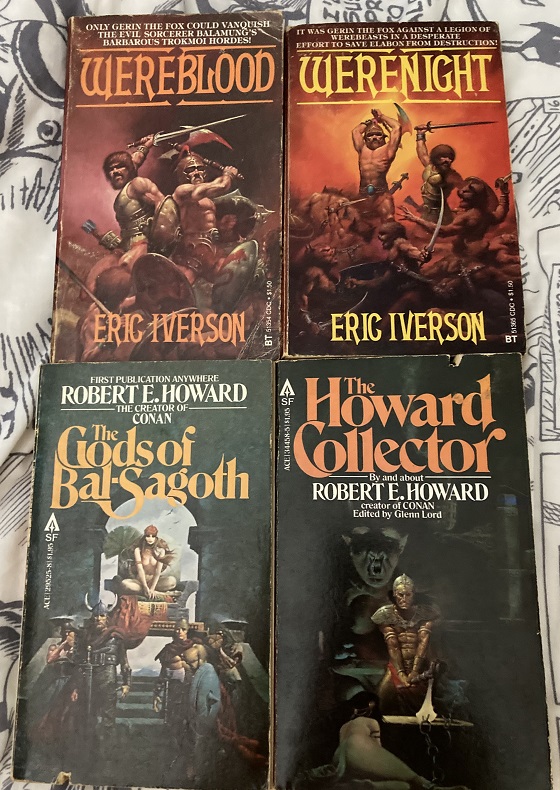
It must have been the very early 1980s when I found myself, during a shopping trip to Maidstone with my parents, as a young teenager in a discount book store (I seem to recall it was one of those shops that sold remaindered titles and craft bits and bobs, kind of a forerunner to today's The Works) and my eye was immediately drawn to the exciting covers of The Howard Collector and The Gods of Bel-Sagoth, which turned out to be anthology titles focusing on the output of Robert E Howard, father of Conan.

I also acquired Wereblood and Werenight, which would turn out to be game-changing sword-and-sorcery titles for me.

These short and pacy novels had an air of Fafhrd and The Gray Mouser about them, and I strongly suspect Fritz Leiber's dynamic duo were a major influence on author 'Eric Iverson'.

At that time, I was deep, deep, deep in the early bloom of my love of Dungeons & Dragons and all things RPG and those two novels were a major influence on me.

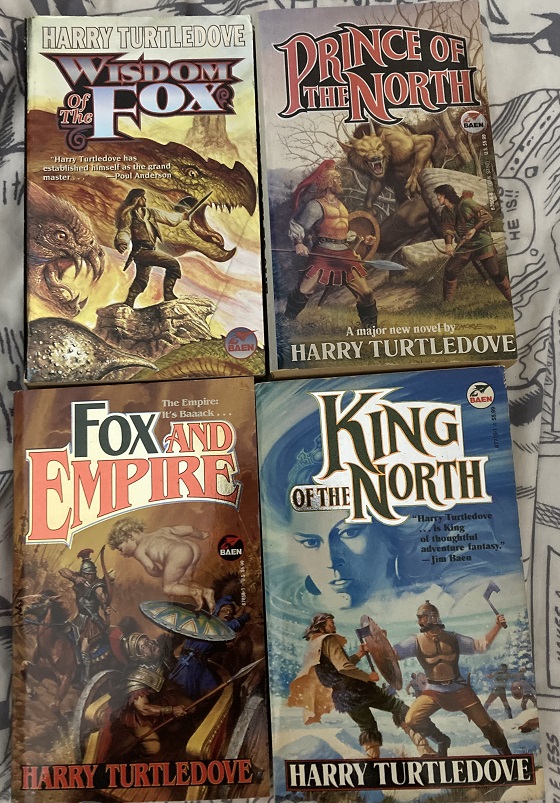
But then I could never find anything else written by Eric Iverson. I always hoped he'd continue the adventures of Gerin The Fox, the protagonist of Wereblood and Werenight.

It was only about a decade or so ago that, thanks to the creation of the Internet, I discovered that Eric Iverson was actually just a pen name of alternate history aficionado Harry Turtledove... and that there were more Gerin The Fox tales.

They turned out to be reasonably easy to track down at the time, on Amazon and eBay, but given how much I loved the original duology as a teenager I still haven't cracked open these later books for fear they can't recapture that magic.

It's probably about time I tried though...  

Thursday, August 28, 2025

THROWBACK THURSDAY: Conan Digests


When we were readying ourselves to move house half-a-dozen years ago, I was shifting boxes in the 'office' part of my attic-gamesroom and 'discovered' a long concealed bookcase; squirrelled away in the corner, on which was my collection of eight, old Conan The Barbarian digests.

These were pocket-sized, British reprints (in black and white) from the early '80s, of Conan's original stint in the pages of Marvel Comics, each around 50-pages long.

These were my first exposure to both Conan The Barbarian and the works of Robert E Howard, I would have been about 14 or 15 when I picked these up.


I guess I was a comparative latecomer to the exploits of the mighty Cimmerian, having cut my sword-and-sorcery teeth - soon after being introduced to Dungeons & Dragons at the tail-end of the '70s - on Fritz Leiber's Nehwon tales with Fafhrd and the Gray Mouser, Harry Turtledove's stories of Gerin The Fox, and then Michael Moorcock's Elric of Melniboné, years before I encountered Conan The Barbarian.

In truth, I think, after the comic book digests, my first actual Robert E Howard book was a remaindered copy of The Gods Of Bal-Sagoth, an Ace Science-Fiction collection of non-Conan stories, that I purchased in a discount book store while out shopping with my parents.

Like pretty much everything at that time, my early interest in Howard's work - and Conan - was fuelled by my desire to make everything about my blossoming passion for roleplaying games, and particularly Dungeons & Dragons.

A passion they still serve today.

My pop culture Odyssey: a slice of super-powered geek life with heavy emphasis on pulp adventure, superheroes, comic books, westerns, horror, sci-fi, giant monsters, zombies etc