Showing posts with label Andy Serkis. Show all posts

Thursday, September 17, 2026

THROWBACK THURSDAY: What Was Gandalf's Handicap?

"...and knocked their king Golfimbul's head clean off with a wooden club. It sailed a hundred yards through the air and went down a rabbit-hole, and in this way the battle was won and the game of Golf invented at the same moment."
Back in 2012 I decided to reread The Hobbit, both to relax and mentally prepare me for Peter Jackson's new movie (An Unexpected Journey), and the thing that has immediately struck me (and probably explains why I stopped reading the book repeatedly after I grew out of my teens) is just what a clunky writer old JRRT is.

He may be a world-maker, language-crafter and mythology-weaver without equal in the realm of fantasy writing, but even if we ignore the odd similes that refer to 'steam engines' and 'pop-guns', or the fact that Bilbo has a clock on his mantlepiece, or that the 'terrifying' trolls are called Bill Huggins, Bert and Tom (these are the same trolls that turn up as petrified scenery in Lord Of The Rings), there is no excusing the ridiculous sentence that I began this piece with.

Read it again and just think about it. Golf was invented in Middle-Earth, before the time of The Hobbit, and was therefore probably being played during the War Of The Ring!

Did I skip the chapter where Legolas and Gimli worked out their racial differences on the Anfalas greens? Did the war disrupt the scheduling of the Rivendell Open?

And talking of Rivendell, check out this fantastic piece of elfish verse:
"O! tril-lil-lil-lolly
the valley is jolly,
ha!ha!"
And I'm only three chapters in. Makes me almost miss Tom Bombadil...

I adore the world Tolkien created, the life he gave to the creatures and races he peopled it with, but I just find the actual words he uses to tell his stories so laboured at times*.

The Hobbit is an easier read than Lord Of The Rings, of course, because it's written for children, not even young adults, but children too innocent to groan at awful puns and cheesy rhymes.

But surely I can't be the only one who has difficulties believing the world of The Hobbit is the same world that Lord Of The Rings takes place in?

For starters, where are all the golf clubs?
* As a side note to demonstrate how contrary I can be, I absolutely love listening to the audiobook of The Silmarillion (I have both the Martin Shaw and the Andy Serkis versions).

Wednesday, September 16, 2026

The Hobbit - An Unexpected Journey (2012)


Although I now class Peter Jackson's Lord Of The Rings as one of my favourite movies, I wasn't overly impressed when I first saw The Fellowship Of The Ring at the cinema. There were too many long shots of people in fancy dress walking through fields and the narrative didn't flow that well. It was only when I saw the extended, director's cut on DVD that I began to appreciate the majesty of Jackson's ambitious enterprise.

So, I suppose there's every possibility that one day I will come to love to An Unexpected Journey. But I can't see it being any time soon.

One of the major problems I have with it (beyond being way too long) is it is simply isn't The Lord Of The Rings. Although there are moments of brilliance in this first, 169-minute segment of The Hobbit, it lurches from broad comedy to grim dourness with very clumsy footing.

It also becomes very clear that the source material is a book aimed squarely at very young children, with its alliteratively-named dwarvish troupe of adventurers, anachronistic sporting references and trolls named Burt and Tom.

On one hand we have the orc war-band speaking in sub-titles, then we have the trolls and goblins speaking English.

There's no sense that this is a real world, something which the original three movies achieved effortlessly.

There are scenes - such as the gathering of big-wigs at Rivendell - that feel wholly enmeshed in this world we have grown to love, but then there's the stupidly-named trolls (one also uses a handkerchief) and other moments of juvenilia, that I know are from Tolkien's book, but still don't tally with the flawless verisimilitude of Middle-Earth from Lord Of The Rings.

The rabbit-drawn sled I can let slide (I have a soft spot for rabbits), but the preposterous stone giants: why, just why?

Although there's some meaty exposition up-front, the film starts really slowly with the dwarves arrival at Bag End and the whole set-up for the plot (could have done without the "That's What Bilbo Baggins Hates" song that came dangerously close to tipping this piece over into high camp).

Then even once the adventurers get going there's a diversion for the audience to visit the nature wizard Radagast The Brown (Sylvester McCoy) which, while visually interesting, takes about quarter-of-an-hour to show us something that Gandalf tells Elrond et al in a couple of lines.

And so it goes on, in fits and starts.

Just as you think the pace is picking up, something will pop up to slow things back down again and the plot doesn't really get flowing until the final act - namely Bilbo (Martin Freeman) playing the 'riddle game' with Gollum (Andy Serkis); the dwarves escape from goblin town (which in a sense is just a replay of the Fellowship escaping Moria, but with wooden bridges replacing stone); then the fight with the orcs; and finally the arrival of the eagles (which is handled very well, as it isn't explained because we know exactly what to expect when we see Gandalf talking to the moth he has captured).

Do have to wonder though why the eagles couldn't carry our heroes a bit closer to their final destination?

There are also odd moments where - given that technology has presumably moved on quite a bit since the Rings films - some of the special effects jarred; there's some quite noticeable green-screening which is always a good way to kick you out of the moment. Is this a side effect of Jackson's use of a higher frame-rate to shoot the movie?

While the director's cuts of all three parts of Lord Of The Rings are long, they flow gorgeously and never feel like a chore, but the two hours 42 minutes (plus about seven minutes of credits) of An Unexpected Journey really felt like a marathon.

It was certainly rewarding once we crossed the finish line, and the final shot of Smaug waking up was worth its weight in gold - but then you have to realise we're only a third of the way.

Perhaps the narrative will flow better when we can watch all three pictures back-to-back and see the full vision that Jackson is bringing to this tale.

There's clearly been a lot of backstory added (from Tolkien's other work) to build up the story of the Necromancer and create a bridge to The Lord Of The Rings and I can't help wishing that more emphasis had been put on this and a scalpel had been taken to the actual story of The Hobbit to strip it back to its core elements.

Friday, July 4, 2025

Kingdom of The Planet of The Apes (2024)

Opening up with Caesar's funeral, Kingdom of The Planet of The Apes then jumps forward in time "many generations" (probably several hundred years) from War For The Planet of The Apes, the end of the first trilogy of the stories in the revamped franchise.

Ape society in this post-apocalyptic world has evolved into numerous tribes and the film's protagonists are the Eagle Clan - who tame wild eagles as their pets.

Noa (It's Owen Teague) of The Eagle Clan finds himself alone when violent ape raiders from another clan kidnap his family and friends, leaving him for dead.

In his quest to track them down, Noa teams up with Raka (Peter Macon aka Bortus from The Orville), an orangutan follower of Caesar's teachings, and a talking human, Mae (The Witcher's Freya Allen).

Mae knows where Noa's tribe has been taken, the kingdom of self-proclaimed "Caesar", the bonobo Proximus (genre stalwart Kevin Durand).

He is employing his many captives as muscle to try and break into the ancient bunker complex around which he has set up camp.

This new Caesar wants to get his hands on the powerful human treasures he believes are stored within.

Mae, however, knows exactly what's in there and has her eyes set on a single, important item that she hopes might give humanity its "voice" back.

Narratively this sub-plot is the only real hiccup in Kingdom of The Planet of The Apes.

Mae - and. it turns out. others - seem very knowledgeable about the Old World and so you have to wonder why they waited "many generations" to put their mysterious plan into operation?

It would be a spoiler to go into too much detail, but the huge revelation in the denouement (which does NOT involve The Statue of Liberty) clearly sets up the - as yet unannounced officially - sequel, leaving so many questions unanswered.

This does, unfortunately, mean an otherwise gorgeous and enthralling movie feels slightly incomplete. 

None of which means I didn't love this film. Despite its 145-minute duration, this is a fantastic, engrossing, adventure romp that comes in a close second, in my admiration for the new CGI Apes era, behind Rise of The Planet of The Apes.

Pitched as the start of a new trilogy of movies, Kingdom of The Planet of The Apes is peppered with call-backs to the original films from the 1960s and '70s, from musical cues to homages (e.g. the human hunt sequence) and Easter Eggs.

Massive kudos to director Wes Ball (previously best known for the Maze Runner trilogy) whose love and enthusiasm for this franchise has helped bring out top-notch performances from the primarily primate performers (with guidance and assistance from the legendary maestro of motion-capture Andy Serkis).

Kingdom of The Planet of The Apes is a thing of beauty, blending location shooting with stage sets, inhabited by the breathtakingly perfect mo-cap apes (courtesy of Wētā FX).

The slight problem this visual feast caused me - particularly when it came to the interactions of the ape characters - was the constant hollering from the dark recesses of my brain going "wow, I wonder how they did that?" and distracting me from the unfolding story.

War For The Planet Of The Apes (2017)


As far as I'm concerned the original 1960s/'70s Planet Of The Apes movies are - warts and all - sacrosanct, critic-proof, indelible parts of my childhood and formative years.

The 2001 Tim Burton 'reboot' is best forgotten (as I think most people have).

And so I came to this decade's retelling of the classic story with a degree of caution.

To date, the new franchise was running 50/50. I really enjoyed Rise Of The Planet Of The Apes, but was ultimately underwhelmed by Dawn Of The Planet Of The Apes.

This left me uncertain of what to expect from War For The Planet Of The Apes, as the same team that had fumbled the ball with Dawn were behind this new offering.

But not only had they learned from their mistakes, but writer-director Matt Reeves and co-writer Mark Bomback have managed to deliver a genuine epic of sweeping emotions and spectacular action.

The time-frame has moved on several years from Dawn.

Caesar (surely an Oscar-worthy mo-cap performance from the brilliant Andy Serkis) and his colleagues fighting the war that the rogue Koba started, but are trying to convince the humans that they just want to live in peace.

However, when The Colonel (Woody Harrelson, in full Marlon Brando/Colonel Kurtz mode) kills members of Caesar's family, the conflict becomes personal and the super-intelligent chimpanzee makes it his mission in life to exact revenge on The Colonel.

The situation is complicated by the discovery that the virus that caused all the problems to start with is continuing to mutate, causing additional problems for the human species.

Taking a small band of loyal followers with him, Caesar sends the rest of his tribe off to safety, then sets out on his crusade.

More than ever, War For The Planet Of The Apes focuses on the simian side of the conflict.

While Caesar is a flawed protagonist, the apes are definitely the good guys and the humans - violent and stupid - are not shown in a great light.

Although primarily a dramatic and violent war film, balanced with some genuine humanity and tragedy, I was surprised by the injection of moments of humour - largely due to the addition of Bad Ape (Steve Zahn) to Caesar's band.

The film is also full of wonderful nods to the original movies, from the introduction of young Nova (Amiah Miller), the mute child who is the one human to side with the apes; through the striking ape crucifixions; to the alpha/omega icongraphy of The Colonel's military encampment.

In spite of its two hours and 20 minutes duration, War For The Planet Of The Apes holds your attention and draws you in, you can't help but feel genuine emotional attachment to the computer-generated, simian characters. Every emotion can be read on their faces as they experience them, you hear ever change in timbre in their voices.

The special effects, especially with regard to the motion-capture portrayal of the apes, are simply incredible. They are so good you truly believe in these characters without a second thought.

This is the gold standard by which other effects-heavy movies should be judged now.

The effects are so good and, more crucially, the performances by the actors portraying the characters created through motion-capture are so impressive that, if you immerse yourself in the movie, it feels as real as any movie shot without any special effects.

And director Matt Reeves has such an incredible artistic eye for visuals, encapsulated perfectly in the final scenes that - clearly deliberately - evoke the feeling of an old school Hollywood Biblical epic when the apes ultimately come to their 'promised land'.

War For The Planet Of The Apes can clearly be read as a prequel to the scenario established in the 1968 original, as it sets up the fall of mankind and the rise to dominance of the apes.

With the advances in movie-making technology, and in the gifted hands of a visionary director like Reeves, I'm now hoping for a genuine remake of the original to bring the franchise full circle.

Dawn Of The Planet Of The Apes (2014)


Director Matt Reeves and Twentieth Century Fox have pulled off a cunning bait-and-switch with Dawn Of The Planet Of The Apes, getting the summer blockbuster crowds flocking to see to a sub-titled foreign film!

Because that's essentially what Dawn Of The Planet Of The Apes is with almost as little English spoken dialogue as an Arnold Schwarzenegger flick, about 75 per cent of the movie is the apes signing - or grunting - to each other, translated as sub-titles.

And the apes are magnificent. There is no denying the brilliance of the special effects and the emotional depth the actors manage to portray through motion-capture.


The script by Mark Bomback, Rick Jaffa and Amanda Silveris also heavily biased towards the simian elements of the story with the humans being two-dimensional at best.

We have followed the key apes - such as Caesar (Andy Serkis) and Koba (Toby Kebbell) - from Rise Of The Planet Of The Apes and they are given solid character arcs. However, in stark contrast, the humans we meet for the first time here we never really get to know anything of any substance about and so they generally come across as broad stereotypes.

Gary Oldman's character, Dreyfus, for instance adds nothing to the story, except his final act of destruction which could have been committed by any of the nameless supporting characters.

It's ten years since the outbreak of simian flu (as seen at the end of Rise) and the apes have made themselves a nice home in the woods outside of San Francisco, across the Golden Gate Bridge, while human civilization has collapsed and been at war with itself for increasingly less resources.

Despite living just across the bridge from each other the apes haven't seen any humans for two years and the humans in San Francisco seem even more oblivious to the colony of apes (I know this is all post-apocalypty, but I did find this a bit hard to believe).

The humans need the energy from an hydroelectric dam up in the forest (to power their iPads mainly) and so send out a small party to scout it out. The group includes Malcolm (Jason Clarke), his son Alexander (Kodi Smit-McPhee), Malcolm's girlfriend Ellie (Keri Russell) and fine Fringe alum Kirk Acevedo as the required troublemaker - and they unexpectedly run into the apes. Naturally hilarity ensues.

Caesar reluctantly comes to trust the humans, while scarred-up Koba hates them with a white-hot fury and does his best to sabotage any moves to establish respect or friendship between the two neighbouring colonies.

Most of the humans - barring Malcolm and his make-shift family - aren't overly fond of the apes either and so inevitably tensions come to a head and conflict breaks out.

The storyline of Dawn Of The Planet Of The Apes isn't particularly clever or original and ultimately it comes off feeling like a bridging film between the fantastic Rise Of The Planet Of The Apes and whatever is coming next in the franchise.

Also, for a summer blockbuster (and especially one with a surprising amount of subtitles), it's a very "talky" film, with some noticeably slow patches between the fast-paced action sequences.

In hindsight, this is an Apes film for lovers of the franchise that, despite its big build-up, seems quite small in its execution, portraying what is presumably a key moment in the development of (this iteration of) The Planet Of The Apes, rather than being the self-contained epic some might have been expecting.

Dawn Of The Planet Of The Apes is enjoyable, but not to the same degree as Rise. It goes part way towards realising the potential set out in the original film, but with the inescapable feeling that there is still a lot more to come.

The main takeaway from Dawn Of The Planet Of The Apes for me was a hunger to see where the franchise goes next.

Rise Of The Planet Of The Apes (2011)


It is inevitable that one day mankind will be superseded by ape-kind and I will be at the front of the crowd, waving my flag and cheering on our new simian overlords.

With that bias in mind, my predisposition was to expect greatness from Rise Of The Planet Of The Apes (hoping it would wipe, forever, from our collective consciousnesses Tim Burton's ill-conceived abomination of 2001).

What I wasn't expecting was just how damn awesome it was!

Rise Of The Planet Of The Apes is, without a doubt, the most perfect piece of filmmaking of 2011, from Rupert Wyatt's direction and Rick Jaffa and Amanda Silver's script to the motion-capture apes and the humans they interact with.

The plot pacing was superb, the foreshadowing excellent, and the beautiful little Easter eggs for fans of the original ape films (from Caesar's model of the Statue of Liberty and the name "Bright Eyes" through to line-lifts such as "it's a madhouse", "get your hands off me..." and a certain other key line delivered by a key character) simply showed how much care and attention had gone into this movie, and its respect for its cinematic predecessors.

James Franco plays research scientist Will Rodman, working on a cure for Alzheimer's, but a catastrophic accident during final testing makes his boss order him to have all their test subjects - chimpanzees - put down.

Will takes pity on a baby chimp and takes him home to be a companion to his father Charles Rodman (John Lithgow), a former music teacher and scholar now in the grip of Alzheimer's.

The chimp, who they name Caesar, soon becomes a central part of the family unit, especially when Will tests his gene-therapy on his father and it works.

Unfortunately, years later, the therapy starts to wear off for Charles and he finds himself in an altercation with his obnoxious neighbour, a pilot called Hunsiker (Stargate's David Hewlett).

Caesar jumps in to save his friend and ends up being taken in by the authorities and handed over to an animal control centre run by John Landon (Brian Cox) and his obnoxious son Dodge (Tom Felton).

It is here, eventually, that Caesar hatches his plan to liberate his fellow apes and take revenge on mankind.

That brief summation of the early scenes of the movie doesn't even begin to do it justice.

As well-rounded as the human characters are, the film truly belongs to Caesar - the CGI ape created by motion-capture technology and based upon the performance of the incredible Andy Serkis (already renowned for brining life to such diverse characters as Gollum and King Kong).

Given that the bulk of his feelings and emotions are expressed through sign language, gestures or facial expressions, Serkis has made Caesar an incredibly complex and well-rounded character.

If he doesn't get some mighty gong for his performance here then there truly is no justice in the world.

You also have to feel slightly sorry for Tom Felton, having played the 'bad boy' of Hogwarts, Draco Malfoy, for all these years, his first post-Harry Potter role is just as objectionable. But he suitably slimy as Dodge and gets his just desserts at the hands of the apes he loves tormenting.

Rise Of The Planet Of The Apes is a classic 'science-experiment-gone-wrong' movie and naturally ends with a breath-taking action sequence that makes great use of the streets of San Francisco and the Golden Gate Bridge.

However, that's not the end of things because as the closing credits hint, and picking up on clues sown throughout the movie (man's first manned mission to Mars, spacecraft disappearing etc), the groundwork was been laid seamlessly for the inevitable sequel.

And it couldn't come soon enough...

Saturday, February 8, 2025

Venom - The Last Dance (2024)


Back from his brief sojourn on the MCU's Earth-616, Eddie Brock (Tom Hardy) and his alien symbiote, Venom, find themselves pursued across America by both the military and extra-dimensional symbiote-hunting monsters called Xenophages.

The military want to study Venom in their underground base, concealed beneath Area 51 in the Nevada desert, while the monsters serve Knull (Andy Serkis, director of Venom: Let There Be Carnage), the god-like creator of the symbiotes.

With nebulous goals of universal suppression, Knull needs "the codex", part of Eddie and Venom's bond, to free himself from Klyntar, a space prison built for him by his rebellious symbiotes.

While on the run, Eddie meets up with a potentially-irritating family of hippies (Rhys Ifans is the alien-mad father, Martin Moon, and Alanna Ubach is his wife, Nova) whose aggravation quotient mellows as the story unfolds. Rather than being just amusing cameos, the Moon family ultimately prove pivotal in the film's third act.

Eddie eventually runs out of luck, is captured by General Rex Strickland (Chiwetel Ejiofor) and transported to the subterranean base, where Stephen Graham's presumed-dead Detective Patrick Mulligan is also being held.

But the Xenophages are still on Eddie's trail, leading to a final - grand scale - showdown at Area 51.

While the Venom trilogy peaked with its second chapter, The Last Dance has an easy-to-follow, straight-forward "chase-and-fight" plot that makes its 110-minute duration bounce along at an engaging pace.

Don't get me wrong, The Last Dance is a chaotic mess - full of extraneous, undeveloped characters - but it simultaneously manages to finely balance absolute silliness and existential cosmic horror.

The scenes featuring Knull look as though they were lifted direct from the comic book source material, and the fact that his menace is never fully realised only adds to the overwhelming sense of dread he exudes.

Although it seems certain that this film is the end of Tom Hardy/Eddie Brock's involvement with Venom, it does leave the door open for an MCU symbiote (just with a new host) and the potentially multiversal threat of Knull and his legions of Xenophages.

As dumb as it was, I actually really enjoyed Venom: The Last Dance, and was genuinely surprised by the main movie's downbeat ending.

There's (of course) a mid- and a post-credit scene, but neither really add much to the story (except to remind us that Knull still very much exists in the Sony'verse, and possibly leaving the door open for further adventures).

Until I discovered the movies, I was never really that interested in Venom as a comic book character, but it's been Tom Hardy's passion for the character and this trilogy that really sold me on it.

I'm not sure, as it stands, how bothered I'd be about future cinematic outings for the character if Tom Hardy wasn't playing the lead.
  • Venom: The Last Dance is now available on Blu-Ray in the UK.

Friday, February 7, 2025

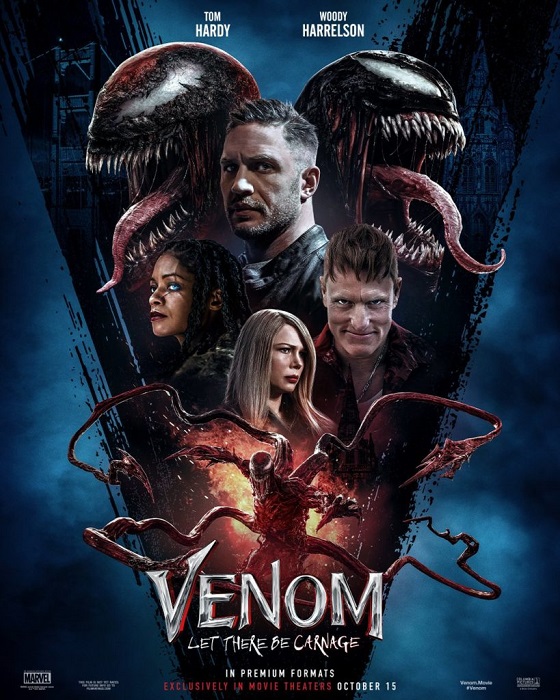
Venom - Let There Be Carnage (2021)

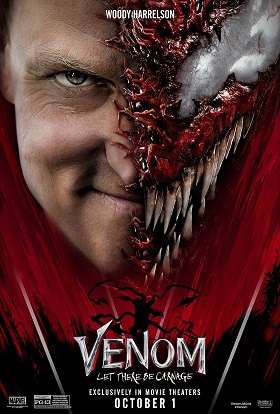
We first met serial killer Cletus Kasady (Woody Harrelson) in the mid-credit scene of 2018's Venom, but he steps into the spotlight for the sequel, Venom: Let There Be Carnage.

The imprisoned killer, now shorn of his fright wig hairdo from Venom, has a fascination with washed-up journalist Eddie Brock (Tom Hardy), little realising that Brock is host to the alien symbiote known as Venom.

However, Venom manages to unearth a clue in Kasady's cell that leads to the buried remains of many of his victims.

This development cements Kasady's fate and propels Brock's career back to its previous heights.

When Brock pays a final visit to Kasady in San Quentin, the killer manages to take a bite out of him... accidentally ingesting part of the alien symbiote.

Kasady's execution by lethal injection then stimulates the creature in his blood, transforming him into the brutal, tentacled monstrosity Carnage.

They break out of the prison in a grand set-piece of mass destruction and murder, and set about tracking down Kasady's childhood sweetheart, Frances, as part of a deal that would see them ultimately killing Carnage's "father", Venom.

Frances Barrison (Naomie Harris) is a mutant codenamed Shriek, with powerful sonic abilities, who is being held in a secret research facility, but Kasady makes short work of its defences and the couple slip away into the night.

However, the seeds of romantic disharmony are sown quite early on as symbiotes are extremely vulnerable to loud noises and so Carnage isn't at all impressed by his host's paramour.

Frances and Kasady immediately plan a wedding, which involves kidnapping police detective Mulligan (Stephen Graham), who cost Frances her eye during an earlier escape attempt, Eddie, and Venom.

To get to Eddie, the bad guys grab his former fiancée, Anne Weyling (Michelle Williams), who is now engaged to Dr Dan Lewis (Reid Scott).

Directed by Andy Serkis, from a script by Kelly Marcel and Tom Hardy, Venom: Let There Be Carnage tries to temper the potentially brutal reality of a character like Kasady bonding with an almost omnipotent creature like Carnage with a tsunami of screwball comedy antics and bizarre attempts at black humour.

In all honesty, it shouldn't work... but somehow it does, thanks in no small part of the hard-boiled charisma of Tom Hardy.

There are echoes of Woody Harrelson's earlier performance in the divisive Natural Born Killers in the romance between Kletus and Frances, but these characters, drawn with broad, pulpy, brushstrokes are nowhere near as well-developed as Mickey and Mallory Knox.

Upon first viewing the original Venom movie was a disaster, and yet there was something about it that drew me back to it on its home video release and I've not only found myself enjoying it more on repeat viewings, but have been drawn into the world of Venom in Marvel Comics as well.

This is something I never thought would happen, as the whole idea of a murderous anti-hero really turned me off the character.

But thanks to Tom Hardy's performance in that first movie and then Donny Cates's phenomenal run on the comics in recent years has really won be round to both the character and its potential... in the right hands.

An overview of the plot makes you realise that Venom: Let There Be Carnage is actually a surprisingly small, and contained, film with the antagonists only being free to sow chaos in the wider world for, seemingly, less than 24 hours.

There is no great hunt for Carnage and Shriek, as they tell Eddie where to find them soon after they've torched the abandoned reform school they were both held in as juvenile delinquents.

The grand finale in the cathedral where Kasady and Frances are getting married, is reminiscent of many similarly-staged climactic confrontations, from the Quatermass Experiment to 2003's Daredevil, but this has the added cachet of battling Lovecraftian abominations... and a surprise cameo by the League of Gentleman's Reece Shearsmith.

Talking of cameos, though, the biggest 'shock' and dollop of fanservice comes - once again - in the mid-credit scene, which sets up Venom's potential appearances going forward with a most exciting development.

This 'squee' moment is almost worth the price of admission alone.
My pop culture Odyssey: a slice of super-powered geek life with heavy emphasis on pulp adventure, horror, comic books, westerns, superheroes, sci-fi, giant monsters, zombies etc