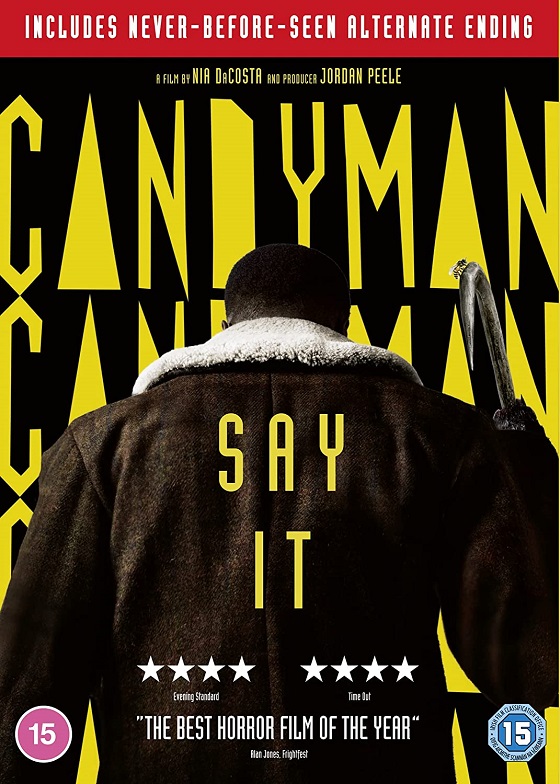
I reviewed the original 1992 Candyman yesterday just to remind me of the titular character's backstory, little realising that the 2021 Candyman would actually turn out to be a direct sequel to that.
Not only does Nia DaCosta's film frequently reference the earlier flick, but it also subtly expands the established mythology and, ultimately, acts as a fresh origin story for the supernatural slayer kept 'alive' through urban legends.
Yahya Abdul-Mateen II, of Watchmen and Aquaman fame, is up-and-coming artist Anthony McCoy seeking inspiration for his next project from the brutal history of the Chicago community in which he lives, the increasingly-gentrified neighbourhood of Cabrini-Green.
His imagination is taken by a story spun by Troy (Nathan Stewart-Jarrett, from Misfits), the brother of his girlfriend, art curator Brianna Cartwright (WandaVision and Mad Men's Teyonah Parris), about white graduate student Helen Lyle (Virginia Madsen), who went on a killing spree in the area in the early '90s.
Digging deeper into this tale, McCoy learns that Lyle was chasing after the myth of the Candyman, a murderous hook-handed ghost that supposedly haunts the neighbourhood and can be summoned by saying his name five times in a mirror.
The more McCoy delves into the myth of Candyman, the more people around him fall victim to violent crime and the artist himself finds his body decaying as what starts as an innocent bee sting slowly rots away his flesh.
With a script by director Nia DaCosta and producers Jordan Peele and Win Rosenfeld, this latest Candyman is a modern reworking of the classic monster movie formula that manages to be simultaneously layered and straight-forward.
It's also one of the most creatively shot horror movies of recent time, with DaCosta not shying aware from blood and gore but often capturing the "kills" from unique perspectives that heighten the horror without glorifying the violence.
There's no requirement to know the '90s Candyman movie at all, as this one tells you everything you need to know to become invested in the contemporary story, but there are a few Easter Eggs that will delight fans of the original.
The blending of modern art, racial tension, and urban myths with a top tier cast and sublime script makes Candyman a powerful and engaging work that builds on the foundation of the first film, creating something new and important that could launch its own franchise but stands alone perfectly well.
Showing posts with label Watchmen. Show all posts
Thursday, September 24, 2026
Candyman (2021)
Labels:
aquaman,
candyman,
film,
film review,
horror,
monster,
retro review,
wandavision,
Watchmen
Thursday, July 23, 2026
Why I Embrace Random Character Creation in TTRPGs
![]() |
| The Adventures Of Superhero Girl by Faith Erin Hicks |
"I didn't pick my superpowers, they picked me"Careers have been made in the comic book industry by being able to dream up new and imaginative superheroes and villains, yet "point-build" roleplaying games expect players to do this - sometimes at a moment's notice - right there at the games table.
In this article about my general preference for random character generation, I have leaned into superhero RPGs for the most part as this is where I have largely encountered this issue.
The out-the-door epic scale of some comic book heroes, compared to the street-level 'normality' of others, also helps make my point about emulating genres, even if in an exaggerated manner.
Sometimes a player will arrive with a preconceived idea for a character, but more often than not - especially if, for example, the players are not totally au fait with the superheroic oeuvre - there's be a lot of umming, ahhing and staring off into space before he or she cranks out a thinly veiled clone of an established, popular character.
This mental constipation can also lead to further frustration and ultimately taint a player's opinion of your campaign before the first adventure has even begun.
And this, for me, is what makes Villains & Vigilantes' random superpower generation system so wonderfully appealing.
Anyone can pick up their dice and within 20 minutes to half-an-hour have the outline of a unique character, ready to play.
It's quick and easy, but there also remains an element of choice - so the experience doesn't go to the other extreme and the player feels totally at the mercy of the gods of fate.
Under normal circumstances, that is playing the "rules as written" in the 2nd Edition Villains & Vigilantes of my youth, each player character gets 1d6+2 rolls across his choice of the five tables of superpowers (powers; devices; magic/psionic items; skills; and magic/psionics) plus a random drawback from the "weaknesses" table.
The player must discard one of his rolled powers and if he wants to drop his "weakness" he has to scrub off a second of his random powers.
Now, of course, the observant among you would have realised this can mean a character ending up with only a single superpower.
Back when we were running our superheroes as a play-by-(snail)-mail game at the dawn of time, we addressed this very issue in our introductory material:
"Whenever someone rolls up a character and then moans: 'But I only got one power! What use is flight?' ... stop and think. If you woke up one morning and suddenly found you could fly would your first reaction be: 'ohhh, boring, wish I could fire blasts of super-heated energy and fry people's skin off..."You just have to look at classic TV shows like Heroes, No Ordinary Family or Misfits or the original X-Men comics to know that people with a single superpower can thrive in a superhero milieu if enough effort is invested by the writer/player into developing the character's personality and backstory.
On the other hand, game-wise, this striving for realism is often more an ideal than a true reflection of the game as it relies on the other players not having rolled up Superman, Dr Manhattan, or Captain Marvel.
Comic book superteams usually represent a broad spectrum of power levels, but there has to be some degree of compatibility and synergy between team members in a game - no one wants to be the Wonder Twin stuck back at Titans Tower, while the team are off facing Deathstroke or Brother Blood.
This, again, ultimately comes down to discussions between the player and the Gamesmaster.
Comic book superteams usually represent a broad spectrum of power levels, but there has to be some degree of compatibility and synergy between team members in a game - no one wants to be the Wonder Twin stuck back at Titans Tower, while the team are off facing Deathstroke or Brother Blood.
This, again, ultimately comes down to discussions between the player and the Gamesmaster.
If he genuinely believes his character is unplayable (or unable to gel comfortably with characters generated by the other players), it's quick and easy to start the random generation process again - rather than endure the mathematically complex juggling act of point balancing, min-maxing and optimisation that goes into "points-buy" character builds.
I've played several different supers systems over the years, but the most memorable characters I - and my peers - have created at the table have all come via the random generation process (e.g. my Acrobatic Flea, Steve's Silverfist, Pete's Hurricane & Brutus, and characters from other V&V games, such as Dave's Nightgaunt and Mark's Copernicus).
I guess my issue is with the idea of "wholly designed characters", and this pretty much applies to any genre, probably because I was introduced to gaming via "old school" Dungeons & Dragons and Traveller.
Both of these systems employed - very different, but no less inspirational - random character generations methods.
I really admire the random "story path" method of character creation in Traveller (yes, your character used to be able to die in the process and, no, they no longer can), but also the fantastic 'group' method of random character creation in Beyond The Wall & Other Adventures from Flatland Games.
This clever folk fantasy system sees your party creating its home village as part of the character creation process, as well as weaving meaningful connections between all the player-characters which, in turn, influence their starting statistics and abilities.
Meanwhile, I have friends who draw Tarot cards to stimulate ideas for their character's personalities and I don't see random generation as being any different.
I've played several different supers systems over the years, but the most memorable characters I - and my peers - have created at the table have all come via the random generation process (e.g. my Acrobatic Flea, Steve's Silverfist, Pete's Hurricane & Brutus, and characters from other V&V games, such as Dave's Nightgaunt and Mark's Copernicus).
I guess my issue is with the idea of "wholly designed characters", and this pretty much applies to any genre, probably because I was introduced to gaming via "old school" Dungeons & Dragons and Traveller.
Both of these systems employed - very different, but no less inspirational - random character generations methods.
I really admire the random "story path" method of character creation in Traveller (yes, your character used to be able to die in the process and, no, they no longer can), but also the fantastic 'group' method of random character creation in Beyond The Wall & Other Adventures from Flatland Games.
This clever folk fantasy system sees your party creating its home village as part of the character creation process, as well as weaving meaningful connections between all the player-characters which, in turn, influence their starting statistics and abilities.
Meanwhile, I have friends who draw Tarot cards to stimulate ideas for their character's personalities and I don't see random generation as being any different.
When it comes to superheroes, all the major teams (such as Justice League, Avengers, Watchmen, Teen Titans etc) feature characters with a broad range of power 'levels' and abilities.
It's only certain structured teams - such as the Fantastic Four - who could be seen to have roughly equivalent power levels.
But the FF are the exception, not the rule, as this "style" of team also tends to share a common origin story as well.
Generally I find that point-buy systems, without a degree of randomness, don't gel for my tastes and style of gaming.
The whole idea of artificial balance is ridiculous and fails to simulate either 'real life' (whatever that means to you, of course, in the context of sci-fi, fantasy, and superpowers) or the comics, novels, films, TV shows etc that your games seek to emulate.
Let's strip this down to ridiculous basics: Players A and B each design 100 point characters; Player A just uses the 100 points and takes no weaknesses, but if Player B takes "heavy smoker" for a bonus of 10 points or "terminal illness" for 50 points, why should Player B's character then have more powers and abilities than Player A? It makes no sense.
I'm not saying character's shouldn't have weaknesses (in fact, as with V&V, I like the risk of random character weaknesses), I'm saying I don't see how the 'reward' for taking them in a point-buy system reflects any degree of verisimilitude.
[Footnote: I strongly recommend you check the highly entertaining Adventures Of Superhero Girl, from 2013, by the talented Faith Erin Hicks, for a wry take on the idea of superheroes with real lives. I can't praise it highly enough - just read and enjoy!].
It's only certain structured teams - such as the Fantastic Four - who could be seen to have roughly equivalent power levels.
But the FF are the exception, not the rule, as this "style" of team also tends to share a common origin story as well.
Generally I find that point-buy systems, without a degree of randomness, don't gel for my tastes and style of gaming.
The whole idea of artificial balance is ridiculous and fails to simulate either 'real life' (whatever that means to you, of course, in the context of sci-fi, fantasy, and superpowers) or the comics, novels, films, TV shows etc that your games seek to emulate.
Let's strip this down to ridiculous basics: Players A and B each design 100 point characters; Player A just uses the 100 points and takes no weaknesses, but if Player B takes "heavy smoker" for a bonus of 10 points or "terminal illness" for 50 points, why should Player B's character then have more powers and abilities than Player A? It makes no sense.
I'm not saying character's shouldn't have weaknesses (in fact, as with V&V, I like the risk of random character weaknesses), I'm saying I don't see how the 'reward' for taking them in a point-buy system reflects any degree of verisimilitude.
[Footnote: I strongly recommend you check the highly entertaining Adventures Of Superhero Girl, from 2013, by the talented Faith Erin Hicks, for a wry take on the idea of superheroes with real lives. I can't praise it highly enough - just read and enjoy!].
Labels:
Acrobatic Flea,
Avengers,
beyond the wall,
captain marvel,
comics,
D and D,
Fantastic Four,
film,
Heroes,
justice league,
mark,
pete,
RPG,
steve,
superman,
Teen Titans,
traveller,
tv,
V and V,
Watchmen
Monday, March 10, 2025
The Salvation (2014)
No genre quite embraces the revenge story like westerns.
Danish immigrant Jon Jensen (Mads 'Hannibal' Mikkelsen) has worked for seven years preparing his farm and raising the funds to ship his wife and child over from the motherland.
Unfortunately, on the day they arrive, and the family is traveling to Jon's home - that he shares with his laid-back brother Peter (Mikael Persbrandt), just outside the town of Black Creek - they end up sharing a stage coach with a couple of ne'er-do-wells with tragic consequences.
Jon, an ex-solider like his brother, quickly exacts revenge, but that's only the beginning of his troubles.
One of the men he kills (Once Upon A Time's Michael Raymond-James) happens to be the brother of the irredeemably loathsome land baron Colonel Henry Delarue (Jeffrey Dean Morgan, of Watchmen and Supernatural fame), an unbalanced ex-Indian killer, with ambitions to take over Black Creek.
Delarue, a gonzo pantomime villain of an antagonist, wants to buy up the town because of the oil beneath it that his paymasters have their beady eyes on.
He also lusts after his brother's mute wife, Madelaine (Penny Dreadful's Eva Green), and very quickly takes advantage of her loss.
Venting his anger on the townsfolk of Black Creek - which includes undertaker-mayor Nathan Keane (Jonathan Pryce) and sheriff-priest Mallick (Primeval's Douglas Henshall) - Delarue demands the capture of his brother's killer and it isn't long before the cowed inhabitants point the finger at Jon.
Despite aspiring to be the new Unforgiven, The Salvation is more spaghetti western in its execution (just check out the number of quirky, gimmicky deaths in the third act, for instance) with a script - from director Kristian Levring and co-writer Anders Thomas Jensen - that's not afraid to corral a few clichés along the way.
Eva Green's character, in particular, gets the short end of the stick, being little more than a trophy to be 'won' and whose development revolves around successive brutalisation until she is finally driven to fight back.
Given that Jon would have only known her as Delarue's sister-in-law and accountant, there's no real logic for why Jon saves her, mid-battle, from Delarue's lieutenant, The Corsican (ex-footballer Eric Cantona), except for the fact that she's Eva Green!
Shot in South Africa, The Salvation looks gorgeous, has great pacing and an ice cool central performance from Mads Mikklelsen - who really can do no wrong.
Plot wobbles and misogyny aside, The Salvation stands as a stylish, old school, western revenge movie.
Subscribe to:
Posts (Atom)
My pop culture Odyssey: a slice of super-powered geek life with heavy emphasis on pulp adventure, horror, comic books, westerns, superheroes, sci-fi, giant monsters, zombies etc


