
Showing posts with label Insidious. Show all posts
Showing posts with label Insidious. Show all posts
Tuesday, April 21, 2026
Tuesday, September 16, 2025
Insidious (2010)

Starting out as a good old fashioned 'haunted house' movie, Insidious spins off into Lovecraftian pseudoscience horror as a family find the ghostly manifestations have followed them to a new house.
Soon after the Lambert family - school teacher Josh (The Conjuring's Patrick Wilson), musician Renai (Rose Byrne) and their three kids - move into a new home, son Dalton (Ty Simpkins) falls into a mysterious coma and his mother starts to see strange apparitions around the house.Eventually, she gets so freaked out the family moves house - but the paranormal phenomena follows them!
Josh's mother, Lorraine (Barbara Hersey), puts her daughter-in-law in touch with medium Elise Rainier (the legendary Lin Shaye) and her team of comedic psychic investigators, Specs (Leigh Whannell) and Tucker (Angus Sampson).
They quickly deduce that it is not the house that is haunted, but comatose Dalton, a gifted 'astral projector' and dreamer, whose soul has gotten lost on his night-time dimensional travels, leaving his body open to potential possession by otherworldly beings.
Things get a bit silly in the latter part of the third act when there's a journey into the ghost-dimension known as The Further, but Insidious scores bonus points with me for one of the most wonderfully over-the-top séance scenes I've ever encountered in a horror movie.
There are a number of telegraphed "jump scares", but the film works best when it's relying on atmosphere (which is why the "monster movie moments" towards the end don't gel quite as well).
Created by the same team that brought us the original, inventive Saw, writer Leigh Whannell and director James Wan, Insidious establishes a solid supernatural mythology that now, several sequels later, was obviously setting up its own franchise from the off.
Monday, July 28, 2025
Ouija (2014)

When their daughter unexpectedly kills herself, Debbie Galardi's (Shelley Hennig) parents move away, leaving their home in the care of Debbie's best friend, Laine Morris (Olivia Cooke).
Laine can't find it in herself to say goodbye to her best friend and so convinces a handful of other teens to join her in playing with a 'spirit board' (aka a ouija board) to try and contact Debbie. This is a game Laine and Debbie played as kids and she knows it isn't real, but just needs some form of closure.
However, when the gaggle of teenagers are gathered in Debbie's old house they do make contact through the board and when greeted with the message "Hi Friend", they believe they've reached Debbie. Unfortunately, they've actually connected with the ghost of a child murdered in the house decades earlier.
And, naturally, things spiral out of control from there.
There's a fairly decent backstory to the main plot of Ouija, but ultimately the film devolves into typical, trashy, teen pop horror because the writers fail to nail down any logic to the ghosts' powers and behaviour, instead letting them do whatever the filmmakers' think will generate a good jump scare.
Even the presence of the brilliant Olivia Cooke, who gets saddled with some contortedly corny lines that she manages to deliver with conviction nonetheless, can't save this effort from being all about the flash, rather than the substance.
Another wasted talent in the flick is Lin Shaye (of Insidious and other horror flick fame) who pops up as the batty sister of the murdered child; there's never any sense that she's doing anything more than reciting her lines.
It was also great to see Shelley Hennig again, a face I haven't seen since The Secret Circle disappeared off our TV screens several years ago (we have yet to be allowed to see the seasons of Teen Wolf where Shelley shows up).
However, while her fellow Secret Circle alumnae Jessica Parker Kennedy was owning it in Black Sails at this time, Shelley's role in Ouija - despite some unexpected appearances towards the end of the tale - isn't that rounded.
The film has its moments, but ultimately Ouija is a missed opportunity to craft a solid ghost story around the Victorian hokum of spirit boards.
If only more thought had been put into the internal logic of the piece and less on creating the next 'oh-so-clever' jump scare, Ouija could have elevated itself above its popcorn status into a decent horror film.
Saturday, January 4, 2025
The Wind (2019)
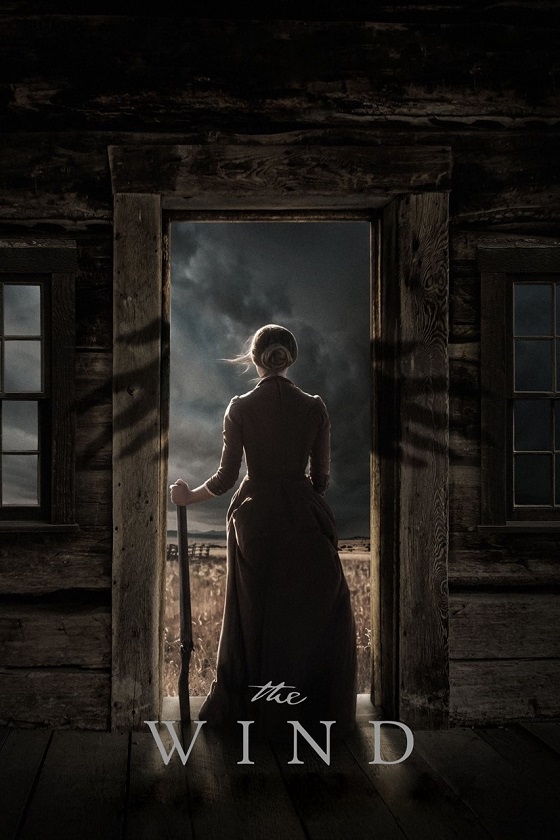
Following such delights as Curse of The Demon Mountain and Bone Tomahawk, 2019's The Wind combines two of my favourite genres - horror and Western - to create a compelling, character-driven, psychological drama.
In the late 19th Century, Lizzy Macklin (Caitlin Gerard) and her husband Isaac (Ashley Zukerman) have carved themselves out a homestead on the desolate American frontier.
When a new couple of settlers - Emma (Julia Goldani Telles) and Gideon Harper (Dylan McTee) - set up home about a mile away, the Macklins are initially delighted to have company, but become increasingly concerned that the new arrivals aren't cut out for the hardships required for living off the land.
The film, written by Teresa Sutherland (one of the staff writer's on Netflix's new Midnight Mass) and directed by Emma Tammi, opens with the aftermath of pregnant Emma's suicide.
Gideon and Isaac then ride off to the nearest settlement to make arrangements for the Harper's property to be shipped back East, leaving Lizzy to clean up and attend to the Macklin's smallholding.
The narrative then unfolds in a series of flashbacks, and flashbacks within flashbacks, intercut with Lizzy trying to cope on her own.
As well as learning that Lizzy and Isaac's son, Samuel, was still born, we also see that Emma was instantly attracted to the more "manly" Isaac, with the suggestion that the attraction may have been mutual.
However, when she falls pregnant, Emma - possibly influenced by a pamphlet on Demons of The Plains - rapidly descends into madness, making wild assertions about "something" being after her child.
She tells Lizzy that Gideon refused to believe her, dismissing her claims of hearing strange voices as simply "the wind".
In due course, though, we discover that when she was pregnant with Samuel, Lizzy also became convinced that there was some demonic force living in the area as well.
Are the women really being hunted by a "demon of the plains" or is it all in their imagination?
In the late 19th Century, Lizzy Macklin (Caitlin Gerard) and her husband Isaac (Ashley Zukerman) have carved themselves out a homestead on the desolate American frontier.
When a new couple of settlers - Emma (Julia Goldani Telles) and Gideon Harper (Dylan McTee) - set up home about a mile away, the Macklins are initially delighted to have company, but become increasingly concerned that the new arrivals aren't cut out for the hardships required for living off the land.
The film, written by Teresa Sutherland (one of the staff writer's on Netflix's new Midnight Mass) and directed by Emma Tammi, opens with the aftermath of pregnant Emma's suicide.
Gideon and Isaac then ride off to the nearest settlement to make arrangements for the Harper's property to be shipped back East, leaving Lizzy to clean up and attend to the Macklin's smallholding.
The narrative then unfolds in a series of flashbacks, and flashbacks within flashbacks, intercut with Lizzy trying to cope on her own.
As well as learning that Lizzy and Isaac's son, Samuel, was still born, we also see that Emma was instantly attracted to the more "manly" Isaac, with the suggestion that the attraction may have been mutual.
However, when she falls pregnant, Emma - possibly influenced by a pamphlet on Demons of The Plains - rapidly descends into madness, making wild assertions about "something" being after her child.
She tells Lizzy that Gideon refused to believe her, dismissing her claims of hearing strange voices as simply "the wind".
In due course, though, we discover that when she was pregnant with Samuel, Lizzy also became convinced that there was some demonic force living in the area as well.
Are the women really being hunted by a "demon of the plains" or is it all in their imagination?
It's nearly impossible for most of us to comprehend the sense of terrifying, utter isolation and loneliness a person would feel in this situation, trying to carve out a living under such unforgiving conditions, without any semblance of modern communication nor any other living soul within miles.
Beautifully shot in New Mexico, The Wind does a magnificent job of charting the mental toll of this lifestyle, particularly as exemplified by the barnstorming central performance of Caitlin Gerard, who you might recognise from Insidious: The Last Key, American Crime, or The Last Ship.
With its emphasis on the atmospheric Western setting, there is an ambiguous, folkloric rural horror aspect to The Wind, which has led people to compare it to The Witch and - with its strong female cast - The Babadook.
The film has a Gothic quality to its narrative, heightened by Emma's own passion for Gothic literature, such as Mary Shelley's Frankenstein.
Beautifully shot in New Mexico, The Wind does a magnificent job of charting the mental toll of this lifestyle, particularly as exemplified by the barnstorming central performance of Caitlin Gerard, who you might recognise from Insidious: The Last Key, American Crime, or The Last Ship.
With its emphasis on the atmospheric Western setting, there is an ambiguous, folkloric rural horror aspect to The Wind, which has led people to compare it to The Witch and - with its strong female cast - The Babadook.
The film has a Gothic quality to its narrative, heightened by Emma's own passion for Gothic literature, such as Mary Shelley's Frankenstein.
I would also add there's an element of John Carpenter's The Thing here as well, given how central feelings of isolation and paranoia are in Lizzy's story.
While the bulk of the horror is psychological, there's a single jump scare that works surprisingly effectively because this doesn't feel like a film where such a gimmick would be appropriate.
Initially a slow burn, The Wind gradually develops its creepy and unsettling tone as the layers of the onion skin are peeled back and we finally get a picture of what's truly happening.
While the bulk of the horror is psychological, there's a single jump scare that works surprisingly effectively because this doesn't feel like a film where such a gimmick would be appropriate.
Initially a slow burn, The Wind gradually develops its creepy and unsettling tone as the layers of the onion skin are peeled back and we finally get a picture of what's truly happening.
Subscribe to:
Posts (Atom)