In a small Swiss village near Trollenberg Mountain, a series of climbers are found decapitated. Alan Brooks, a UN investigator, is sent to the area to look into unusual radiation levels, and he helps with the investigation. While investigating he meets Anne Pilgrim, a psychic who experiences visions of the deaths and is drawn to the mountain.
Thank you to Film Masters for making The Trollenberg Terror aka The Crawling Eye available online.
Part Quatermass, part The Thing From Another World and based on a 1956 ITV Saturday Serial television programme, The Trollenberg Terror (or The Crawling Eye) by the legendary Hammer horror writer Jimmy Sangster, is the story of scientist Alan Brooks (Forrest Tucker) summoned to the Swiss Alps to investigate some mysterious goings-on.
On the way, he meets up with the Pilgrim Sisters, Sarah (Jennifer Jayne) and Anne (Janet Munro), a theatrical mind-reading act, heading to Geneva. Only Anne is actually truly psychic and feels compelled to disembark at the same train station as Brooks... that is, Trollenberg, where there have been a number of unexplained climbing accidents.
Visiting the mountainside observatory, Brooks is also informed of an unnatural cloud that has been hanging around the mountain and giving off radiation. This reminds him - and the observatory's Professor Crevett (Warren Mitchell) - of a similar mysterious incident they investigated in the Andes and that Crevett had attributed to extraterrestrials.
In the meantime, Anne has received a physic summons to the mountain and after she is prevented from going, a climber - presumed missing - returns from the mountain and attempts to kill her.
The Trollenberg Terror is a pot-boiler, slowly building to its dramatic climax (perhaps too slowly for modern audiences), when the true face of the monster on the mountain shows itself out of the fog.
Before that though we get a couple of decapitations and a surprising "head in a rucksack" shot that I wasn't expecting.
As well as playing out like a high-altitude reworking of The Thing, withholding the big reveal until the final act adds a layer of Lovecraftian paranoia to The Trollenberg Terror as well.
The film doesn't so much create a sense of tension as one of scientific enquiry, a desire to know what's going on and, as long as you love giant monsters, then you're not going to be disappointed by this atmospheric slice of '50s schlock horror.
In those wild and carefree days of the late 1950s, long before America had put a man on the Moon, a scientific project is examining the effects of cosmic radiation on living beings... by sending up rockets loaded with test animals!
Unfortunately, one vessel goes off course, exposing its subjects to an extended dose of radiation, and causing the rocket to crash somewhere in Africa.
Six months later, square-jawed scientist Dr Quent Brady (Jim Davis, who would go on to star in Dallas) and his associate Dan Morgan (Robert Griffin) read newspaper reports of supposed monsters wreaking havoc near where they believe their lost rocket might have ended up.
Naturally, they head off to investigate, speculating that there might be some connection with the consignment of wasps sent into space on the doomed ship.
Their journey from the coast to Central Africa is long and arduous, and they find themselves and their bearers plagued by hostile natives, insufferable heat, dehydration, contaminated water, et al before they even get to the missionary station on the edge of the region known as Green Hell, where these "monsters" are said to be.
Unfortunately, their arrival at the missionary station coincides with the death of the 'saintly' Dr Lorentz (Vladimir Sokoloff), who had been investigating the monsters himself.
Our heroes' bearers have had enough and scarper, but Dr Lorentz's daughter, Lorna (Barbara Turner), persuades local villagers to take their place - on the condition that she can accompany Dr Brady's expedition into the Green Hell.
Turner seems a bit lost here but she would later write the screenplay for the killer-dog movie Cujo, so I can forgive her anything.
Monster From Green Hell is a must-watch for aficionados of kitsch, 1950's B-movies that are so awful they're hilarious.
Spliced together with stock wild animal footage and scenes from 1939's Stanley and Livingstone, California stands in for Central Africa... and it's quite obvious.
The narrative structure of Monster From Green Hell is an object lesson in bad storytelling, from giving away the appearance of the kaiju-sized killer wasps within the first 10 minutes (thus destroying any sense of mystery as to what our heroes are tracking) to committing the cardinal sin of cinema: a deus ex machina resolution that the protagonists had absolutely no hand in.
Spoilers for a six decade old movie, but the wasp queen and her drones are all wiped by a volcanic eruption (which, of course, our heroes had nothing to do with) before they can multiple and take over the world.
The way the story unfolds the destruction of the giant wasps would have occurred whether or not Dr Brady had been hunting them.
Even though Monster From Green Hell only runs for 71 minutes, and starts off very breezily, director Kenneth G Crane's pacing is all over the place, with the extended journey through Africa taking up an inordinate amount of time, for instance. Then, with only 10 minutes or so to go at the climax of the piece, the movie suddenly switches to an almost pointless "explorers lost in maze of underground tunnels" story.
You don't come to a B-movie expecting character development and there's certainly none on display here, with pretty much everyone simply being walking mouthpieces for the lines of Louis Vittes and Endre Bohem's screenplay.
The giant wasp model, though, is a classic of the era, which is probably why Crane decided the audience should get to meet it long before the main characters do.
However, I'm not sure that wasps have pincers, but I guess that's part of the mutation that caused them to balloon up to Godzilla size.
The size of the giant wasps seems quite flexible, and we rarely see more than one at a time, leading me to think - right up until the final act - that there might only be one giant wasp, despite Dr Brady's insistence that there was a swarm of them.
It also feels rather odd that Brady and his team are able to track the wasps by giant footprints they leave in the dirt. It's never stated outright, but I decided in my headcanon that due to the creatures' enormous size their fragile wings aren't powerful enough now to lift them off the ground.
The restored print of 1957's Monster From Green Hell, for the most part, is striking in its crisp black-and-white, although there are still scenes with the odd scratch down the centre, but then the film is 65 years old and I doubt it's been treated with any particular reverence until it was cleaned up for its physical media release a few years ago.
It has now been officially released online (see above) by Film Masters.
This version of the movie also comes with a slightly random, but nevertheless oddly delightful, colourised final sequence... when the heroes watch as nature does what they couldn't.
When a couple of courting teenagers disappear from a small, isolated Texas town, their parents - and the local sheriff (Fred Graham) - fear they have eloped.
But this is just the start of a wave of disappearances, many connected to road traffic accidents on the lonely roads that traverse the unexplored woodland that surrounds the town.
The father of the missing boy, wicked mine owner Mr Wheeler (Bob Thompson), puts pressure on the sheriff to blame the disappearances on Chase Winstead (Don Sullivan), ace hot-rod mechanic and crooner, de facto "leader" of the local youth and clearly the smartest teenager in the county.
The sheriff isn't having any of it, because he relies on Chase to keep the other youngsters on the straight and narrow and he knows he's a good kid who cares for his widowed mother (Gay McLendon) and disabled younger sister, Missy (Janice Stone).
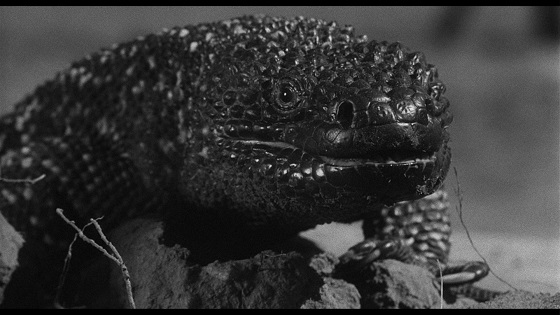
Eventually, the town drunk Old Man Harris (Shug Fisher) spots an enormous gila monster - the size of a bus - when it derails a passenger train, and the sheriff finally has something to work with.
The titular Giant Gila Monster
Meanwhile, Chase and his friends have organised a "platter party" (dance night) at a local hall, hosted by celebrity DJ, Horatio Alger 'Steamroller' Smith (Ken Knox), who owes Chase a favour.
Not only is Chase revealed to the audience as having just cut a record, but he also gets to sing a song - which he'd previously sung to his sister - but, thankfully, that's the moment the gila monster decides to attack the barn dance.
The sheriff drives the beast away with his rifle, but it's up to Chase to deliver the well-foreshadowed coup de grâce on the oversized reptile.
The Giant Gila Monster: Special Edition was the first Blu-Ray release from new film restoration, preservation and distribution company, Film Masters.
The creature feature hits stores Stateside in September 2023 as the headliner in a Blu-Ray double-bill with The Killer Shrews.
Both films are from 1959, stalwarts of the drive-in era of no-budget shlock productions, cranked out for a very specific demographic.
Despite the often laughably poor acting and occasionally ropy script from director Ray Kellogg and co-writer Jay Simms, there is a convincing, 1950's sense of community pervading this 74-minute B-movie.
And it's this verisimilitude that comes closest to saving the picture because, in all honesty, until the closing moments, when townsfolk get to finally see their mysterious nemesis, The Giant Gila Monster is a whole heap of nothing.
Sure, things happen and Chase and the sheriff get to run around a bit but because they are so clueless as to what is really going on there's no real sense of jeopardy.
Random musical interludes from Chase, as well as nuggets of backstory coldly calculated to tug at your heartstrings, make the movie a quiet strange viewing experience, as more time is spent developing the potential victims than actually justifying what is happening with the giant monster.
The suggestion from the opening spiel is that it has grown large due to its lack of contact with any real threats in its isolated habitat, so why has the giant gila monster chosen now to start eating humans?
As far as I could tell no reason was given, although I like to think it was somehow tied to Wheeler's dodgy mining practices.
While the audience has sight of the monster from the get-go - a real life lizard dropped into miniature model sets - there is no actual interaction with it until the final act, and it's only then that we can truly get an idea of its supposed gigantic size and the threat it poses to the community.
Much of the action takes place at night, but thanks to this new restoration from 35mm archival materials (and Blu-Ray presentation), the contrast is crisp enough that while we still know it's meant to be night time we can actually see what's going on.
This new release of The Giant Gila Monster: Special Edition is definitely a film that connoisseurs of vintage "so bad it's good" monster movies need to add to their collection.
However, it's not really one for the casual viewer as you need to cut the film an awful lot of slack to really enjoy it.
As well as a trailer and commentary track, the Blu-Ray disc of The Giant Gila Monster includes an audio, archival, interview with the late Don Sullivan aka Chase Winstead.
"I'm in hot pursuit of them Killer Shrews"
Ironically the 'bonus feature' in the two-disc set, The Killer Shrews, is actually the superior film (which, of course, isn't saying much).
Captain Thorne Sherman (James Best) and his engineer, 'Rook' Griswold (Judge Henry Dupree), just manage to outrun a hurricane in their boat and make it to the isolated island where they have to drop off supplies.
There they discover a small scientific community, led by Swedish geneticist Dr Marlowe Craigis (Baruch Lumet) and his daughter, zoologist Ann Craigis (Ingrid Goude), preparing for a siege rather than just bad weather.
The handful of scientists and their assistants are living in fear of the results of an experiment run wild: giant shrews (actually dogs in ratty costumes) devouring all the wildlife. But now they've run out of other animals to eat and are turning on the small human population.
With the double threat of both a major weather event and mutant animals, The Killer Shrews is what old school Doctor Who fans would term a classic "base under siege" scenario.
There is genuine claustrophobic tension here as the sea captain tries to organise the defence of the island's adobe stockade against the mutant monsters.
Another masterpiece from the team of writer Jay Simms and director Ray Kellogg, Killer Shrews is a more focussed and coherent horror yarn than The Giant Gila Monster.
While the shrews themselves are very obviously a combination of glove puppets (for close-ups) and 'disguised' canines (for long shots) there is an undeniable charm about this ultra-low budget approach to creating a swarm of killer monsters.
Even the justification for making the creatures even deadlier, by turning their bite's poisonous, is a clever little idea than works within the logic of the story.
Coming in at barely over an hour's running time, there's a rugged, pulpy quality to The Killer Shrews, served up with some quality acting from the permanently drunk bad guy Jerry Farrell (Gunsmoke star Ken Curtis) and our square-jawed lead played by the future Sheriff Rosco P Coltrane of Dukes of Hazzard fame.
This disc includes a film commentary track, original radio spots for both movies, and an informative quarter-of-an-hour documentary on the career of Ray Kellogg.
He was a contemporary of Ray Harryhausen who took effects in a different (cheaper) direction as well as working on many big budget movies, including directing John Wayne's The Green Berets, and acting as second unit director on Cleopatra and Adam West's Batman: The Movie.
Also packaged with the films is a 24-page booklet featuring essays on the Texas radio pioneer and films' producer, Gordon McLendon (who appears in The Killer Shrews as absent-minded scientist Dr Radford Baines), and a critical dissection of Killer Shrews by professor and film scholar Jason A Ney.
My pop culture Odyssey: a slice of super-powered geek life with heavy emphasis on pulp adventure, horror, comic books, westerns, superheroes, sci-fi, giant monsters, zombies etc