Showing posts with label david lynch. Show all posts

Monday, October 27, 2025

HALLOWEEN HORROR: Mandy (2018)


Revenge thrillers are not renowned for their complex plots and they don't come more linear than Nicolas Cage's wonderously visceral Mandy (out on DVD this week).

It's 1983 and grizzled lumberjack - and man of few words - Red Miller (Cage) and his artistic, hippy, girlfriend Mandy Bloom (Andrea Riseborough) live an idyllic life in the wilderness.

Unfortunately, by chance, one day Mandy catches the eye of failed musician and deranged cult leader Jeremiah Sand (Linus Roache).

Sand employs demented biker gang The Black Skulls to kidnap Mandy for his pleasure, but things don't go exactly according to plan, sending Red on an epic, furious, quest for vengeance.

At times feeling like a journey into Hell curated by David Lynch, Mandy is part Apocalypse Now, part Texas Chain Saw Massacre, and part Unforgiven, taking queues from multiple genres as writer/director Panos Cosmatos aims his laser-focus on Red's mythic mission of revenge.

I loves me some weird cult shit and Mandy delivers on that front with The Black Skulls and Sand's Children of the New Dawn, and enough peculiar characters and mannered dialogue to populate a suburb of Twin Peaks.

Startling visuals merge with subtle camera tricks to disorientate the viewer, enhancing our insights into the minds of both protagonist and antagonist, creating an artistic cocktail of psychedelic grindhouse.

Reminiscent of Baskin in its brutal relentlessness, Mandy, however, is more concerned with the human - and occasionally superhuman - monster than the cosmic.

The role of Red is one that only Cage could truly have embodied, segueing from effortless charm to ruthless killer as his descent into madness progresses.

With a running time just shy of two hours, Mandy feels a fraction of that duration thanks to its spectacular pacing and addictive imagery.

The plot may be a short railroad, but the scenery is breathtakingly hypnotic as you are catapulted along this stunning and unforgettable ride.

Saturday, October 25, 2025

HALLOWEEN HORROR: Antrum - The Deadliest Film Ever Made (2018)


As I've said many times I have a particular weakness for stories about cursed media, such as Cigarette Burns, Archive 81, Deadwax, The Hills Run Red, etc but the conceit of these movies tends to be that we, at most, see and hear only glimpses of the cursed object while our protagonists track it down and, invariably, suffer the fate of all those who have pursued it in the past.

The unique gimmick of 2018's Antrum: The Deadliest Film Ever Made is that we, the audience, are seeing the entire movie for ourselves, bookended by a pair of mockumentary segments, establishing the terrifying backstory and provenance of this "unique" print of a legendary 1970s Bulgarian (?) movie called Antrum that has left a trail of death in its wake.

In a sense, we are now the protagonists in the story of this artefact, "daring" to watch it despite its existential reputation.

The central movie-within-the-movie, while occasionally horrific and tense (because we keep expecting something to happen due to the manufactured reputation attached to what we are now watching), is essentially a grim, but possibly grittily mundane, nightmarish tale about a couple of children, Oralee (Nicole Tompkins) and Nathan (Rowan Smyth), on a camping trip.

The film opens with their beloved family dog, Maxine, being put down by a vet.

Nathan is traumatised by this, especially when his mother (Kristel Elling) suggests that Maxine has gone to Hell (for reasons we discover later in the film).

So Oralee hits upon the idea of taking her younger brother out into some spooky woods (clearly inspired by Japan's infamous Aokigahara forest) to dig a tunnel down to Hell to rescue the soul of Maxine.

Oralee has it all planned out as a therapeutic exercise, but her scheme goes awry as strange things start to happen and they stumble across a farm belonging to a pair of degenerate, white trash individuals (Dan Istrate and Circus-Szalewski) who like to capture people and cook them inside a giant brass effigy of Baphomet.

Although the role of the cannibals isn't particularly protracted, I still felt this was the weakest element of the film, a peculiar random encounter with shades of Texas Chain Saw Massacre meets the grisly realism of Man Bites Dog, jumbled in with the demonic terrors (imagined or otherwise) that the siblings were also contending with.

While this story on its own is a powerful thriller, with strong horror elements, the overriding unease of the film comes from what has supposedly been done to the print of Antrum that we are watching.

The documentary portions of the larger film acknowledge that there are subliminal images and symbols cut into the movie print, but there are plenty of other details (from Midsommar-style "faces" in the background of scenes to words scratched onto the negative) left for us to discover on our own, along with occasional odd jump cuts and auditory strangeness that really gets under your skin if you let it.

A puzzle box of a picture, where you find yourself searching for clues to the bigger picture while still being invested in the story of the two siblings in the woods, Antrum: The Deadliest Film Ever Made has definite shades of The Blair Witch Project and a soupçon of additional David Lynch weirdness about it.

Actually a Canadian horror film written and directed by David Amito and Michael Laicini, Antrum deserves praise for its hardcore attempt to establish a verisimilitude around the supernatural print of this supposedly cursed movie.

If you allow yourself to buy into this, even if just for the 95 minute running time of the movie, this has the potential to stay with you for the longest time... and don't be surprised if find yourself tempted to watch it again to see if you missed anything.

Tuesday, October 21, 2025

HALLOWEEN HORROR: Honeydew (2020)


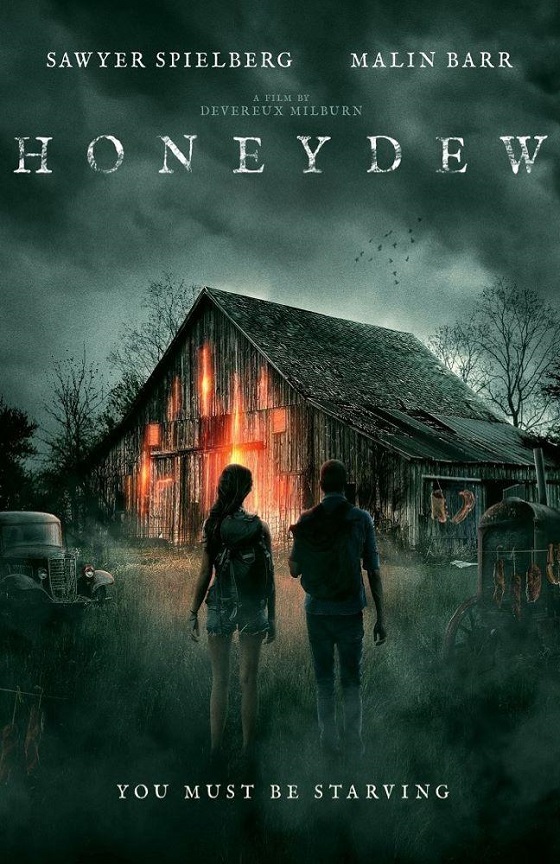
Botany student Rylie (Malin Barr) and her waiter-cum-actor boyfriend Sam (Sawyer Spielberg, son of Steven Spielberg and Kate Capshaw) are travelling across New England, so she can research an outbreak of an ergot-like fungus called "sordico" that has been devastating local farms.

After their attempt to camp in a field is interrupted by the land owner in the middle of the night, they find their car won't start and so have to walk to the nearest property in the hopes of being able to call for assistance.

They turn up at the home of eccentric old farmer Karen (Barbara Kingsley), who lives in a rundown house with her brain-damaged son, Gunni (Jamie Bradley), who passes his time watching Popeye cartoons or staring at static on the TV.

Karen phones a neighbour to come over and help, but he never turns up and so the young couple are forced to share an awkward evening meal with Karen and Gunni, before the strange old lady shows them to a basement bedroom where they can pass the night.

Despite his medically-necessary dietary regime, Sam can't settle and so goes back upstairs to eat some more.

He is surprised by Gunni, who seems to be trying to tell him something, but then Sam passes out and has a Popeye-themed hallucination about his stomach condition.

Upon waking, he can't find Rylie - or Karen - and starts to search the house and its environs, but wandering into a barn he is ambushed and drugged.

Written and directed by Devereux Milburn, Honeydew is Texas Chain Saw Massacre family dynamics seen through a David Lynch or League of Gentlemen lens, with the extended sequence of Karen's hospitality to her guests being a marvellous, nerve-testing, exercise in the horror of the peculiar and uncomfortable.

Milburn clearly likes to push his audience as far as they can comfortably go, then push them a bit further.

No matter how bizarre the behaviour of the strange hostess - and her son - gets it feels so real and genuine, there is clearly something going on that the young guests aren't privy to.

While there is shock and gore in Honeydew, the best weapon in its arsenal is discomfort. 

From the start, this atmosphere is accentuated by unusual sound design and experimental split screen, which could be construed as affectation, but if you allow yourself to be drawn into this nightmare, it can be genuinely unnerving.

Having taken a reasonably cliché set-up - and some very on-the-nose foreshadowing of the cause of the madness ahead - the writer/director puts a impressively disturbing spin on things.

Even when you think the action has moved into more familiar captivity tropes, matters continue to unfold in dark, weird, perverse, and unexpected ways. 

For a moment, Devereux Milburn lulls you into thinking Honeydew might turn out to be standard Hollywood horror fare after all, but then he swiftly pulls the rug from under your feet.

But then the frights aren't over. 

The bleak denouement seems to go on and on (but in a good way), and the more you dwell on what is happening before your eyes the more it'll get under your skin.

Monday, October 20, 2025

HALLOWEEN HORROR: It Follows (2014)


What joy to find an original horror film, one that is not a creatively-bankrupt sequel, tired 'found footage' or "based" on some bullshit 'true story'.

Writer/director David Robert Mitchell's It Follows is a beautifully languid take on the familiar slasher film trope of "avoid teenage sex", turning it on its head and giving it a retro-modern style, thanks to its Detroit locations and fantastic score by Rich Vreeland (aka Disasterpeace).

The closest touchstone I can conjure is the idea of the original Nightmare On Elm Street but as directed by David Lynch.

Carefree Jay (Maika Monroe) is a 19-year-old girl dating the seemingly-normal Hugh (Jake Weary), but after they have sex for the first time things turn weird.

Hugh kidnaps Jay to an abandoned parking garage and explains to her he has infected her with a supernatural STD... she is now cursed to be forever followed by an unrelenting, slow-walking, shape-changing creature (that only those infected with this curse can see) that will methodically hunt her down unless she can pass the curse on to someone else.

However, once "It" catches up with the infected person and kills them, it then turns its attention back to the person who passed the curse on to them and so on, working its way back down the chain of infection.

Death, it seems, is inevitable and can only be delayed.

Once back home, Jay enlists her younger sister, Kelly (Lili Sepe) and their friends - which includes the hormonally-driven Paul (Keir Gilchrist), who has been crushing on Jay since they were kids - to keep her safe from her unseen stalker.

It Follows isn't perfect, and occasionally slips off the rails so you catch yourself thinking "waitaminute, that doesn't make sense", but generally you'll get swept up in the verisimilitude of the scenario, the dream-like aesthetic, convincing teenage portrayals and the atmospheric settings (accentuated by the John Carpenteresque soundtrack).

What also makes a pleasant change is we aren't spoon-fed explanations for what "It" is and why it does what it does. There is no way for the protagonists to discover this, so why should we. It is pure nightmare/urban myth fodder from start to finish.

The old school Elm Street comparison continues with Paul's pragmatic scheme to kill the creature - even though, ultimately, it kind of backfires and they have to resort to a more direct approach.

The ending is left open - again, this reflects the protagonists lack of solid evidence for what has occurred - but that doesn't mean It Follows needs a sequel. We don't need to know who created this curse. The horror works so much better with not knowing.

Friday, October 17, 2025

HALLOWEEN HORROR: Hagazussa (2017)


Imagine David Lynch remade The Witch, but set it in 15th Century Austria and you might have some idea of what to expect from the totally weird Hagazussa.

For the first half-hour of this glacially-paced movie young Albrun (Celina Peter) nurses her sickly mother Martha (Claudia Martini), who is seemingly dying of the plague, in an isolated shack up in the snowy Alps.

Then the story jumps forward in time and Albrun is all grown-up (Aleksandra Cwen), a full-time goat-herder with a child of her own (Gerdi Marlen Simonn) to care for, although there is no sign of the father.

Shot with a Lynchian obsession for misty landscapes, wind through tree branches, and extreme close-ups of nature, Hagazussa is unrelentingly grim, atmospheric, folk horror.

Just when you think the story can't get any darker, it goes there.

Major kudos to Aleksandra Cwen who pretty much carries the bulk of the movie on her own - with the aid of her amazingly expressive eyes, which writer/director Lukas Feigelfeld makes great use of when the subject matter crosses that line where suggestion is the only way to go.

Like The Head Hunter, there is minimal (German) dialogue (with English subtitles), so it's left largely to the viewer to piece together a narrative that suits the visuals.

Albrun and her mother have been shunned by the nearby community as "witches", but with the intervention of the local priest, Albrun is befriended by local woman Swinda (Tanja Petrovskij).

However, this takes an unexpectedly unpleasant turn.

Now, my reading of what I witnessed in Hagazussa is that the plague that then comes to the community is Albrun's revenge, but the ultra-grim events that follow are the price she has to pay for the black magic.

The multiple taboo-busting, potentially triggering, nastiness that unfolds in the final third of the 102-minute film makes The Witch look like a Carry On film in comparison.

This certainly isn't a movie for those who think jump scares are the height of horror movie craftsmanship or embrace frenetic slasher flicks as the "one true way" for the genre.

Playing heavily with the paranoia of isolation, as well as Lovecraftian fear of the unknown heightened by religious indoctrination,  Hagazussa is unnerving and horrific, rather than frightening.

You're more likely to feel a bit nauseous than scared. 

This is art house horror, plunging deeper and deeper into the dark pit of the human soul on a more cerebral than visceral level (not that that there isn't viscera on display!).

Hagazussa takes the idea of the "slow burn" to excruciating new lengths, but definitely gets under your skin if you're willing to surrender yourself to it.

Right up until the final moment. Then, bizarrely, taking a leaf out of low-budget '80s fantasy, everything randomly ends in inexplicable fire.

Thursday, October 9, 2025

HALLOWEEN HORRROR: I Saw The TV Glow (2024)


In late '90s suburbia, a pair of isolated teens - Owen (Justice Smith) and Maddy (Brigette Lundy-Paine aka Jack Haven) - bond over their shared appreciation for a late night, young adult TV show called The Pink Opaque.

The show, which is woven throughout the main feature, is clearly inspired by Buffy The Vampire Slayer (it uses the Buffy font for its credits and one of the main characters is called Tara, which then echoes on a meta level when Amber Benson - who played Tara on Buffy - pops in for a brief cameo). But this is Buffy filtered through The Mighty Boosh and directed by David Lynch.

Although Buffy was strongest influence in my eyes, there were definite shades of Twin Peaks (particularly The Return) in both the show-within-the-film and the 'real world' of Owen and Maddy: the pivotal, central scene taking place in a liminal bar while a band plays in the background (their song featuring the lyric "I Saw The TV Glow").

Just as the The Pink Opaque is about to be cancelled - on a shocking, fifth season cliffhanger - Maddy disappears, leaving behind a burning television in her garden.

Almost a decade later, she returns to find Owen, and tries to convince him that she has been "inside the show" and that their memories of watching it in her basement were false, that they were really the characters they remembered from the show.

I'd been sold on I Saw The TV Glow as a "horror picture" and had been expecting something akin to the wonderful Channel Zero: Candle Cove serving of creepypasta television from 2016.

I was wrong. While there are fleeting elements of unnerving psychological horror, especially in Maddy's powerful speech about her efforts to recreate the season five cliffhanger of The Pink Opaque, so that she could get to "season six", the art house film's theme is an allegory for the trans experience and a meditation on the nature of reality and how that impacts identity.

The final act follows Owen as he grows into adulthood, but there is an increasing feeling that - while he represses it - he is living a lie, the whole experience with The Pink Opaque serving as a metaphor for his confused sexuality.

Written and directed by Jane Schoenbrun, I Saw The TV Glow is mesmerically shot, drifting in and out of the TV show as it skims through Owen's life like the chapters on a DVD. 

While the gamer in me was quite fixated on the mythology of The Pink Opaque (with its 'big bad' Mr Melancholy and his demonic henchbeings), the emotional performances of the two leads held my attention throughout.

I Saw The TV Glow wasn't quite what I was expecting, but I didn't mind: it's still a weird and powerful piece of 'coming of age' cinema. John Hughes this ain't!

Saturday, October 4, 2025

HALLOWEEN HORROR: Baskin (2015)


If you're looking for a memorable horror movie that feels like it was based on an HP Lovecraft story, but wasn't, then look no further than surreal Turkish splatterfest Baskin.

A generally unlikable, thuggish, group of police officers respond to a call for back-up in a rural area with a bad reputation.

Among the five-man team is Arda (Görkem Kasal), the newest recruit and the ward of the chief Remzi (Ergun Kuyucu).

As the freshest face in the unit, Arda has yet to be ground down, or corrupted, by the obviously hard work the men do.

Unfortunately on the way to the emergency, their van crashes.

The squad has to ask for directions from a strange group of "frog-hunters" they find camped at the edge of the lake their van ended up in.

A quick jaunt through the woods brings them to an abandoned Ottoman Empire-era police station.

The building appears to have been taken over by squatters, who have vandalised it with it peculiar graffiti and left evidence of all kinds of obscenities.

But it's only really as they descend into the lower levels of the building that the true horror of the building's current inhabitants becomes clear.

And the police officers soon find themselves in the clutches of a  terrifying, possibly sub-human, cult.

While Görkem Kasal's Arda is the nominal star of the story, the stand-out performance has to be the amazing Mehmet Cerrahoglu as the cult leader Baba (The Father).

Baba: The Father
A Turkish Clint Howard, Cerrahoglu's incredibly rare skin condition gives him a unique physical appearance that he draws amazing power from here in his first feature film role.

Forget all the splatterpunk Grand Guignol for a moment, Baba is the iconic image of Baskin that will endure.

Baskin (Turkish for 'Raid') was the first full-length movie from Can Evrenol, an extrapolation of his 11-minute short of the same name (which featured several of the same actors, including the magnificent Mehmet Cerrahoglu).

Buoyed along by a thumping, Carpenteresque, score, Baskin is Lovecraftian cosmic horror meets Hellraiser by way of The Void, Blair Witch, The Last Shift, In The Mouth Of Madness, and - for for better or for worse - Twin Peaks: The Return.

Even though it predates David Lynch's most recent visit to Twin Peaks, there's a key scene in Baskin - as well as its ending - that share important thematic, and stylistic, similarities and, I think, will ultimately decide whether you rate Evrenol's surreal shocker or not.

One thing I felt after viewing Baskin is that it is more of an experience than a coherent narrative. It's main purpose is to draw the audience into the mind-boggling ordeals that the policemen go through, rather than explaining too much or attaching it all to a traditional story structure.

Be warned, things do go a bit torture porn once the coppers are captured, but, for me, it's all about intent.

This isn't a bunch of wealthy businessmen torturing 'innocents' for shits and giggles, but an evil cult trying to transform its "chosen one" through arcane rituals handed down from their unknowable ancient deities.

Although the truly weird stuff doesn't start until the half-way mark of this 96-minute film, the pacing and rhythm are perfect so you're drawn in from the get-go, as the tension escalates and you try to figure out what the hell's going on.

Throughout Baskin there's talk about dreams (and dreams within dreams) and one - almost heavy-handed - shot of Arda nodding off in the van before everything goes sideways that I thought was the M. Night Shyamalan moment when the "it's-all-a-dream" twist was given away.

But, and I know some of you may consider this a spoiler, that's not what's going on. If it had all been a dream I would have been very annoyed and not nearly as smitten as I am by this flawed gem.

Much of Baskin has a dream-like nature, and dream-logic to its flow, but - as far as I'm concerned - what was happening to the protagonists was very real.

Having sat through much of the movie inner-monologuing "don't be a dream, don't be a dream", I'm now looking forward to going back and watching it again, comfortable in the knowledge that Baskin avoids that cop out (pun intended).

It is, however, genuinely the stuff of nightmares.

Tuesday, August 5, 2025

Call Me A Sucker, But My Interest Is Piqued!

A scientist's string theory experiment goes wrong when his brane explodes. Corey Harlan must find him and the brane's core in a mysterious house where doors lead to other worlds, guided by the dimensional being Aclima.
I guess I'm a sucker for punishment, but Bulk really intrigues me - despite the fact that I have never seen a film by British auteur Ben Wheatley that I liked (and it feels like I've seen quite a few).

Every time I promise myself that 'enough is enough' and I won't be lured into watching his next offering... and then I do, and inevitably I utterly hate it.

However, I'm hoping the Lynchian Bulk will be different...

Tuesday, July 8, 2025

The Outwaters (2022)


For reasons that now elude me, The Outwaters has been on my “must see” list for several years.

Now thanks to Shudder I’ve seen it and that’s two hours of my life where I could have been doing something much better.

Four twentysomethings go into the Mojave Desert to shoot a music video in an out-of-the-way place, and instead get tangled up in some very weird and horrific, indescribable, cosmic horror shit. The film we're watching is then presented as recovered footage entered into evidence for a police report on the four missing persons.

I cannot tell a lie: The Outwaters is the epitome of everything I hate about "found footage" films.

On one hand, this aspect has a very solid air of authenticity to it, but that means: migraine city.

Written and directed by the film's main protagonist Robbie Banfitch, this is "found footage" at its most irritating.

For the better part of 110 minutes, we are “treated” to too much camera shake, too many “in your face” close-ups, muffled dialogue and blurred and out-of-focus visuals.

It’s really difficult to follow along or get a handle on any of our protagonists. There’s no one to empathise with or even care about.

This is certainly no Blair Witch or As Above, So Belowwhere effort was made to present faux footage in a cinematic manner. Even the divisive Skinamarink makes more sense.

The extended 20-minute set-up is really hard going, and a waste of film, as the narrative only starts to struggle into being once the characters get to the desert and hints of the peculiarities-to-come start to manifest. 

The film definitely feels like it's going to pick up once the quartet are in desert and getting spooked by strange subterranean explosions and the mandatory paranormal light shows, but too much is buried under a surfeit of found footage tropes. 

An hour into the viewer's ordeal, the really weird shit seems to kick off, but it's the middle of the night, and it’s impossible to get even a vague idea of what’s going on as all we see are random flashes of light accompanied by hysterical screaming.

Banfinch strives way too hard to find verisimilitude in the footage but instead simply looses his audience quiet rapidly in a mess of blood and strange sounds, screaming red reptiles, all mixed in with some time loop shenanigans, and some kind of demon.

There's even a half-baked attempt to suggest the characters had stumbled into some top secret government experimental zone (à la Stranger Things), but that's just another piece of mud slung at the wall to see what sticks. That and the self-inflicted penile amputation that's way funnier than I think it was supposed to be.

This is the sort of movie that a certain breed of film student will spend ages trying to analyse and dissect, coming up with their own elaborate theorems of what it all means. But, seriously, you could watch a black screen with someone screaming in your face for an hour and come to the same conclusions. 

To be fair, I think I actually get what Banfinch was trying to do by bombarding us with a constant, supercharged sense of extreme disorientation, but he just didn’t do it very well; his David Lynch aspirations got away from him.

Honestly, The Outwaters annoyed me immensely (it's a long time since a film has wound me up quite so much, for all the wrong reasons) and if nothing else is a sterling example of why, as a general rule (with a few exceptions), I find that "found footage" films suck.

Even ones that try to mask their lo-fi offerings as "cosmic horror".

Friday, March 14, 2025

Skinamarink (2022)


Experimental, arthouse horror Skinamarink is the kind of film to be experienced rather than necessarily followed as you would a more traditional movie.

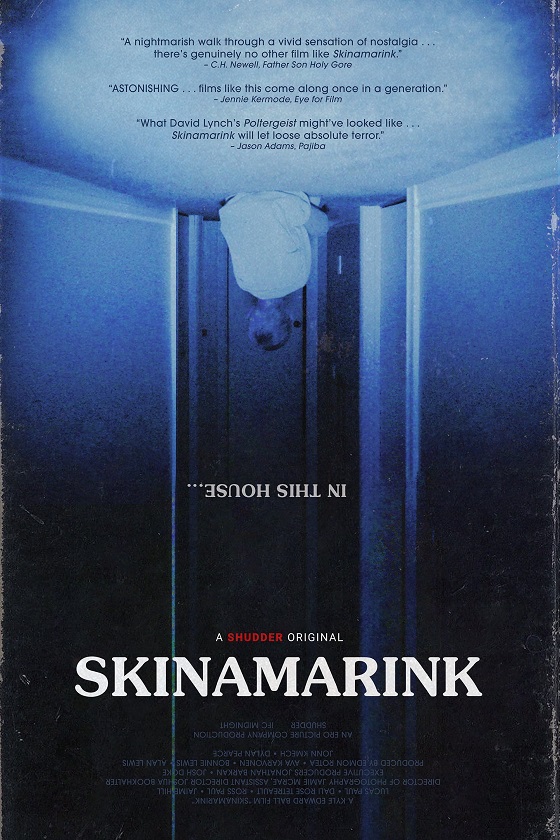
Named after a nonsense playground chant from North America, the plot of this Canadian film - written and directed by Kyle Edward Ball - revolves around the travails of two seemingly abandoned young children, four-year-old Kevin (Lucas Paul) and his sister, six-year-old Kaylee (Dali Rose Tetreault).

The kids wake up in the middle of the night to discover all the windows and doors leading out of their home have disappeared, along with their father (Ross Paul) and mother (Jaime Hill).

Kevin and Kaylee decamp to the lounge and turn on the television to watch cartoons while they play with their toys.

Soon, though, they realise they are not alone in the house, and a strange, disembodied, voice starts speaking to them and making demands of them.

When Kaylee tries to challenge the omnipotent entity, she is punished, and it is left to her younger brother to wander through the 'haunted house' alone.

Shot almost entirely at a low angle, so that we are either taking the point-of-view of one of the young protagonists or simply seeing events unravel from their level, the disorientating film demands our attention from the moment it begins.

We barely glimpse the children - the adults we see even less - and it's usually just legs and feet, while the dialogue is a mixture of often mumbled, naturalistic, delivery and - when it's too quiet to properly make out - subtitles.

The only sounds we hear are diegetic, so there are long periods of near-silence where - if you've surrendered yourself to the movie experience - you start to subsume sounds from your own environment, until you can't tell what's happening in the movie and what's in the room with you.

Objects appear and disappear, one of the televised cartoons gets stuck in a loop, and eventually we see flashes of shapes and figures in the shadows, toys and video cassettes stuck to walls and the ceiling, blood splatters across the TV screen etc 

Lighting is also minimal, often coming just from the flickering of the TV screen or a child's torch,.

Combined with the faux retro patina of the film, and its 1995 setting, all these tricks give the film the aura of a proto-found footage/video nasty mixed with dream logic and early David Lynch stylings. 

Ball's obsession with the TV screen and the way objects flicker in and out of existence scream David Lynch and it wouldn't take much, if you were so inclined, to headcanon this slice of disturbing weirdness into the world of Twin Peaks.

If demons and the supernatural were real, I can't help believing that an actual encounter with a paranormal entity might be something akin to the experience of watching this movie: intense, unsettling, confusing, baffling, bewildering, and ultimately beyond our comprehension. 

There is no "stunt man in rubber suit" or slick CGI monster serving up jump scares. In a very Lovecraftian way, at its core, Skinamarink is clearly "something man was not meant to know". 

Nothing that happens is overtly explained, meaning Skinamarink is the ultimate montage movie; it is up to us to assemble our version of what's going on from the succession of images and sounds that Ball provides us with.

Depending on the personal baggage and preconceptions you bring to Skinamarink, it's either a terrifyingly immersive and psychological descent into a child's nightmare encounter with a demon or 105 minutes of laughably pretentious bullshit. Your mileage will vary.

Personally, I'm glad I watched this peculiar work of mad genius as I've never seen anything quite like it before, but I have no great desire to see it again in a hurry.

I was hooked by it as it played but the concentration required to fully absorb Skinamarink was rather draining.

Thursday, March 6, 2025

The Lighthouse (2019)


Late in the 19th Century, apprentice lighthouse keeper Ephraim Winslow (Robert Pattinson, The Batman) arrives on an isolated New England island for a four-week stint to learn the "wickie" craft from veteran lighthouse keeper Thomas Wake (Willem Dafoe).

A former lumberjack, Winslow soon chafes at the drudgery of his chores under the stentorian commands of the superstitious Wake, and becomes particularly obsessed with the older man's refusal to allow him to tend the lighthouse's lamp.

The disputes between the men ebb and flow like the tide, as they gradually build a tenuous friendship that appears to be heading towards a father-son relationship, with Winslow both respecting and loathing the grizzled Wake.

However, as his time on the island draws to an end, Winslow is driven to break another of Wake's edicts: not to kill any of the militant seagulls that have the run of the island. Wake tells him it's bad luck to do so, as the birds contain the souls of dead seamen.

When a bird dies in their watertank, Winslow loses his temper and kills the first one that lands nearby.

And while Winslow is already starting to see things on the lonely island, the murder of the seagull is the signal for all Hell to break loose.

The men suddenly find themselves cut off by a seemingly never-ending storm, time plays tricks on them, details in Wake's stories change, Winslow's hallucinations get worse, the tension between the men mounts, leading to inevitable violence.

Released through Sky Store this week, The Lighthouse is a stunning, claustrophobic, physiological, horror movie.

Given the current state of the world, it is also an unexpectedly prescient study of two strong personalities locked down in a confined space for an excessive period of time - and possibly a template for many more movies to come in the next few months and years.

Inspired by historical events, once again - as he did with The Witch - writer/director Robert Eggers demonstrates his ear for linguistic verisimilitude, with the two, mighty, central actors in The Lighthouse not scrimping on the thick accents and genuine, period, vocabulary.

Beautifully shot in crisp black and white and shown in an archaic, square, ratio that accentuates the claustrophobic story, the film's escalating weirdness embraces both Lovecraftian horror and David Lynch levels of peculiarity that will have you wondering about your own sanity as well as that of the men trapped in the titular edifice.

Saturday, February 15, 2025

Galaxy Of Terror (1981)


Recommended to me by my good mate Paul, Galaxy Of Terror is a slightly bonkers, early '80s Alien-wannabe, produced by the legendary Roger Corman and resplendent in that "they're making this up as they go along" feeling that he always brings to his movies.

In an alien galaxy, there is a world ruled by a glowing-headed dictator known as The Master (a very natty special effect, it must be said, and a character that has nothing to do with Doctor Who), who hand picks a miss-matched team of astronauts to embark on a rescue mission to the desolate planet Morganthus - where an earlier ship has crashed.

The rescue team boasts a host of well-known performers: Erin Moran (Joanie from Joanie Loves Chachi and Happy Days), Robert Englund (Nightmare On Elm Street, V etc,) David Lynch-stalwart Grace Zabriskie, horror-movie veteran Sid Haig and familiar TV faces Ray Walston and Bernard Behrens.

Throw in some rubbery monsters and an unpleasant assault by a giant rape-maggot that ranks with the original Evil Dead's animated tree as just plain wrong, and it's no wonder this has become a cult classic.

To be fair it quite quickly shakes off its Alien aspirations as it heads more into pseudo-psychological territory somewhere between Shakespeare and Space 1999.

For a low-budget schlockfest, Galaxy Of Terror has some very impressive visuals: as well as the storm-lashed surface of Morganthus we are treated to the sci-fi/Dungeons & Dragons delights of the massive, maze-like interior of a pyramidal structure the adventurers have to explore to turn off the energy beam that caused them to crash-land as well.

And if that isn't enough of an incentive to track this B-movie treasure down (as long as you can stomach the giant maggot scene and a squirm-worthy moment involving a shard of crystal sliding under someone's skin) there's the added bonus that the film is only 81 minutes long.
My pop culture Odyssey: a slice of super-powered geek life with heavy emphasis on pulp adventure, superheroes, comic books, westerns, horror, sci-fi, giant monsters, zombies etc