Showing posts with label shudder. Show all posts

Monday, October 27, 2025

HALLOWEEN HORROR: The Amusement Park (1973)


George A Romero's "lost" movie, 1973's The Amusement Park is a bit of an odd fish.

It was the only work-for-hire movie the father of modern zombie cinema made, commissioned by the Lutheran Service Society of Western Pennsylvania "as an educational film about elder abuse", but shelved soon after completion.

A print was discovered of this believed-to-be-lost film in 2017, restored, and was made available to view on Shudder.

Directed and edited by George A Romero, from a script by Wally Cook, The Amusement Park primarily features volunteer actors, or people who were actually involved in elderly care at the time.

In an interview, Romero's wife Suzanne Desrocher-Romero is quoted as saying:
"They [did] use it initially, but I suspect that they thought it was a little edgier than they would have liked."
Clocking in at just under an hour, the main story is bookended by stage actor Lincoln Maazel (who portrays the main character in the film) addressing the audience on how poorly the elderly generation are treated and how we should all change our attitudes to be more accommodating.

The story commences with a jovial Maazel entering an anonymous white room with a single door out.

There's another old man in there, looking the worse for wear, and groaning.

Maazel tries to engage him in conversation, but the battered man simply tells him there's nothing out there and not to go through the door.

Opening the door, Maazel - who also plays the key role of Tateh Cuda in Romero's 1978 vampire film Martin - sees a busy fun fair and steps through.

What follows is a metaphorical bombardment of this old man, with all the subtlety of a sledgehammer, as he stumbles - increasingly deliriously - through a cavalcade of on-the-nose - but often still rather clever - allegories about old age. 

For instance, pensioners are seen queueing up to hawk their valuables in exchange for tickets to the fun fair rides; there's an eye test before you're allowed to drive one of the dodgems (bumper cars) and if you hit someone police and insurance company reps show up; when Maazel tries to be kind to some children he gets heckled as a "degenerate"; a young couple visit a fortune teller and see a terrifying vision of their future in a rundown flat, penniless, and unable to get the medicine they require etc

When Maazel tries to help fellow elderly punters at the fair, the younger - more numerous - visitors don't pay him any attention.

At one point he is hustled into an attraction ominously called Boot Hill, which turns out to be a grim physiotherapy centre.

A "freak show" just features old people, and when Maazel goes to leave, the crowd proclaim that "one is escaping" and chase after him.

There's a moment when Maazel is set upon by a trio of bikers.

Another scene has him being pickpocketed by a sleazy con-artist.

Even when it seems like he might have found some solace reading The Three Little Pigs to a picnicking girl her mother soon packs up and takes the girl away, leaving Maazel almost in tears.

Finally, the ground down and broken Maazel stumbles back into the white room, now the battered version of himself as his earlier self enters the room again, fresh and full of optimism.

Stylistically, I feel The Amusement Park owes a lot to 1962's Carnival of Souls, with elements of Stanley Kubrick's 1971 A Clockwork Orange,.

You can also see echoes of The Amusement Park in LQ Jones's 1975 adaptation of Harlan Ellison's A Boy and His Dog.

It's obvious from the get-go why the film's commissioners decided not to go with this peculiar oddity as their Public Service Announcement of choice.

It falls into the same broad category as the notoriously disquieting British public information films of the same era, but is considerably longer - and more surreal - than those tended to be. 

While The Amusement Park does get across its point about the systemic mistreatment and general abandonment of the elderly, it does it in a way that is more likely to turn off a general audience rather than inspire them to take positive action. 

Not because of its more shocking and dark content, but because of its art house approach of disjointed sounds and imagery.

As an amateur cinéaste, I found The Amusement Park an interesting watch (primarily because of who directed it), but I can't say it educated or inspired me about elderly care in any manner.

Additional research c/o Wikipedia.

Saturday, October 25, 2025

HALLOWEEN HORROR: Antrum - The Deadliest Film Ever Made (2018)


As I've said many times I have a particular weakness for stories about cursed media, such as Cigarette Burns, Archive 81, Deadwax, The Hills Run Red, etc but the conceit of these movies tends to be that we, at most, see and hear only glimpses of the cursed object while our protagonists track it down and, invariably, suffer the fate of all those who have pursued it in the past.

The unique gimmick of 2018's Antrum: The Deadliest Film Ever Made is that we, the audience, are seeing the entire movie for ourselves, bookended by a pair of mockumentary segments, establishing the terrifying backstory and provenance of this "unique" print of a legendary 1970s Bulgarian (?) movie called Antrum that has left a trail of death in its wake.

In a sense, we are now the protagonists in the story of this artefact, "daring" to watch it despite its existential reputation.

The central movie-within-the-movie, while occasionally horrific and tense (because we keep expecting something to happen due to the manufactured reputation attached to what we are now watching), is essentially a grim, but possibly grittily mundane, nightmarish tale about a couple of children, Oralee (Nicole Tompkins) and Nathan (Rowan Smyth), on a camping trip.

The film opens with their beloved family dog, Maxine, being put down by a vet.

Nathan is traumatised by this, especially when his mother (Kristel Elling) suggests that Maxine has gone to Hell (for reasons we discover later in the film).

So Oralee hits upon the idea of taking her younger brother out into some spooky woods (clearly inspired by Japan's infamous Aokigahara forest) to dig a tunnel down to Hell to rescue the soul of Maxine.

Oralee has it all planned out as a therapeutic exercise, but her scheme goes awry as strange things start to happen and they stumble across a farm belonging to a pair of degenerate, white trash individuals (Dan Istrate and Circus-Szalewski) who like to capture people and cook them inside a giant brass effigy of Baphomet.

Although the role of the cannibals isn't particularly protracted, I still felt this was the weakest element of the film, a peculiar random encounter with shades of Texas Chain Saw Massacre meets the grisly realism of Man Bites Dog, jumbled in with the demonic terrors (imagined or otherwise) that the siblings were also contending with.

While this story on its own is a powerful thriller, with strong horror elements, the overriding unease of the film comes from what has supposedly been done to the print of Antrum that we are watching.

The documentary portions of the larger film acknowledge that there are subliminal images and symbols cut into the movie print, but there are plenty of other details (from Midsommar-style "faces" in the background of scenes to words scratched onto the negative) left for us to discover on our own, along with occasional odd jump cuts and auditory strangeness that really gets under your skin if you let it.

A puzzle box of a picture, where you find yourself searching for clues to the bigger picture while still being invested in the story of the two siblings in the woods, Antrum: The Deadliest Film Ever Made has definite shades of The Blair Witch Project and a soupçon of additional David Lynch weirdness about it.

Actually a Canadian horror film written and directed by David Amito and Michael Laicini, Antrum deserves praise for its hardcore attempt to establish a verisimilitude around the supernatural print of this supposedly cursed movie.

If you allow yourself to buy into this, even if just for the 95 minute running time of the movie, this has the potential to stay with you for the longest time... and don't be surprised if find yourself tempted to watch it again to see if you missed anything.

Friday, September 26, 2025

Hellbender (2021)

Lonely teenager Izzy (Zelda Adams) lives in an isolated house on a wooded mountain with her mum (Toby Poser).

They have a fun life, foraging in the woods, making rock music as a White Stripes-like combo called H6llb6nd6r, painting, and homeschooling.

But Izzy wants to meet other kids of her own age.

She believes her mother is shielding her from people because she has an immune deficiency disease, but the audience very quickly learns that Izzy's mother is actually a powerful witch.

She's a Hellbender, a powerful demonic-witch that gains power from the fear coursing through the blood of their prey.

Stealing away from her mother's smothering protection, Izzy makes friends with some local teenagers, but when they are partying, she gets coerced into drinking a Tequila shot with a wriggling earthworm in it.


Consuming the flesh of a living creature triggers Izzy's latent Hellbender powers, causing her to freak out.

On one hand, her mother is pleased that Izzy has discovered her legacy, but now she has to teach her daughter how to marshal her powers responsibly.

Unfortunately, Izzy is drawn to the allure of power.

Hellbender is a small, but mighty, character study, written and directed by, and starring, the incredibly talented Adams family.

The character chemistry is real because Toby Poser, wife of director John Adams, is really the mother of Zelda Adams, while Zelda's sister Lulu plays the first friend Izzy makes, Amber. John also pops up on screen as Amber's uncle.

With the script credited to John, Zelda, and Toby, and the latter two listed as directors alongside John, the development of Hellbender was clearly an organic process.

But just because this is a family affair - and their band, H6llb6nd6r, provides the soundtrack to the movie - doesn't mean Hellbender is a low budget am dram debacle.

The film is a cracking, psychedelic, surreal, folk horror tale powered along by escalating tension and terror, splattered with buckets of blood, and inventive special effects.


Early on there are Carrie vibes to the proceedings, but while the inciting incident does involve Izzy's peers, this isn't your typical teen-centric splatterflick, instead concentrating primarily on the relationship between mother and daughter.

A coming-of-age story with a difference, in a very real sense we're seeing a "monster" movie from the perspective of the monster.

Great thought has clearly gone into developing the mythology of the Hellbenders, from the source of their powers, through their grisly blood-magic, to their method of reproduction.

Building to a magnificent climax, for me the film was slightly let down by its open-ended denouement, where I'd rather hoped for something more definitive.

But then again, that feeds into the concept of this being a creature feature told by the creatures.

With an 86-minute running time, and small cast, the pacing of Hellbender is perfect from the get-go to the icky finale.

With a traditional antagonist becoming the protagonist, and no real antagonists to worry about, and by staying laser-focused on its central characters, with no distracting sub-plots, the end result is a truly memorable experience. 

I cannot wait to see what this unique troupe of cast and crew conjure up next, because they clearly have an affinity with horror movies, and their familial trust allows them to push their stories in interesting directions.

Wednesday, September 24, 2025

Offseason (2021)


Marie (Doctor Sleep's Jocelin Donahue) is the daughter of late Hollywood actress Ava Aldrich (Melora Walters). When she learns of the vandalism of her mother's grave, she and partner George Darrow (Joe Swanberg) head towards the isolated island community where her mother is buried.

Arriving there, she is told by the creepy bridge operator (horror stalwart Richard Brake) that the island is about to close down for the winter, raising the sole bridge that connects it to the mainland until the worst of the weather has passed in the spring. 

Once on the island, Marie finds herself entangled in a disorientating labyrinth of strange goings-on, unhelpful locals, and general weirdness.

As all this is kicking off, Marie lets slip to George that, on her deathbed, her dementia-addled mother had told her a story of the island, that its original settlers had signed a pact with a demon to protect them from the bad weather that regularly lashes the place.

This being a horror flick, of course, you know that this isn't just the ravings of a sick old woman.

The problem with Offseason - from writer/director Mickey Keating -  is the major disconnect between the story, which is certainly solid although not wholly original, and what actually appears onscreen.

Ultimately, the movie is too enigmatic for its own good, hitting the audience with clichés when it could have devoted more time to drip-feeding us clues as to what's really go on.

It's a fine line between mystery and plot hole, and all too often what is meant to be the former actually feels like the latter.

On one hand, Offseason looks gorgeous (with its near-constant Silent Hill-style mists and attractive lead), but there are moments when we ought to be getting a better picture of what's going on, but instead it's hidden in shadow.

The dream-like atmosphere that follows Marie's wanderings around the near-deserted island community doesn't always work, as it often suggests that none of what's happening is real and thus has no real jeopardy.

A visual treat, the 83-minute Offseason owes an awful lot to HP Lovecraft's The Shadow Over Innsmouth as well as the legendary black-and-white creepfest Carnival of Souls, but - despite that impressive DNA - the film still doesn't give us enough meat to really sink our teeth into.

There's definitely a great idea buried in there somewhere, but we don't get to see enough of it to really appreciate what I think Mickey Keating was shooting for.

Thursday, August 21, 2025

Jakob's Wife (2021)

Jakob's Wife was a pet project of the iconic Barbara Crampton, who had apparently spent years trying to bring the script by Kathy Charles, Mark Steensland, and director Travis Stevens to life.

She is quoted on IMDB as saying:

"I read it and I was immediately captivated. I hooked up with Bob Portal at Alliance Media Partners and it took many years for us to develop the project and put it together."

In the film, Crampton plays Anne Fedder, the dutiful but downtrodden wife of a boorish, small town minister, Pastor Jakob Fedder (Larry Fessenden).

The film wastes no time in getting to the meat of its storyline when an attractive girl, Amelia Humphries (Nyisha Bell), disappears on her way home from an evening church service.

Then Anne has the chance to meet up with an old flame, Tom Low (Robert Rusler), who is back in town to help with the restoration of a historic gin mill.

The couple rendezvous at the rundown, out-of-town, property but just as it looks like their old romance is about to be rekindled, they are attacked by supernatural forces.

Tom is killed off swiftly, but Anne returns home later... a changed woman.

Bonnie Aarons as The Master
She has fallen under the spell of an enigmatic, asexual, vampire lord - of the old school, Nosferatu-style - known only as The Master (Bonnie Aarons, who also played the titular role in The Nun).

Once Jakob realises what's going on in his town, he is at first naturally horrified, but then his desire to exterminate the vampire threat (which he readily accepts as real) is tempered by a determination to save his wife, somehow.

The story pivots and lurches thematically and tonally, but it is Barbara Crampton's powerful central performance around which everything revolves and that holds this strange 98-minute affair together.

I think it's supposed to be a dark comedy, but this really isn't clear from the get-go.

There's a definite Fright Night vibe - and even a touch of Buffy The Vampire Slayer - to Jakob's Wife, but it has an odd habit of allowing characters to flip from 'good guys' to 'bad guys' at a moment's notice.

Jakob, for instance, isn't a particularly likeable person to begin with, and yet there are times when he's suddenly - slightly uncomfortably - thrust into the role of 'hero'.

In all honesty, the majority of the audience isn't ever going to care for him... even if, at the eleventh hour, he realises what a great catch his wife is.

And I wasn't totally sold by his transition from "thoughts and prayers solve everything" to "killing in the name of love".

Conversely, Anne switches from murderous monster to "hero" and back again several times in the tale.

Director Travis Stevens was certainly very lucky to have an actor as brilliant as Barbara Crampton as the power engine behind his movie, because it could have possibly spun totally out of control without her presence.

Jakob's Wife is a buffet, a potential melange of different tastes that may, or may not, appeal depending on your personal preferences and tolerances.

Monday, August 11, 2025

Head of The Family (1996)

It's amazing what you can just stumble across on Shudder.

I'd just finished one "time-filler" movie and up popped in the "also available" offerings: Head of The Family, a Full Moon film I'd never even heard of before but clearly inspired by the legendary cover story of DC Comics' Black Magic issue one, from 1973 (see below).


Although no acknowledgment is made in the credits the similarities are staring you right in the face!

Now, the 1996 movie is from Full Moon so you know it's going to be cheap and sleazy, and not one you want your wife randomly wandering in in the middle of (as Rachel did!)

Gangster and drug dealer Howard (Gordon Jennison Noice) is trying to muscle in on Lance's (Blake Adams) diner business, unaware that Lance is having a torrid affair with Howard's stunning wife, Loretta (Playboy model Jacqueline Lovell).

Lance resorts to blackmailing a weird family of local well-to-do mutants, the Stackpools, into disposing of Howard.

Although then Lance gets greedy and tries to scam money out of the peculiar family, only to have the tables turned on him and Loretta.

There's an element of 2003's House of 1,000 Corpses in the way the Stackpool quadruplets are seemingly 'farming' captives in their basement for scientific experiments, and I can't help but wonder if maybe Rob Zombie picked up on this at some point when 'crafting' his first flick about the murderous Firefly family.

The head of the Stackpool family is poster boy Myron (J.W. Perra), a giant head with all the brains and mild telepathic influence over his siblings: the superstrong, but dumb, Otis (Bob Schott); the bug-eyed Wheeler (James Jones), with incredible senses; and the seductive Ernestina (Alexandria Quinn as Dianne Colazzo).

Myron's siblings: Otis, Wheeler, and Ernestina!
You will note that there are only two main female characters in this movie, both hot blondes and both who are required - in Jacqueline Lovell's case nearly constantly - to get naked.

Written and directed by Mr Full Moon himself, Charles Band, Head of The Family is supposedly a black comedy, but while it does raise a laugh every so often that's invariably because you are laughing at it.

Myron's experiments - to find a 'regular' human body capable of holding his mighty intellect - are set up like Chekhov's Gun, and I was half-expecting Howard to make a more dramatic return than he actually did, now 'gifted' with Myron's brain.

But no, that thread was seemingly just there for an excuse to show off some low-budget post-operative patients.

Several scenes, particularly in the final act, go on way too long, such as Loretta's uncomfortable attempt to seduce Myron and then her forced involvement in a play about the death of Joan of Arc... with its expected fiery pay-off.

The whole "blackmail scheme backfiring" is nicely plotted, very film noirish, but, narratively, one of the big issues I had with Head of The Family is that there's no one to root for.

Both sides of the dramatic equation are equally scuzzy and despicable, although I guess, if anything, I felt slightly more empathy for the Stackpools as, despite all their money, they were clearly physically and mentally disabled.

Even the denouement (and this is a mild spoiler for a 29-year-old Z-list schlock movie) has Loretta taking advantage of the mentally ill Otis.

In a strange way, I'm glad I discovered Head of The Family - for its vague connection to a comic book that's near and dear to my geeky heart - but beyond that, and the swathes of skin on display, there's very little to recommend this shoddy old movie.

I've talked before about my early exposure to comic books as a young kid, namely the Fantastic Four in British reprints and discovering The Flash and Shazam in a newsagent's spinner while on holiday on the South Coast.

But there was always one other comic book cover that has stuck with me - possibly from the same time I found those comics in a seaside newsagents back in the early 70s.

All I could remember was the picture... and the pun. However, in 2013, thanks to a magnificent retro comic book blog, Rip Jagger's Dojo I was mentally reunited with the first issue of DC's Black Magic (dated November 1973).

I suspect it was probably early '74 (or it could have been late '73, I suppose) when I saw this comic. I was about seven at the time - and either mum didn't approve or I was too chicken - but I didn't pick it up.

However, the "head of the family" pun stayed with me.

I'm pretty certain that anyone who knows me will see that my dark sense of humour is perfectly encapsulated in this image and I think it's fair to say that it was possibly a bigger influence on me in my formative years than I realised.

I still regard it as one of the greatest visual gags ever. Over the years I've recycled it in roleplaying games and awkward social occasions (and probably will, again, in the future).

Thank you, Joe Simon and Jack Kirby!

Soon after encountering Black Magic #1 on Rip's site, I tracked down a reasonably-priced copy (thank you, eBay), and it now has pride of place among my gallery of framed covers in the lounge.

My framed copy of Black Magic #1 from 1973

Friday, July 25, 2025

Weird World War Horror Awakens On Monster Island

After being torpedoed by allied submarines, a Japanese soldier and a British POW are stranded on a deserted island and soon discover that they’re being hunted by a ferocious mythological creature, the Orang Ikan. Monster Island aka Orang Ikan drops today (Friday, July 25) on Shudder.

Tuesday, July 8, 2025

The Outwaters (2022)


For reasons that now elude me, The Outwaters has been on my “must see” list for several years.

Now thanks to Shudder I’ve seen it and that’s two hours of my life where I could have been doing something much better.

Four twentysomethings go into the Mojave Desert to shoot a music video in an out-of-the-way place, and instead get tangled up in some very weird and horrific, indescribable, cosmic horror shit. The film we're watching is then presented as recovered footage entered into evidence for a police report on the four missing persons.

I cannot tell a lie: The Outwaters is the epitome of everything I hate about "found footage" films.

On one hand, this aspect has a very solid air of authenticity to it, but that means: migraine city.

Written and directed by the film's main protagonist Robbie Banfitch, this is "found footage" at its most irritating.

For the better part of 110 minutes, we are “treated” to too much camera shake, too many “in your face” close-ups, muffled dialogue and blurred and out-of-focus visuals.

It’s really difficult to follow along or get a handle on any of our protagonists. There’s no one to empathise with or even care about.

This is certainly no Blair Witch or As Above, So Belowwhere effort was made to present faux footage in a cinematic manner. Even the divisive Skinamarink makes more sense.

The extended 20-minute set-up is really hard going, and a waste of film, as the narrative only starts to struggle into being once the characters get to the desert and hints of the peculiarities-to-come start to manifest. 

The film definitely feels like it's going to pick up once the quartet are in desert and getting spooked by strange subterranean explosions and the mandatory paranormal light shows, but too much is buried under a surfeit of found footage tropes. 

An hour into the viewer's ordeal, the really weird shit seems to kick off, but it's the middle of the night, and it’s impossible to get even a vague idea of what’s going on as all we see are random flashes of light accompanied by hysterical screaming.

Banfinch strives way too hard to find verisimilitude in the footage but instead simply looses his audience quiet rapidly in a mess of blood and strange sounds, screaming red reptiles, all mixed in with some time loop shenanigans, and some kind of demon.

There's even a half-baked attempt to suggest the characters had stumbled into some top secret government experimental zone (à la Stranger Things), but that's just another piece of mud slung at the wall to see what sticks. That and the self-inflicted penile amputation that's way funnier than I think it was supposed to be.

This is the sort of movie that a certain breed of film student will spend ages trying to analyse and dissect, coming up with their own elaborate theorems of what it all means. But, seriously, you could watch a black screen with someone screaming in your face for an hour and come to the same conclusions. 

To be fair, I think I actually get what Banfinch was trying to do by bombarding us with a constant, supercharged sense of extreme disorientation, but he just didn’t do it very well; his David Lynch aspirations got away from him.

Honestly, The Outwaters annoyed me immensely (it's a long time since a film has wound me up quite so much, for all the wrong reasons) and if nothing else is a sterling example of why, as a general rule (with a few exceptions), I find that "found footage" films suck.

Even ones that try to mask their lo-fi offerings as "cosmic horror".

Sunday, July 6, 2025

Deadwax (2018)

To celebrate the resumption of my Shudder subscription I wanted to remind all you horror fans out there about the streaming service's selection of rare grooves and highlight one of its finest exclusive tracks that I unearthed several years ago: Deadwax.

From Indiana Jones's quest to find the Ark of The Covenant in Raiders of The Lost Ark to Norman Reedus tracking down the sole print of La Fin Absolue du Monde in Cigarette Burns, I have always had a particular penchant for stories about the hunt for cursed artifacts, sources of forbidden knowledge. 

Treading similar ground to the Constantine episode The Devil's Vinyl, Deadwax is an eight-part Shudder serial about Etta Pryce (Hannah Gross), a professional "vinyl hunter", who is tasked by one of her rich clients to track down the only pressing of a legendary record, that is said to drive those who hear it insane... or worse.

Etta doesn't always operate 100 per cent within the law, and so turns to her 'mentor', gadget-builder Ian Ullman (Xena's Ted Raimi), who also has contacts within the vinyl collecting world that can help our heroine.

Initially parallel to the main story, then intertwined, we also meet a police forensics officer, Len Perry (Evan Gamble), who accidently hears part of the 'cursed record' while at the scene of bizarre murder.

The mummified husk of the victim has had all the moisture drained from its body, while apparently listening to this particular record on headphones.

Even just listening for a second, Perry is touched by the effects of the mysterious sounds on the recording and his life quickly spirals out of control.

As each episode is only about quarter of an hour long, I'm not sure why Deadwax wasn't edited into a single movie. Unless the creators were trying to emulate the tracks of an LP, in which case they missed a trick in not naming each chapter a "track" rather than a "part".

That said, the strongest of all the episodes, which is almost a stand-alone horror story in its own right, is Part Four, which is a flashback tale about college radio DJ, Tuck Weston (Chester Rushing), and his encounter with the fabled record the whole series revolves around.

This chapter not only delivers some incredible backstory material for the story, but also amps up the strangeness that undercuts everything in Deadwax.

At the quality end of low-budget, while there's some weak rear projection moments on some of the car journey scenes in Deadwax, necessity definitely proves to be the mother of invention for the more surreal and weird effects that really bring home the Lovecraftian horror later on.

I know I bang on about "Lovecraftian" horror a lot, but while the recent Empty Man played to the cosmic horror of this sub-genre, Deadwax leans way more into Lovecraft's fondness for the dangers of weird science, with this story echoing several of his original stories in its ideas.

Written and directed by Graham Reznick, whose CV includes extensive work as a sound designer for numerous films, the unnerving creepiness factor of Deadwax helps gloss over the few cracks in the narrative.

Rather than resorting to cheap jump scares, this is smart horror that relies heavily on its viewer actually projecting themselves into the story and accepting that this could be happening to them.

Monday, June 16, 2025

Abraham's Boys: A Dracula Story With A Difference

Max and Rudy Van Helsing have spent their lives under the strict and overprotective rule of their father, Abraham.

Unaware of his dark past, they struggle to understand his paranoia and increasingly erratic behavior. But when they begin to uncover the violent truths behind their father’s history with Dracula, their world unravels, forcing them to confront the terrifying legacy they were never meant to inherit.

Based on the short story by Joe Hill.

Thursday, March 27, 2025

The Sadness (2021)


After a year of combating a pandemic with relatively benign, cold-like, symptoms, the frustrated populace of Taiwan - many considering the virus a hoax perpetuated by the government or big business - finally lets its guard down.

This is when the Alvin virus spontaneously mutates into a rabies-like plague, unleashing its victims' inner demons.

As random acts of violence begin to break out across the city, the streets of Taipei escalate into an orgy of brutality and depravity, as those infected are driven by their most primitive desires to commit the most extreme acts of cruelty and depravity they can imagine.

A young couple, Jim (Berant Zhu) and Kat (Regina Lei), find themselves separated in the chaos.

Kat was taking the underground to work when the rioting began, while Jim was getting his morning coffee at a local café.

Trapped between the trigger-happy authorities and tidal waves of ordinary people transformed into psychotic killers, as personified by the lecherous businessman (Tzu-Chiang Wang) who stalks Kat,  The Sadness follows Jim and Kat on their separate odysseys, as they attempt to survive and reunite.


A strikingly memorable 99-minute movie, The Sadness is the first feature film of Canadian writer/director Rob Jabbaz, who works out of Taiwan, and, if nothing else, signals the arrival of a major new horror talent on the scene.

It needs to be stated up front that this is not a film for the overly sensitive, easily triggered, or faint of heart, as it very quickly descends into epic Grand Guignol, with spraying blood and viscera decorating many a scene.

The early subway sequence is simultaneously over-the-top and terrifyingly real in its depiction of human ferocity in a confined space that you may never want to travel on a tube train again. 

The Sadness is George Romero's 1973 film The Crazies cranked up way past 11, with its pseudo-zombie infected retaining their intelligence and ability to communicate but with no filters, no restraint holding them back.

Like something from a Clive Barker splatterpunk opera, the plot of The Sadness is about those grim, dark thoughts we all experience upon occasion - but would never act upon - being made manifest.

The mutated Alvin virus eliminates those social contracts of human civilization, allowing the most evil and sadistic part of a person's id to take the driving seat.

With Jabbaz's commitment to the verisimilitude of the plague he has created at the heart of The Sadness, sexual violence is threatened (often) and suggested throughout the film, but never graphically shown.

The harrowing nature of the horror is heightened from more mainstream zombie outings because the fast-moving infected can still talk, issuing vulgar taunts and gross threats of their intentions.

These plant disturbing images in the viewer's mind which never manifest on camera, but help accentuate what we do see: the boundary-challenging display of dismembered, often cannibalised, bodies, severed limbs, torn flesh etc

The titular "sadness" is both from the realisation that the infected know what they are doing, but can't stop themselves (which is why some of them are seen crying before or after their attacks), and also the psychological effect this scenario has on those not yet affected by the virus.

As the gorefest snowballs, the uninfected are pushed to shocking acts of violence in self-defence, so that eventually it's difficult to differentiate between the infected and uninfected.

Some of the manic momentum of The Sadness is lost towards the end of the second act, during a key scene that (necessarily) exposits the backstory of the virus and how it works, before the story turns inwards for its conclusion, bringing the drama down to a very intimate level.

It gradually becomes clear, as the movie enters its third act, that we are not heading towards a happy ending, rather something far more nihilistic that borrows a trick from a particularly famous zombie movie (just styling it differently).

As infection/zombie tales go, The Sadness is not so much a film of be enjoyed, as it is an experience.

What you make of that experience depends on your intestinal fortitude and willingness to watch a brilliantly shot survival horror film set against a bleak, misanthropic, backdrop of disgusting cruelty being perpetrated by the worst of humanity.

However, The Sadness isn't simply a bloodbath of mindless violence (although there is rather a lot of that), the script also cleverly addresses - very topically -  the seemingly modern phenomena of social media-fuelled paranoia and politicised truth that surrounds wide-spread emergencies, such as pandemics. 

Be prepared to be challenged.

Friday, March 14, 2025

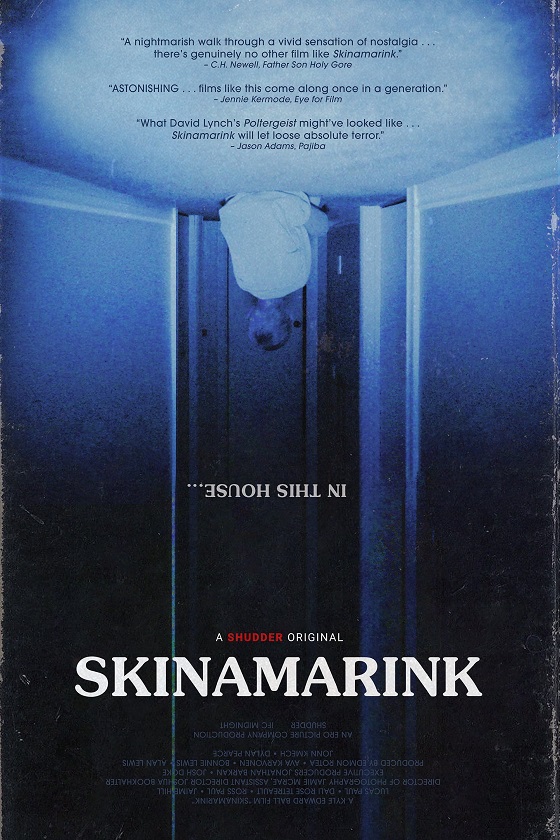
Skinamarink (2022)


Experimental, arthouse horror Skinamarink is the kind of film to be experienced rather than necessarily followed as you would a more traditional movie.

Named after a nonsense playground chant from North America, the plot of this Canadian film - written and directed by Kyle Edward Ball - revolves around the travails of two seemingly abandoned young children, four-year-old Kevin (Lucas Paul) and his sister, six-year-old Kaylee (Dali Rose Tetreault).

The kids wake up in the middle of the night to discover all the windows and doors leading out of their home have disappeared, along with their father (Ross Paul) and mother (Jaime Hill).

Kevin and Kaylee decamp to the lounge and turn on the television to watch cartoons while they play with their toys.

Soon, though, they realise they are not alone in the house, and a strange, disembodied, voice starts speaking to them and making demands of them.

When Kaylee tries to challenge the omnipotent entity, she is punished, and it is left to her younger brother to wander through the 'haunted house' alone.

Shot almost entirely at a low angle, so that we are either taking the point-of-view of one of the young protagonists or simply seeing events unravel from their level, the disorientating film demands our attention from the moment it begins.

We barely glimpse the children - the adults we see even less - and it's usually just legs and feet, while the dialogue is a mixture of often mumbled, naturalistic, delivery and - when it's too quiet to properly make out - subtitles.

The only sounds we hear are diegetic, so there are long periods of near-silence where - if you've surrendered yourself to the movie experience - you start to subsume sounds from your own environment, until you can't tell what's happening in the movie and what's in the room with you.

Objects appear and disappear, one of the televised cartoons gets stuck in a loop, and eventually we see flashes of shapes and figures in the shadows, toys and video cassettes stuck to walls and the ceiling, blood splatters across the TV screen etc 

Lighting is also minimal, often coming just from the flickering of the TV screen or a child's torch,.

Combined with the faux retro patina of the film, and its 1995 setting, all these tricks give the film the aura of a proto-found footage/video nasty mixed with dream logic and early David Lynch stylings. 

Ball's obsession with the TV screen and the way objects flicker in and out of existence scream David Lynch and it wouldn't take much, if you were so inclined, to headcanon this slice of disturbing weirdness into the world of Twin Peaks.

If demons and the supernatural were real, I can't help believing that an actual encounter with a paranormal entity might be something akin to the experience of watching this movie: intense, unsettling, confusing, baffling, bewildering, and ultimately beyond our comprehension. 

There is no "stunt man in rubber suit" or slick CGI monster serving up jump scares. In a very Lovecraftian way, at its core, Skinamarink is clearly "something man was not meant to know". 

Nothing that happens is overtly explained, meaning Skinamarink is the ultimate montage movie; it is up to us to assemble our version of what's going on from the succession of images and sounds that Ball provides us with.

Depending on the personal baggage and preconceptions you bring to Skinamarink, it's either a terrifyingly immersive and psychological descent into a child's nightmare encounter with a demon or 105 minutes of laughably pretentious bullshit. Your mileage will vary.

Personally, I'm glad I watched this peculiar work of mad genius as I've never seen anything quite like it before, but I have no great desire to see it again in a hurry.

I was hooked by it as it played but the concentration required to fully absorb Skinamarink was rather draining.

Friday, January 10, 2025

The Beach House (2019)

In an attempt to patch up their relationship, opinionated, deadbeat, college dropout - and runner-up in a Skeet Ulrich-lookalike competition - Randall (Noah Le Gros) takes his supersmart girlfriend, Emily (Liana Liberato) to his family's beach house.

As it's out of season, they're expecting to have the place to themselves.

However, due to a breakdown in communication with Randall's dad, they instead find a couple of old family friends - Mitch (Hell on Wheels and Dawn of The Dead's Jake Weber) and his sick wife, Jane (Maryann Nagel) - are already staying there.

As the house is big enough to accommodate everyone, after a few awkward moments, they agree to "get to know you" meal that, having exhausted the alcohol supply, ends with the consumption of some edible marijuana.

Senses heightened by the drugs everyone is awed by a blue luminesce that clings to everything around the beach.

And the next morning, things start to get even weirder as people start to feel violently ill.

Having witnessed an apparent suicide, Emily - the only real candidate for the title of 'final girl' - stumbles across something vile and gelatinous on the beach, and soon finds herself trying to escape an unnatural fog that's rolling in as well.

For all intents and purposes, The Beach House is another reimagining of HP Lovecraft's Color Out Of Space, only this time the alien infestation is coming from the bottom of the ocean, rather than the cold depths of the cosmos.

Mixed in for good measure is a flavouring of Stephen King's The Mist and John Carpenter's The Fog, and maybe a soupçon of Quatermass.

There's no denying that all the ingredients are there for a quality horror film, and it was trailers for The Beach House that originally got me thinking about subscribing to the Shudder streaming service.

If you're coming to this cold, you should be aware that it's a really slow burn. Pretty much nothing  really happens for the first half of this 88-minute movie, except Mitch and Jane being a bit odd.

But then, suddenly, the body horror cranks up and we're off to the races.

There are some deliciously gross-out moments around this time when you can't help wondering if this is going to be "the greatest film of all time", but sadly it isn't.

Like Emily herself, the plot stumbles all over the place, trying to figure out what's going on.

Having a lead character's obscure area of study - and interests - corollate almost exactly with the nature of the random, apocalyptic, scenario  that she has fallen into is rather heavy-handed, even if Emily doesn't really call upon her area of expertise once everything starts to hit the fan. 

Instead, it is simply sown in as ominous exposition during the meal with Mitch and Jane, and like a lot of the set-up is more or less a red herring. 

That said, I have no problems with stories - horror ones, in particular - where the audience isn't spoon-fed an explanation of what's occurring (if nothing else, it helps you sympathise with the struggles of the central characters), but I'm not sure writer/director Jeffrey A Brown's script gave us as much information as he thought it did.

But, perhaps, my biggest bugbear - which kept pulling me out of the moment - was the total absence of mobile phones.

There was no indication that The Beach House was a 'period piece', but nobody had a mobile phone (which, of course, would have been very useful and would have almost certainly changed the direction of the story). Nobody even mentioned the idea of finding one.

Communication-wise, all we saw were a couple of disconnected landlines and a CB radio.

Where were the mobile phones? I'm annoyed at myself over how much this bugged me, but mobiles are ubiquitous in modern society and their absence was as big a mystery as what was actually causing the water-borne infection.

My pop culture Odyssey: a slice of super-powered geek life with heavy emphasis on pulp adventure, superheroes, comic books, westerns, horror, sci-fi, giant monsters, zombies etc