Showing posts with label China. Show all posts

Friday, May 1, 2026

Journey To The West - Conquering The Demons (2013)


How many movies can you think of that climax with a fight between King Kong and God*? I can name one: Journey To The West - Conquering The Demons.

With Conquering The Demons writer/director Stephen Chow gives us a prequel to the well-known tale of The Monkey King as portrayed in various media, including the '70s TV show Monkey!

Conquering The Demons is the origin story of the famous quartet at the heart of the latter tale - Monkey, Pigsy, Sandy and Tripitaka - although this isn't entirely obvious until the final moments of the movie, as the film stands well enough on its own without any prior knowledge.

The story grows gradually out of a number of vignettes with characters that seem rather familiar from other iterations of Journey To The West (one of the  Four Great Classical Novels of Chinese literature) but cast as villains where we have only really known them as reluctant heroes before. You'll also spot items that eventually become iconic artefacts in the story of Monkey and Tripitaka's travels.

Zhang Wen plays scruffy demon-hunter Xuan Zang who doesn't want to slay demons but simply remind them they were once innocent children, though the songs in his book of 300 Nursery Rhymes.

While battling a giant fish-shaped water demon, Xuan crosses paths with the pretty and resourceful Miss Duan (Qi Shu), who is attracted to Xuan's innocence - despite his outward expressions of chaste disinterest.

After a run-in with an unstoppable pig demon, Xuan's master sends him on a quest to seek help from The Monkey King, imprisoned under Five Finger Mountain.

Luckily, he is not alone when he comes up against the ultimate trickster - he has fellow demon-hunters, Miss Duan, Prince Important (Show Luo), Almighty Foot (Chaoli Zhang) and Fist of the North Star (Xing Yu) to watch his back.

Blending comedy (both physical and verbal), with horror, martial arts, wire-work, magic, romance, song, tragedy and pathos in a cocktail rarely seen in Western cinema, Conquering The Demons is a genuinely captivating action movie.

Chow's take on The Monkey King is a lot darker than any I've been used to before. He's still playful, selfish, manipulative and arrogant, but he's also really very evil here - having clearly not learned his lesson from when Buddha trapped him under the mountain 500 years earlier.

The humour subsides in the totally gonzo climax as The Monkey King demonstrates his true nature, making short work of the demon-hunters before Xuan calls on Buddha to intercede and matters come to a head on a cosmic scale.

It's no surprise this film raked in the yuan in China, Journey To The West - Conquering The Demons is not only magnificent storytelling but a visual feast as well, packed as it is with magical martial artists and monsters.
* Technically it's The Monkey King and Buddha... and it's not really even a fight... ignore me, you just have to watch it... seriously... watch this film!

Wednesday, April 29, 2026

The Monkey King (2014)


For those up on their Chinese mythology (or fans of the old Japanese TV show, Monkey!), the basic story of The Monkey King is a familiar one, although this latest big screen adaptation adds a few flourishes and twists to the traditional tale.

At its heart though, it's a straight-forward morality play about a naive and egotistical animal spirit, Sun Wukong aka Monkey King (Donnie Yen), being tricked into helping the evil forces of the Bull Demon King (Aaron Kwok) get through the Gates Of Heaven and attempt a coup against the Jade Emperor (Chow Yun-Fat).


Kam-Yuen Szeto and Edmond Wong's script is very clever, giving the well-known tale a fresh coat of paint rather than a total overhaul.

For instance, I liked the introduction of the low-key romance between the Monkey King and Silver Fox (Xia Zi Tong), that added an extra layer to explaining his willingness to go along with the Bull Demon King, and unlike many Western films this sub-plot doesn't slow the phenomenal pacing of the main story.

Although The Monkey King is two hours long, it moves along like a bullet train, but where it falls down is the rather inconsistent quality of its special effects.

While the blend of "people-in-costumes" creatures and CGI gives the movie a certain charm - the 'costume creatures', for instance, evoke memories of the old Monkey! TV show... and Power Rangers - the computer graphics lurch from breath-taking to appalling.

Rather oddly, for me, the equally unpredictable subtitles on my Thai-import DVD didn't hamper my enjoyment of the movie.

Some lengthy dialogue scenes merited no sub-titles (particularly, for some reason, when Sun Wukong was speaking) and at other times screeds of text would race across the screen at migraine-inducing speed.

And yet, the plot was still easy to follow. Yes, I might have missed some moments of witty (or profound) dialogue, but the visual storytelling was so spot on that I still felt as though I had my finger on the film's pulse.

That's not to say it's simplistic. This is an Asian fantasy after all, so there are some insane segues and moments of mind-baffling surreality that trigger 2001: A Space Odyssey flashbacks, but you watch enough of these movies and you learn to just go with it.

Interestingly, The Monkey King serves as a prequel to the better known story of Monkey and Tripitaka's 'Journey To The West'; we just get a teasing glimpse of young Tripitaka in the closing moments.

Tuesday, April 28, 2026

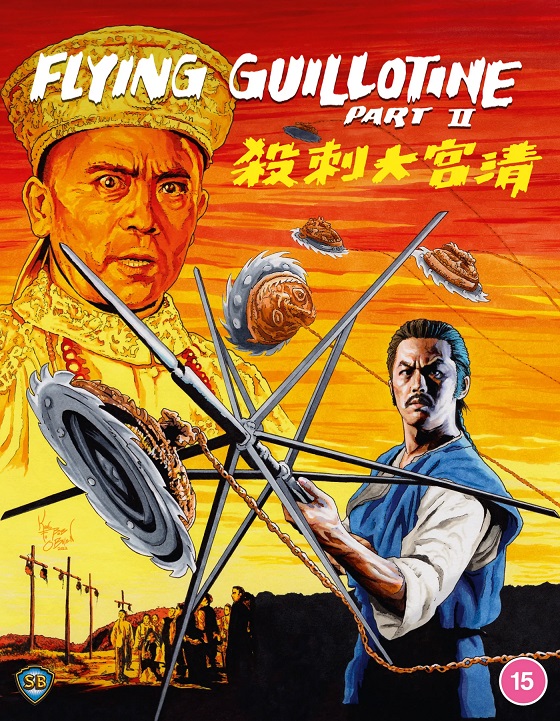
Flying Guillotine Part II (1978)


The cunning but cruel Qing emperor Yung Cheng (Feng Ku) has a hatred of the conquered Han and a penchant for having people's heads cut off, as exemplified by his revolutionary "flying guillotine" weapon.

The flying guillotine is an almost certainly fictitious weapon said to have been thrown over an opponent's head and causing instant decapitation.

However, heroic rebel Ma Teng (Lung Ti) has invented the "iron umbrella", a device to counter the flying guillotines, and even turn them back on their users.

So the emperor calls on the guillotine's inventor, a high lama, to design an even better flying guillotine.

Meanwhile, the Han rebels, including Na Lan (Szu Shih), daughter of a palace official, keep trying to assassinate the emperor.

Their plans - especially one involving poisoned daggers firing out of a scroll case - are inspired, but the crafty emperor is always one step ahead.

Ultimately, this leads to a monumental, large-scale, showdown in the emperor's palace between his forces and those of the rebels.

The denouement is not exactly what I was expecting, but I appreciated its honesty.

Set in Ancient (17th Century?) China, Flying Guillotine II aka Palace Carnage is an incredibly pacey and chaotic Shaw Brothers martial arts masterpiece, full of incredible fight sequences, superheroic wire-fu, and bonkers, physics-defying, exotic weaponry.

Throw in a couple of unexpected moments of brief female nudity, frequent splashes of bright red blood, and some half-decent dubbing and Palace Carnage is an impressive, if occasionally hard to follow, frenetic slice of 1970's Hong Kong martial arts. 

There's an avalanche of palace intrigue, spying and counter-spying, as Na Lan wins the emperor's favour - much to the disgust of his senior aides - and gets to form her own all-female cadre of palace guards.

While all the main rebels are superb fighters, major kudos to the ultimate badass villain, Yung Cheng, who holds his own against at least half-a-dozen rebel mooks and ultimately faces off against the three main heroes and gives no quarter.

This final showdown is as glorious a spectacle of bloody martial arts as you could hope for from a Shaw Brothers flick.

Monday, April 27, 2026

MUSICAL MONDAY: Turn The Tide ( NiNi Music x RYUJIN)

Turn the Tide is an Epic Asian folk metal collaboration between NiNi Music and RYUJIN (Ryoji Shinomoto).

Blending traditional Asian instruments with melodic metal, the song tells the story of the legendary Pirate Queen Zheng Yi Sao and the storms of war that turned the tide of battle across the seas.

Shot across Asia with shots from the beautiful Hokkaido.

Friday, April 10, 2026

SINBAD WEEK: Sinbad of The Seven Seas (1989)


As the original 1947 Sinbad The Sailor movie proved, you can make an excellent Sinbad film without Harryhausen effects as long as you have a great cast and script - Sinbad Of The Seven Seas has none of these.

I guess my spidey-sense should have been tingling by the mere sight of Lou 'Incredible Hulk' Ferrigno grinning on the cover of the DVD case.

And if not then, by the fact that the film opens with a contemporary framing device of an annoying  mother (Daria Nicolodi) reading her equally annoying daughter (Giada Cozzi), Edgar Allan Poe's The Thousand-and-Second Tale of Scheherazade (although Poe's story bears no similarity to this sorry affair).

So far, so Princess Bride. But the narration continues, even as the scene shifts to Sinbad and his multi-racial crew, and then it continues some more and it pretty much never stops throughout the whole movie!

And if that wasn't bad enough, all the dialogue by the main characters has been rerecorded and dubbed over - quite badly and quite obviously.

Not that the actors are that good anyway, nor do they have quality material to work with and little apparent direction from Enzo Castellari, master of the spaghetti western and director of the original Inglorious Bastards.

From start to finish, Sinbad Of The Seven Seas is a dreadful script performed by dreadful actors, with the only comparison I can make being the distinctly British tradition of pantomime. And like pantomime, unless you are under six, Sinbad The Sailor is - in equal parts - likely to bore you to distraction and have you laughing out loud at its awfulness.

The only performer to come out of this with any kudos is John Steiner as villainous vizier Jaffar, clearly the only one in on the joke, who is gloriously over-the-top and arch, switching between delightful smugness and being his own worse enemy. Not only does he tell Sinbad where he has hidden the magic crystals that Sinbad must track down but then, having summoned a magical storm to batter Sinbad's ship, he runs it ashore on one of the islands where some of the crystals are hidden!

Inexplicably Sinbad is joined on his adventures by a Viking (Ennio Girolami), a Chinese soldier of fortune called Samurai (!!!) (Hal Yamanouchi), effete prince Ali (Roland Wybenga) - who is to marry the caliph of Basra's cute daughter, Alina (Alessandra Martines) - as well as a bald chef and a cowardly dwarf called Poochie (Cork Hubbert).

While chasing after the magic jewels that Jaffar has scattered - like a pointless video game - they encounter a number of ludicrous obstacles, most of which are overcome by very bad fight sequences (Sinbad has an odd habit of throwing his sword away and simply wrestling whatever he is facing).

The only scenario that shows a bit of initiative is Sinbad's seduction by Amazon Queen Farida (Melonee Rodgers) and her ultimate comeuppance.

I can't even bring myself to discuss the surreal cameo by bodybuilder Teagan Clive as Jaffar's co-conspirator, Soukra, the S&M dominatrix witch, except to say, like the rest of the film, it will leave you perplexed, bemused and possibly in need of counselling.

Unless you are in a particularly masochistic mood, really love ultra-low budget bad movies or are aged under six, Sinbad Of The Seven Seas is best steered clear of.

Tuesday, February 17, 2026

WELCOME TO THE YEAR OF THE HORSE

Photo by Tao Yuan on Unsplash
Happy Chinese New Year

The Lunar Year of The (Fire) Horse runs from today until February 5, 2027, when we usher in the Year of The Goat.

As the horse is my animal sign, I'm supposed to be extra lucky this year... if I'm bold enough!

Which is nice.

Friday, January 30, 2026

Swords, Sandstorms and Snow: What More Do You Need?

Dao Ma (Jing Wu), the "second most wanted fugitive," is entrusted by his benefactor, the chief of Mo family clan, to take on a mysterious escort mission - escorting the "most wanted fugitive," to Chang'an.
This sublimely edited teaser trailer makes Blades of The Guardians (aka Biao ren) look absolutely phenomenal.

Based on a popular manhua (Chinese comic), the wuxia film will be released in the States by Well Go USA Entertainment on February 17 in cinemas and via VOD.

Simultaneously, the film will be released in mainland China, during Chinese New Year.

The translated first volume of the manhua will be available in the UK in March, as Blades of The Guardians.

Wikipedia expands on the comic book's hook by telling us:
Hired fighters called Escorts protect targets, criminals for whom the government has issued an arrest warrant.

On the eve of civil unrest in the last years of the Sui dynasty, a government of fear and terror is gaining power in China, and feelings of hatred and enmity are emerging among some people.

A bounty hunter named Dao Ma travels throughout ancient China with his three-year-old son Xiao Qi and lives with the power of his sword.

One day Dao Ma accepts a mission for which he is guided to the city of Chang'an. He plans to pay off his debt to a therapist named Mo, and when he travels in the western desert, he accepts a simple mission that turns into a critical, dangerous issue.
Released on March 5 in trade paperback form: Blades of The Guardians, vol 1. 

Thursday, October 16, 2025

THROWBACK THURSDAY: Pleasant Dreams!


Back in 2015, Rodney Ascher, director of the controversial documentary Room 237 about Stanley Kubrick's The Shining, released his documentary, The Nightmare, about the phenomenon of sleep paralysis.

Now this is something I have experience of.

Despite my love of all things horror-orientated (monsters, cannibals, ghosts etc), when it comes to real life I'm not so brave, so as we are fast approaching Halloween I thought it would be time to share my own 'horror movie' experience:

Way back in 2002 I went to visit Paul when he was working for an English-language newspaper in Beijing, China.

He was staying in a big, one-bedroom flat in a tall tower block, so I was sleeping on a makeshift (but comfortable) bed in his lounge.

Alcohol usually played a large part in making sure I had a good night's sleep... but one night I awoke with an "invisible person" sitting on my chest; pinning me down. I couldn't move!

I have no recollection of what happened later but talking to Paul the next day I discovered I wasn't the first person this had happened to. There was the usual urban myth circulating about someone jumping to their death from one of the flats... but no-one could ever say which one.

Later I read about 'sleep paralysis', which (basically) means your mind has woken up but your body is still asleep, so you can see and think - but not move; but at the time I was as convinced as I've ever been that I had come face-to-invisible-face with a ghost!!!

From Wikipedia:
In Chinese folk culture, sleep paralysis is referred as "gui yà chúang" (鬼压床), literally: "Ghost press bed": 鬼: ghost, 压: press, 床: bed. The belief is that a spirit or ghost is sitting or lying on top of the individual while they were sleeping, causing the sleep paralysis. This is thought to be a minor body possession by the forces from the dead, and usually doesn't cause any harm to the victim.

Thursday, March 20, 2025

THROWBACK THURSDAY: Let's Get Spiritual

The Hall of Harmony and Peace at Yonghe Temple, Beijing. Picture: Yinan Chen
 
Continuing my recollections of the highlights of my visit to China (to visit Paul) in 2002, I will never forget my visit to the Yonghe Lamasery in Beijing.

Paul had gone to work, so I took a taxi into the temple, little realising that I was turning up in the middle of a major Buddhist new season festival, a kind of exorcism of evil spirits.

There was an hour of dancing by monks in freaky masks, in front of the chief Lama and his posse.

Then everyone paraded through the temple to the main gate, where there was more banging of drums and cymbals, and stuff got burnt (which I couldn't see). 

Then everyone paraded back to the main arena, had a team huddle and threw 'gifts of the gods' (ie. food) out into the crowd.

STAMPEDE TIME!

I got a peanut, then an old Chinese woman offered me a little orange, which I thanked her for.

After this people seemed to disperse, so I started to wander the temple grounds, and found the last temple, which holds a giant Buddha, where all the monks - and the locals - were praying.

All the other Westerners had vanished by now.

The monks were handing out sacred yogurt, which people were either storing in jam jars or rubbing into their hands and faces. I decided to go for the hand/face option with my dollop!

Outside of the temple I watched more Chinese saying their prayers and lighting joss sticks.

It was all very moving, and one more illustration of why the Buddhists have the coolest religion.  

Thursday, March 13, 2025

THROWBACK THURSDAY: Ain't No Party Like A Great Wall Party!

All Along The Watchtower: Paul and yours truly getting ready to par-tey!

Paul worked as a sub-editor for The China Daily in Beijing for a year  and in March, 2002, I flew out to visit him for three weeks.

That time was chosen because his birthday falls then, and he and his colleagues on the paper had arranged a unique birthday experience which will never be repeated (for one reason, the Chinese authorities have now ruled it illegal).

We camped out overnight on a little known part of The Great Wall!

The album cover pose - note Lori's hair seems to have a life of its own!

It took us an hour and half to get to "base camp" from  Paul's flat in Beijing (45 minutes by bus and 45 minutes in a haggled minibus). Base camp turned out to be a tin shack seemingly in the middle of nowhere.

It was about 8pm and pitch dark. The owner of the shack woke up to cook us some noodles and, aided by the minimal light from the shack, Paul pointed out to me, across a valley, THE WALL, rising straight up the mountain opposite.

And it's BIG. The word "Great" doesn't do it justice.

The noodle lady let us rest for a while in her hut, which consisted of a bed (which we sat on), a table, an array of food, and postcards. She lived there with her daughter, making money catering to travellers who come to this less touristy part of the wall.

This section of the wall hadn't been rebuilt - which also meant it was devoid of souvenir salesmen - and was really only suitable for hardcore, adventurous types (ie. not me!)

The first part of the walk was across the top of a dam, with water lapping at one side and, well, nothing on the other. At the time I thought it might be a gentle slope down to some fields or something...

Hours later, on the way back in broad daylight, I discovered it really was down to nothing. Well, about 1,000ft of nothing then a rocky base. Straight down. And that was ignoring the crosswinds that had whipped up over night (but I'm getting ahead of myself).

The actual climb started with a gentle zig-zag to a metal ladder that got us onto the wall. Then a steeper climb - with nothing on either side - to the first watchtower.

The towers are basically shells with four walls and a lot of windows. At first I was content to stop there - as were a couple of Paul's friends - but the rest of the party assured us that the next watchtower was even better.

So, after a 20-minute, breath-regaining, rest we set off again... on the ascent of fear!

Yes, there was a rubbly path of sorts, and yes, on some parts there were even elements of wall on either side, but you could tell you were going a long way up - and practically vertically!

Morning: It's Bloody Freezing!

 I have never been happier to collapse into a ruined monument than when I made it to the next watchtower. This one had more inner walls and a wooden ladder to a parapet (which, once I was drunk enough to overcome my fear of heights thanks to a combination of absinthe, cheap beer and Southern Comfort, I was soon scuttling up and down like a monkey).

We set up the CD player, broke out the drink and a got a fire going. Very quickly the party moved from the ground floor to the parapet, where much dancing and silliness was done by all - under the influence of alcohol and the ignorance offered by pitch darkness.

We crashed about 4am and woke less than three hours later in a deep freeze. I'd always thought I was pretty good with the cold, but this was unbelievable; especially when combined with the aforementioned cross winds.

Then Paul suggested I look at the view. I stuck my head out of the doorway we had come in and swore very loudly. The path looked like an almost straight drop down to the reservoir... which was a looooong way below us!

Thankfully, Paul was on hand to help me back down, because, in all seriousness, I just don't think I could have made it back on my own. The descent was terrifying enough for someone who suffers with vertigo (thank God we went up at night), but then the walk across the dam - which was about three foot wide - in the wind, with a massive rucksack on my back, nearly saw me letting the side down.

However, fear element aside, this was one of the most awesome experiences of my life. Come on, how many people can say they've partied the night away on The Great Wall Of China?

One last look back...

Saturday, March 1, 2025

PULP PICTURE OF THE MONTH: The Terror of The Tongs (1961)


As I said last month in my review of 1959's The Stranglers of Bombay, Hammer recycled that film's plot for 1961's The Terror of The Tongs, simply relocating the action from 19th Century India to early 20th Century Hong Kong.

After his daughter (Barbara Brown) is slain by Tong gangsters searching for an incriminating list of their key members, British sea captain Jackson Sale (Geoffrey Toone) wages a one-man crusade against the secret organisation, punching his way through Hong Kong's underworld with the subtly and diplomacy of Robert E Howard's Sailor Steve Costigan.

There's no denying that this is an exciting thriller, but even with the appearance of an anti-Tong coalition among the Chinese community (who see Sale as a useful weapon to direct against their foes), the racism on display is inescapable.

In his first headlining role for Hammer, Christopher Lee - as Red Dragon Tong leader Chung King - gets to test-drive the problematic "Chinese" make-up he would later make famous in the Fu Manchu series of movies.

There are plenty of Asian actors in the large cast, although primarily as extras, but the bulk of the key Chinese roles have gone to Western performers in "yellow-face".

The death of Sale's daughter, Helena, is also pretty much the text book definition of "fridging" as she turns up purely to be killed off in the next scene and give Jackson his motivation for wanting to bring down the Tongs.

He channels his grief through his fists, and while occasionally Sale uses his wits, his main investigative tool is violence.

Coming in at just over an hour and a quarter running time, there's no hanging around in The Terror of The Tongs, so when Sale rescues the gorgeous half-Chinese/half-French Lee (the charismatic Yvonne Monlaur, probably best known for her lead role in The Brides of Dracula) random romance is clearly on the cards.

However (slight spoilers for a 60-year-old film), her ultimate character arc was both unexpected and slightly gratuitous. 

Not only does The Terror of The Tongs reuse the plot of The Stranglers of Bombay, but Doctor Who's Roger Delgado is also back, this time as Chung King's number two, essentially the same role he played in the earlier movie.

Shot in vibrant colour, in contrast to the crisp black and white footage of The StranglersThe Terror of The Tongs is also available as part of Powerhouse's high-end Indicator range of Blu-Rays.

The use of colour means director Anthony Bushell is able to splash around plenty of bright, red blood, but the most horrific scene - a sequence where Sale falls into the hands of Chung King and is ritually tortured - is so well framed that it made me squirm without actually showing any graphic details of the "bone-scraping" needles that were being used.

A two-fisted pulp adventure, with unfortunate casual racism throughout, the central story of The Terror of The Tongs remains engaging (if simplistic), providing you can acknowledge the uncomfortable casting decisions of the time when it was shot.

Thursday, February 27, 2025

Infra-Man (1975)


Hong Kong's first superhero movie, Infra-Man (aka The Super Inframan or Chinese Superman) is everything you would expect from a mid-70s Asian martial arts/sci-fi mash-up.

The Earth is threatened by the subterranean Glacier Empire of Demon Princess Elizebub (Terry Liu), also known as Princess Dragon Mom, recently awoken from 10 million years of hibernation and now keen to conquer the Earth with her legion of monstrous henchmen.

Earth's best defence is China's Science Headquarters, run by the genius Professor Liu Ying-de (Hsieh Wang).

Using "science" he transforms one of his staff, the heroic Rayma (Danny Lee), into the superhero Inframan - using bionic-like implants, hormone injections, and high-tech gadgets.

Princess Elizebub's legion of rubber-suited monster lieutenants

China's Superman then uses a variety of powers to take on Elizebub's monsters, so the wicked demon queen kidnaps the professor's daughter, Liu Mei-Mei (Man-Tzu Yuan), in an attempt to blackmail him into making her an Inframan of her own!

The iron-willed professor refuses to capitulate, meaning that he and his daughter end up frozen in ice... and it's left to Rayma and the Science Headquarters' army to storm Elizebub's underground base, rescue their colleagues and save the world.

The frenetic pace with which the story moves suggests that Infra-Man could easily have been storyboarded by a six-year-old kid and their box of action figures.

From the film's fit-inducing psychedelic title sequence,  Infra-Man is a brilliantly bonkers blend of 1970's Doctor Who and Power Rangers, with cheesy, cheap and cheerful special effects slammed up against campy rubber-suited monsters.

Given the slightly garbled English of the sub-titles, a particularly magical thing about this movie, directed by Shan Hua, is that you could watch it without any dialogue at all and still follow what's happening. 

It's the spoken words of the script by Kuang Ni that lead to all the head-scratching and misunderstandings.

Witch-Eye (Dana Shum)
We don't actually need all the ridiculous, mumbo-jumbo scientific gobbledegook explanations of how Inframan's powers supposedly "work" because they are pure technobabble and bafflegab.

On the other hand, I cannot tell a lie, I was rather distracted by Princess Elizebub's second-in-command, the scantily-clad Witch-Eye (Shu-Yi Tsen aka Dana Shum), who was able to shoot green beams from the eyes embedded in the palms of her hands.

For a film presumably aimed at a young audience, her fate was one of the most unexpectedly shocking.

In fact, while there's a lot of talk by the villains about 'killing', I'm pretty certain they only actually kill one person onscreen, whereas Infra-Man gets quite brutal in his treatment of the monsters from the get-go, blowing them up, melting them, severing limbs etc

Produced and distributed by Shaw Brothers Studio, the martial arts fight sequences - which are plentiful - are top notch and help distract from the largely nonsensical, yet wonderfully over-the-top, plot.

Wednesday, January 29, 2025

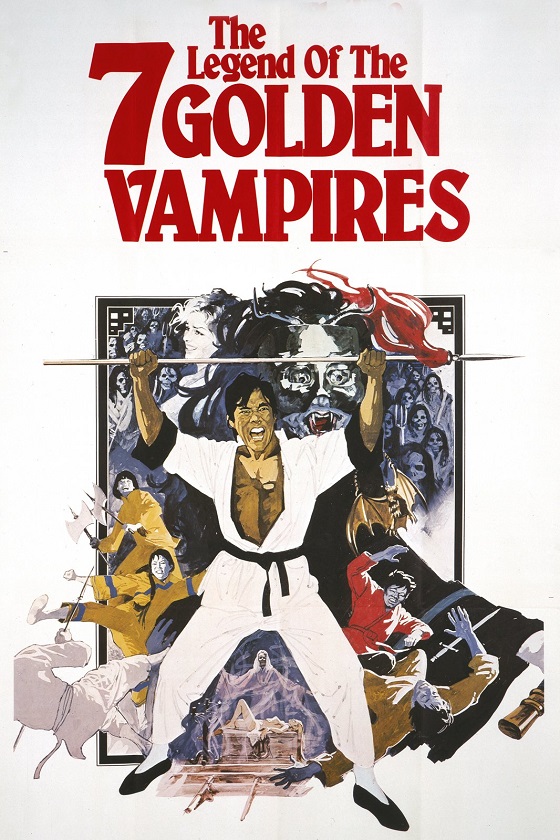
The Legend of The 7 Golden Vampires (1974)


In 1804, a wicked Chinese priest, Kah (Chan Sen), makes his way to Transylvania to ask Count Dracula (John Forbes-Robertson) to resurrect the "seven golden vampires" that Kah had previously employed to keep local peasants in order back home.

Dracula, however, has other ideas and steals Kah's physical form so that he can relocate to China and get back into the bloodsucking business for himself.

A century later and Professor Van Helsing (Peter Cushing) is lecturing at China's Chungking University on the dangers of vampires, while also seeking aid and co-operation to investigate local legends of the undead.

He is met with derision from all but one of his audience, Hsi Ching (David Chiang), whose village has been almost destroyed by attacks from The Seven Golden Vampires.

Meanwhile, Van Helsing's son, Leyland (Robin Stewart), has befriended the forthright, wealthy and attractive European widow Vanessa Buren (Julie Ege), who has caught the eye of a local tong boss.

Vanessa agrees to finance Val Helsing's expedition to the isolated village, on the condition that she can join the party, and Ching introduces his seven kung-fu trained siblings who will provide protection on the journey.

Soon after setting out, the group is ambushed by tong thugs and Van Helsing gets his first taste of Chinese martial arts.

Later on, they make camp in a cave and find themselves under attack from several of the gold mask-adorned vampires and an army of skipping zombies.

From there, the next stop for our heroes is their besieged village, where they organise the remaining villagers into a defensive force and await the assault of the vampires and their legion of the undead.

One of the vampires kidnaps Leyland's girlfriend, Ching's sister Mai Kwei (Shih Szu), leading the surviving heroes to pursue him to Kah's temple, where Van Helsing discovers that Kah is actually his archenemy: Count Dracula.

After this final conflict, like a good many films of its era, the movie abruptly ends without showing any interest in exploring the high cost our heroes had to pay to get through the climactic confrontation between good and evil.

A joint production of Hammer Films and The Shaw Brothers, The Legend of The 7 Golden Vampires is surprisingly good for what it is, but could have been so much better.

From the moment they are introduced, the protagonists are stuck on a narrative railroad, travelling from point A to point B on a linear journey, broken up by impressive fight scenes... and culminating in a massive fight scene.

You get the impression that the Hammer crew were so delighted to be able to blend their tried-and-tested horror formula with Chinese martial arts that they couldn't really think of anything else to do with their Chinese cast or exotic scenery (it was shot on location).

While there's no denying the film is a lot of fun, there is so little to actual story that beyond its martial arts "gimmick" it is largely ephemeral. 

The golden vampires aren't even the classic Chinese jiangshi ('hopping vampires'), which would have brought something a bit unusual to a '70s Hammer flick, but are instead a strange mix of Western vampires and Eastern martial artists.

It also pays not to think too hard about the 100 year time jump from the prologue to the main story and the havoc that plays with Van Helsing's timeline if he's coming off the back of his (many) fights with Dracula in, and around, Transylvania.

Are we supposed to assume that Dracula was doing all this - and dying frequently - at the same time he was in China running The Cult of The Seven Golden Vampires?

Or is this a different Dracula? 

Although he is reduced to a largely supporting role, John Forbes-Robertson's take on Count Dracula is oddly camp, with his make-up bearing a more than passing resemblance to Cesar Romero's Joker in the Adam West Batman show.

Long out of print and pretty rare in these parts, I watched the 86 minute DVD version of The Legend of The 7 Golden Vampires, having finally tracked it down on eBay for a reasonable price, but I understand there's a 110 minute Eastern version that I'd love to see one day.

Ultimately, The Legend of The 7 Golden Vampires comes across as a massive missed opportunity.

Tuesday, January 21, 2025

Creation of The Gods I - Kingdom of Storms (2023)


With Creation of The Gods II: Demon Force scheduled for cinematic release at the end of this month, I thought it was the right time for me to cast an eye over Creation of The Gods I: Kingdom of Storms.

Thankfully, independent British distributor Cine Asia has released this 148-minute epic in a lovely Blu-Ray edition.

The Creation of The Gods trilogy is an adaptation of 16th Century fantasy novel Investiture of the Gods written by the Ming dynasty author Xu Zhonglin.

Kingdom of Storms is essentially a fantastic and fictitious retelling of the political fallout following the ascension of the last king of Shang dynasty.

Triumphant war hero Yin Shou (Fei Xiang) returns to his father's court - after quelling a rebellion - to be feted for his victory.

However, unknown to all, he has been seduced by a nine-tailed fox demon, who has possessed the body of the late Su Daji (Narana Erdyneeva), daughter of the rebellion's leader. And who can blame him really?

Narana Erdyneeva as Su Daji

Through some magical manipulation around the celebratory feast both Yin Shou's father and then his elder brother are slain, leaving him next in line for the throne.

However, this act triggers something supernatural called The Great Curse, which could potentially wipe mankind from the face of the Earth, with Yin Shou's self-sacrifice being divined as the only solution.

He says he's willing to do it... but we all know he's not!

At the same time, the mystic immortals of Kunlun send a trio of monks to deliver a magical scroll to Yin Shou that will save the world from the effects of the curse.

However, they quickly realise that the tyrant Yin Shou is not the right person to possess this power and a running battle ensues for the scroll and to topple the king.

Based on a 500-year-old story of events that took place in 2,000BC China, Kingdom of Storms is a complex, mesmerising tale of wuxia swords and sorcery.

Starting off as a magnificent, and quite grisly, grounded war tale, the supernatural elements are slowly seeded in with the arrival of the fox demon, then we meet the Immortals (who are basically superheroes), an evil sorcerer (whose powers include being able to safely remove his own head and animating enormous stone fu dog statues), a green-skinned demonic baby and so on.

Although the film is two-and-a-half hours of reading subtitles, the narrative sucks you in as the action gallops along, so you are drawn in to the wonderment of the visuals and the storytelling. 

There's even a couple of "mid-credit scenes" as the very long, Chinese language, credits roll - so you'll probably want to keep your finger on the 'fast forward' button once the main movie ends.

While there are echoes of Lord of The Rings, and even Game of Thrones, in Kingdom of Storms, director Wuershan - who co-wrote the script with Jianan Ran, Ping Ran, and Cao Sheng - has crafted a mighty vision that reminded me of the visceral thrills I felt when I first saw Crouching Tiger, Hidden Dragon and Zu: Warriors of The Magic Mountain.

There is a jaw-dropping majesty in Creation of The Gods I: Kingdom of Storms that emphasises, as if you needed telling, that cinema is a global artform, not limited to Hollywood or the UK, and other cultures have very different, but no less engrossing, ideas of how to entertain an audience.

I hope Cine Asia is able to release Creation of The Gods II: Demon Force on Blu-Ray reasonably quickly after the film hits cinemas, and then Creation of The Gods III: Creation Under Heaven follows swiftly after that.

Sunday, January 12, 2025

Now This Is How You Tell An Epic Saga

Taishi Wen Zhong led the army of Shang Dynasty including Deng Chanyu and four generals of the Mo Family to Xiqi. With the help of Kunlun immortals such as Jiang Ziya, Ji Fa led the army and civilians of Xiqi to defend their homeland.
Well Go USA brings the second part of Chinese epic Creation of The Gods to American cinemas on January 31 (IMAX on January 29).

I know I'm biased, but for my money, I'd rather see the kind of mythology depicted in Creation of The Gods II: Demon Force serving as the background to a superhero comic than the tried-and-tested tropes of more Western pantheons such as the Norse and Ancient Greeks.
My pop culture Odyssey: a slice of super-powered geek life with heavy emphasis on pulp adventure, superheroes, comic books, westerns, horror, sci-fi, giant monsters, zombies etc