Showing posts with label Hammer. Show all posts

Tuesday, October 6, 2026

Backrooms (2026)


Disgruntled Clark (Chiwetel Ejiofor), the manager of a failing furniture store in 1990's San Jose, California, finds a mysterious "portal" in his store's basement.

It leads to the seemingly never-ending "backrooms": an "abandoned" maze of bizarre yellow rooms and corridors constantly bathed in humming neon light.

When he disappears, Mary (Renate Reinsve), his therapist - who Clark had been seeing regularly because of his anger issues - goes looking for him. She is surprised to find that his rambling tales of this alternate liminal dimension are actually true.

Directed by 19-year-old Kane Parsons, who originated the online Creepypasta-esque idea of The Backrooms in 2019, the film is one of those weird fiction horror pieces that is best experienced with as little foreknowledge or preconceptions as possible.

Part mainstream cinema, part "found footage", and utilising a minimal script by Will Soodik (who wrote 10 episodes of Ash vs Evil Dead as William Bromell) Backrooms does an excellent job of capturing the confusing, unnerving atmosphere of the source material, but could well frustrate a lot of viewers with its lack of explanation as to what it really going on.

Scientist Phil (the great Mark Duplass) provides a vague info-dump in the final act, but even he - and his organisation - don't have an explanation for the "backrooms". Which is the point of the original conceit, it's there purely to unnerve viewers and creep them out (as well as inspiring others to make their own online "backrooms" contributions).

Are there clues in the half-sunken objects, reversed signage, partially-remembered people? Possibly, but probably not. To me, it's the three-toed statue on the Lost island all over again: a cool visual that's there to look cool, that's all. Nothing deeper.

Ultimately the A24-produced movie is no more than an expanded iteration of one of these YouTube offerings with a bigger budget and slightly more developed central characters.

It never was going to give any definitive answers because that is not the nature of the "backrooms". Once you have a concrete explanation interest wanes because there is no more mystery.

Don't get me wrong, I love this new wave of horror films - and TV shows - based on modern, internet-spawned myths and ghost stories.

It's an innovative addition to the Universal era monsters, the Hammer monsters, the Halloween-inspired monsters etc

Every generation deserves its own horror movie mythology that reflects its experiences of the world. It's only fitting that this generation's inexplicable horrors are growing out of the internet.

Thursday, September 3, 2026

Brides Of Dracula (1960)

Dracula is dead, but his cult lives on in late 19th Century Transylvania.

Young Marianne (Yvonne Monlaur) is heading to the Lady's Academy at Bachstadt, where she is to be a student-teacher, but she gets diverted to the home of Baroness Meinster (Martita Hunt), little realising that the kindly old eccentric wants to feed her to her imprisoned vampiric son, the Baron (David Peel).

The naïve Marianne frees the Baron from his bondage, then flees the castle only to be found unconscious in the woods by Dr Van Helsing (Peter Cushing) who has been called to the village by the local priest.

Marianne eventually makes it to the girls school, but then the Baron shows up and proposes marriage - before turning turning one of her co-workers into a vampire.

Brides Of Dracula is fun but forgettable. Cushing is, naturally, the star but Freda Jackson as the Baron's insane nanny - in a Renfield role - is the most striking character, while Peel's Baron has an effete streak about him that makes Edward Cullen look positively macho.

A jolly romp from the Hammer production line, this 85-minute piece of frippery adds nothing to the vampire mythos, ends with the inevitable giant conflagration (as seems de rigeur in Hammer horrors) and includes possibly the most ridiculous use of an object to form a vampire-destroying crucifix: the shadow of the sails of a windmill... the very windmill the vampire was using at its nest!

Tuesday, September 1, 2026

Hammer's New Period Horror Will Chill You To The Bone

Twelve years in the making. This is Ithaqua: the wind with teeth.

A remote 1800s fur-trade outpost is plagued by an ancient evil with an insatiable hunger for flesh. The cold is the least of anyone's problems…

Directed and written by Casey Walker and starring Luke Hemsworth, Leenah Robinson, Kevin Durand, Craig Lauzon and Michael Pitt. This is a haunting folk horror experience where isolation, hunger and myth collide.

Hammer Presents is proud to bring Ithaqua to UK screens, premiering at FrightFest last weekend, ahead of its full release in early 2027.

Captain Kronos - Vampire Hunter (1974)


How have I gone this long without seeing this wonderful little film? Especially as Rachel bought me the Blu-Ray for Christmas several years ago and it's just sat on my shelf waiting for the right moment.

Clearly an influence on a variety of other monster-hunting shows from Buffy The Vampire Slayer to The Witcher, and the Ravenloft setting in Dungeons & Dragons, the mythology presented in Captain Kronos: Vampire Hunter suggests a wider world and the adventure we witness in this film is obviously just a single episode in his storied life.

Liberating stunning gypsy girl Carla (Caroline Munro) on the way - locked in the stocks for "dancing on a Sunday" - former Imperial Guard captain-turned-professional vampire hunter Kronos (Horst Janson) and his hunchbacked companion, Professor Hieronymous Grost (John Cater), respond to a summons to investigate a suspected vampire attack.

We learn that there are many varieties of vampire, beyond the accepted stereotype, and the one operating here appears to drain life rather than blood.

However, Kronos and Grost need to investigate further, to uncover its weaknesses.

At a later point this involves a darkly humorous sequence when one of their allies falls foul of the vampire and they struggle to find the right method of execution.

The film doesn't really make too much of an effort to conceal the mystery of who the vampire is, but still manages to slip in a few surprises in the wake of the "big reveal" in the final act.

Wearing its '70s pedigree on its sleeve, Captain Kronos: Vampire Hunter takes place in one of those peculiarly Hammer, vaguely Central European, pseudo-nineteenth century settings where 90 per cent of the women look like glamour models.

The dashing swordsman and his posse
And Munro's Carla is there mainly to take the role of dogsbody, vampire bait, and the Captain's booty call.

But casual sexism aside, this is a well-paced, swashbuckling-horror from writer-director Brian Clemens (the main scriptwriter of hit '60s spy-fi show, The Avengers, and screenwriter of Dr. Jekyll and Sister Hyde and The Golden Voyage of Sinbad, amongst many other achievements on his CV), that really would have worked as a serial.

Janson plays the deadpan Kronos straight, showing that the war hero is clearly damaged, not just from losing his family to vampires, and that's what makes the katana-wielding, Chinese herb-smoking swordsman all the more intriguing.

Then on top of the layered central character (we learn very little about Grost except that he's an expert on vampire lore and he's insecure about his appearance) we are treated to a number of his peculiar, folktale-inspired, tricks to unearthing the undead.

I was particularly fond of the dead toad gimmick (this is something I need to work into an RPG).
"If a vampire should bestrode / Close to the grave of a dead toad / Then the vampire life shall give / And suddenly, the toad shall live."
There's a minimalist look about the movie as well (no doubt down, in part, to the budget), where scenes - regardless of the size of the set - feature very few characters, which reminded me of my beloved Hawk The Slayer.

Light-weight and well-lit, compared to many of the more Gothic Hammer vampire flicks (as these vampires don't sizzle in sunlight), Captain Kronos: Vampire Hunter is a unique film in the Hammer vaults - which is a shame, because there's obviously many more adventures to be had with these characters.

Wednesday, July 8, 2026

"We're Going To Make A Person!"


The 1970 Hammer film, The Horror of Frankenstein is coming to Talking Pictures TV in the UK on Sunday, July 19, at 9.25pm, with a repeat showing on August 6 at 9.20pm.
Brilliant but arrogant scientist Victor Frankenstein (Ralph Bates) builds a man from spare body parts, only for the monster to come alive and wreak havoc.

Thursday, October 23, 2025

HALLOWEEN HORROR: Countess Dracula (1971)


In 17th Century Hungary, the elderly and recently widowed Countess Elisabeth Nádasdy (Ingrid Pitt) discovers she can temporarily restore her youth and libido by bathing in the blood of young virginal women.

Initially, her secret is only known to her castellan Captain Dobi (Nigel Green, a familiar face from such classics as Zulu and Jason & The Argonauts), who has loved the countess from afar for two decades and sees the death of her husband as making way for him, and her brainwashed nurse, Julie (Patience Collier).

At the reading of her husband's will, the Countess finds herself attracted to a new arrival, Lt. Imre Toth (Sandor Elès, who has an air of Jonathan Rhys Meyers about him), the son of her husband's wartime colleague and heir to the Count's stables and collection of valuable horses.

Unfortunately, the will divides the late Count's estate between the Countess and their daughter, Ilona (Lesley-Anne Down, of North and South, and Dallas), who has yet to arrive back from a stay of many years in Vienna.

Thus, the Countess instructs Dobi to kidnap Ilona on her return to the area, and she is bundled off as a prisoner of mute woodsman Janco (Peter May), who's not the sharpest tool in the box but still manages to thwart her multiple escape attempts.

In the absence of the real Ilona, the de-aged Countess assumes the role of her daughter and seduces cavalry officer Toth.

However, because her dark magic never lasts longer than about 48 hours, the Countess finds herself switching between the 'characters' she plays in the castle, while also charging Dobi with finding her fresh victims.

The wise old librarian Grand Master Fabio (Maurice Denham) quickly becomes suspicious and starts to investigate the goings-on in the castle, but this comes at a cost.  

However, his downfall opens the eyes of Toth, just as the castle is forced into "lockdown" by the Chief Bailiff, Captain Balogh (Peter Jeffrey), who concludes that the person responsible for the recent spate of murders could be among the Countess's staff.

Blackmailed into staying, Toth is forced to go through with the planned wedding to the fake Ilona, but the Countess needs another bath of blood to maintain her looks and energy for the honeymoon.

With no visitors coming to the castle, the jealous Dobi has to retrieve a virgin for exsanguination so his unrequited love can find some kind of happiness with a younger man.

Guess who he brings back?

A solid, if ultimately unremarkable, slice of Hammer Horror fare, with music from Harry Robertson of Hawk The Slayer fame, this is a creative compression of the legend of the real Hungarian Countess Elizabeth Báthory, a real 16th Century serial killer said to have bathed in the blood of her victims.

Of course, the Countess isn't a classic cinematic vampire - there are no fangs on display, and she doesn't drink the blood, but rather uses it as skin cream - so the title Countess Dracula (shoehorned into the dialogue right at the last moment) is a slight misnomer. 

Mainly enjoyable for the charms of Ingrid Pitt, the film certainly improves the closer it gets to its climax, but to modern eyes one can't help thinking that with some judicious trimming of the fat this could have made a really good hour-long shocker.

I went into Countess Dracula pretty certain I'd seen it before, but as the tale unfolded, the more convinced I became that it was actually 'new' to me and I'd simply conflated it with the many other 'boobs and blood' vampire films I've sought out over the years.

Tuesday, September 23, 2025

The Return of Dracula (1958)


Evading the European police, Count Dracula (Francis Lederer) kills Czech artist Bellac Gordal who is on his way to America to stay with his extended family.

Dracula assumes the artist's identity and turns up in the small, whitebread community of Carleton, California, to be met by Bellac's widowed cousin Cora Mayberry (Greta Granstedt), and her children, aspiring dress designer Rachel (Norma Eberhardt) and young Mickey (Jimmy Baird).

Their neighbour Rachel's boyfriend, the ill-mannered Tim (Ray Stricklyn), is also at the station to greet Bellac, and takes an instant to dislike to the charming European visitor.

You know with a manly heroic name like that, Tim's going to be Rachel's knight in shining armour, right?

Tim and Rachel... need I say more?

After he is moved into their spare room, the Mayberry's quickly learn that their European cousin is quite eccentric, keeping to himself, sleeping in, slipping out of the house unnoticed etc

When Mickey discovers his "beloved" kitten Nugget mutilated in an abandoned mineshaft in the hills, it becomes clear that Dracula is here to feed!

However, I'm not exactly sure how we're supposed to feel about the tearful Mickey at this point because he'd seen earlier that Nugget had fallen into a spike-filled pit trap in the mine... and just left him there, promising to come back the next day.

He did try to go back that evening, but was told it was getting too dark to be playing in an abandoned mineshaft. He never mentioned to anyone that that's where he'd seen Nugget!

So, I reckon Mickey is just as guilty as Dracula for the fate of his cat.

Bellac learns of a sickly blind girl, Jennie Blake (Virginia Vincent), that Rachel has been reading to at the parish house, where she helps out.

So Dracula pays Jennie a midnight call and gives her his trademark love bite.

The next day, Jennie is at death's door, and asking for Rachel.

Jennie just manages to rasp out a vague warning before dying.

Around the time of Jennie's funeral, the European police show up, initially in the form of private detective Mack Bryant (Charles Tannen), posing as an agent of the Department of Immigration.

He "wants to check Bellac's immigration paperwork" and manages to snap a sneaky picture of the Undercover Count with a spy-camera in his cigarette lighter.

Outside, he hands-off the film to professional Dracula hunter John Merriman (John Wengraf).

But Bryant's days are numbered. Heading to the train station, to wait for a train out of this kooky place, Bryant spots the supposedly dead Jennie on the other side of the railway tracks.

Lured over there, he is killed by a white German Shepherd dog (was this Dracula... or even Jennie, transformed into a killer dog?).

Undercover Dracula aka Cousin Bellac

Rachel is getting worried about Bellac, after having a nightmare in which he tried to hypnotise her into removing her crucifix (which she got from Jennie).

Then, while trying to find her cousin to convince him to come to a Halloween party at the parish house, she discovers a painting in his room, depicting her lying in a coffin. Why? Who knows, really?

Rachel telephones Tim, but is surprised by Bellac ... because he casts no reflection in the hall mirror and she didn't see him sneaking up behind her.

Tim turns up and whisks a slightly befuddled Rachel away to the Halloween party.

Meanwhile, in the graveyard, Merriman, a couple of random police officers, and local vicar Rev Dr Whitfield (Gage Clarke), discover that Jennie's coffin is empty, so wait for her return (I'm trying to resist using the term "stakeout", for reasons...).

She returns, they paralyse her in her coffin by placing a cross on her chest, there's a bit of a debate over whether she was actually buried alive, then Merriman drives an enormous stake through her heart.

Meanwhile, Rachel slips away from the Halloween party - before the winner of the costume contest is announced - and Tim follows her out to the abandoned mineshaft, where Dracula has set up camp.

Dracula tries to hypnotise Rachel into becoming his bride, but the staking of Jennie makes him weak at the knees and so Tim heroically (well, with a bit of effort) uses Rachel's crucifix to drive Dracula back into the spikey pit (see, foreshadowing!)

With a running time of 77-minutes, The Return of Dracula aka The Fantastic Disappearing Man is the very definition of a B-movie.

Clearly an unofficial sequel to both Bram Stoker's original book and Universal's Dracula franchise, it's not great (but also it's not that bad either), but it vanished from the public consciousness once Hammer's Horror of Dracula aka Dracula was released later the same year, and the iconic Christopher Lee became synonymous with The Count.

It's kind of a shame really because, despite the complete absence of any special effects, beyond the odd cloud of mist when a vampire manifests, Francis Lederer is quite a charismatic Dracula.

While fangless, he compensates with his Teddy Boy quiff.

As this was made in the 1950s, during The Cold War, there's a strong "beware outsiders" vibe to this piece, with All-American, rough-and-ready, Tim's instant distrust of the suave "foreigner" being proven right in the end.

The script, by Pat Fielder and directed by Paul Landres, is paper-thin, but still manages to wander all over the place, with the two - almost simultaneous - climatic showdowns happening with no established correlation, beyond Dracula's reaction to Jennie being staked miles away.

There was an odd moment in this black and white film, when Jennie was staked, a short, colour, shot of bright red blood bubbling up from an impaled corpse had been spliced into the action.

Checking IMDB, this was a deliberate tactic for the theatrical release of the movie, and was restored for cable TV when it was shown on Turner Classic Movies.

While there, I also learned while Lederer hated this making this film, he reprised the role of Count Dracula in a 1971 episode of Night Gallery, A Question of Fear/The Devil Is Not Mocked.

Had Christopher Lee not swept onto the scene, with his big swooshing cape, there's a possibility (albeit remote) that The Return of Dracula might have had a bigger impact on vampire culture, as - for all its shortcomings - there's a certain simple charm about it.

Sunday, April 13, 2025

Nosferatu - A Symphony Of Horror (1922)


The first, albeit unofficial, cinematic adaptation of Bram Stoker's Dracula, F.W. Murnau's Nosferatu takes the novel's core elements, gives the characters new names, and delivers a chilling and iconic vampire tale.

Told in five delineated acts, the striking images we know so well come, primarily, from the climax of the movie when Count Orlok (Max Schreck) arrives, by boat, in the German city of Wisborg and stalks the maiden Ellen (Greta Schröder).

She's the wife of real-estate agent Thomas Hutter (Gustav von Wangenheim), who traveled to Transylvania, at the behest of his increasingly insane boss, Knock (Alexander Granach), to negotiate the purchase of a property in the city for the enigmatic Count Orlok... who happens to be a vampire.

Orlok spies a picture of Ellen in a locket of Hutter's and immediately knows where he's dining once he arrives to take up residence in Wisborg.

As a film that's almost a hundred years old, Nosferatu has a very different narrative structure to that which we are used to today. For instance, Hutter - the protagonist - has no involvement in Orlok's eventual demise, this is all down to Ellen, who takes it upon herself to act as bait for the vampire.

Nosferatu is a silent foreign-language film, meaning the intertitles (the cards that appear onscreen, between live-action shots, with dialogue or narrative) are written in German, with English sub-titles.

However, the result of this is that sometimes, when the intertitles contain a lot of text, the sub-titles clash with the text underneath, which is somewhat annoying.

I know the restoration of this movie for the Blu-Ray was striving for authenticity, but perhaps an option to view the film with English intertitles might have been an idea.

The print is tinted, alternating between, mainly, yellow and grey, but as far as I could tell there was no pattern, or meaning, to the changes of colour, it just helped make the film's imagery pop a bit more.

Of course, the main draw of Nosferatu is Max Shreck's incredible portrayal of the vampire count. With a single performance he encapsulated, and created, an entirely new vampire sub-species, with its own mannerisms and abilities that are, at once, similar but markedly different to the traditional (Hammer/Universal era) vampires we generally think of today.

Shreck's Orlok is not charming, suave, or romanticised, but an otherworldly beast that happens to have taken a human form. He is the living embodiment of plague - a theme echoed in The Strain television series (and books and comics), whose vampires bear more than a passing resemblance to Orlok.

Graf Orlok - portrayed by Max Schrek

Saturday, March 1, 2025

PULP PICTURE OF THE MONTH: The Terror of The Tongs (1961)


As I said last month in my review of 1959's The Stranglers of Bombay, Hammer recycled that film's plot for 1961's The Terror of The Tongs, simply relocating the action from 19th Century India to early 20th Century Hong Kong.

After his daughter (Barbara Brown) is slain by Tong gangsters searching for an incriminating list of their key members, British sea captain Jackson Sale (Geoffrey Toone) wages a one-man crusade against the secret organisation, punching his way through Hong Kong's underworld with the subtly and diplomacy of Robert E Howard's Sailor Steve Costigan.

There's no denying that this is an exciting thriller, but even with the appearance of an anti-Tong coalition among the Chinese community (who see Sale as a useful weapon to direct against their foes), the racism on display is inescapable.

In his first headlining role for Hammer, Christopher Lee - as Red Dragon Tong leader Chung King - gets to test-drive the problematic "Chinese" make-up he would later make famous in the Fu Manchu series of movies.

There are plenty of Asian actors in the large cast, although primarily as extras, but the bulk of the key Chinese roles have gone to Western performers in "yellow-face".

The death of Sale's daughter, Helena, is also pretty much the text book definition of "fridging" as she turns up purely to be killed off in the next scene and give Jackson his motivation for wanting to bring down the Tongs.

He channels his grief through his fists, and while occasionally Sale uses his wits, his main investigative tool is violence.

Coming in at just over an hour and a quarter running time, there's no hanging around in The Terror of The Tongs, so when Sale rescues the gorgeous half-Chinese/half-French Lee (the charismatic Yvonne Monlaur, probably best known for her lead role in The Brides of Dracula) random romance is clearly on the cards.

However (slight spoilers for a 60-year-old film), her ultimate character arc was both unexpected and slightly gratuitous. 

Not only does The Terror of The Tongs reuse the plot of The Stranglers of Bombay, but Doctor Who's Roger Delgado is also back, this time as Chung King's number two, essentially the same role he played in the earlier movie.

Shot in vibrant colour, in contrast to the crisp black and white footage of The Stranglers, The Terror of The Tongs is also available as part of Powerhouse's high-end Indicator range of Blu-Rays.

The use of colour means director Anthony Bushell is able to splash around plenty of bright, red blood, but the most horrific scene - a sequence where Sale falls into the hands of Chung King and is ritually tortured - is so well framed that it made me squirm without actually showing any graphic details of the "bone-scraping" needles that were being used.

A two-fisted pulp adventure, with unfortunate casual racism throughout, the central story of The Terror of The Tongs remains engaging (if simplistic), providing you can acknowledge the uncomfortable casting decisions of the time when it was shot.

Saturday, February 1, 2025

PULP PICTURE OF THE MONTH: The Stranglers of Bombay (1959)


In 1830s India, a dedicated - but disillusioned - British East India Company officer, Captain Harry Lewis (Guy Rolfe) petitions his commander, Colonel Henderson (Andrew Cruickshank), for permission to investigate the disappearance of thousands of natives as well as numerous goods caravans.

Only the job gets handed off to new arrival Captain Christopher Connaught-Smith (Allan Cuthbertson), an old family friend of Henderson.

Lewis comes to believe that there's a secret cult operating in the countryside, committing all these murders, kidnappings, and robberies, but even when he presents evidence to the other officers he is dismissed out of hand.

The cult of Kali-worshipping stranglers - The Thugs - has infiltrated the upper echelons of both native society and the BEIC, and are doing everything they can to discredit and thwart Lewis, even attacking him and his home.

But he won't be deterred.

The Stranglers of Bombay, an 80-minute black and white, but still quite gruesome, Hammer thriller from 1959 is available on Blu-Ray from Powerhouse's high-quality Indicator range of releases, and is a wonderful slice of semi-historical pulp adventure.

While The Thugs - including Doctor Who's original Master Roger Delgado in an uncredited but key supporting role - are clearly the "bad guys", all the BEIC officers, bar the repeatedly ignored Lewis, are painted as boorish, incompetent, arrogant, or corrupt.

Lewis is a classic pulp hero, slightly eccentric, but dogged and excellent at his job (even if his so-called superiors don't acknowledge that), but he's also a middle-aged, married man in a role that one might normally associate with a younger fellow.

The violence, for its time, is shocking, but certainly not glorified (there is a fight between a mongoose and a snake, which is important to the plot, but obviously wasn't filmed with CGI or puppets). 

Helmed by legendary Hammer director Terence Fisher, from the first produced script of David Zelag Goodman, who would go on to pen such classics as Straw Dogs and Logan's Run, the plot of The Stranglers of Bombay also served as the basis for 1961's Terror of The Tongs (which featured Christopher Lee in his first headlining Hammer role).

Look out for my review of Terror of The Tongs in due course.

Wednesday, January 29, 2025

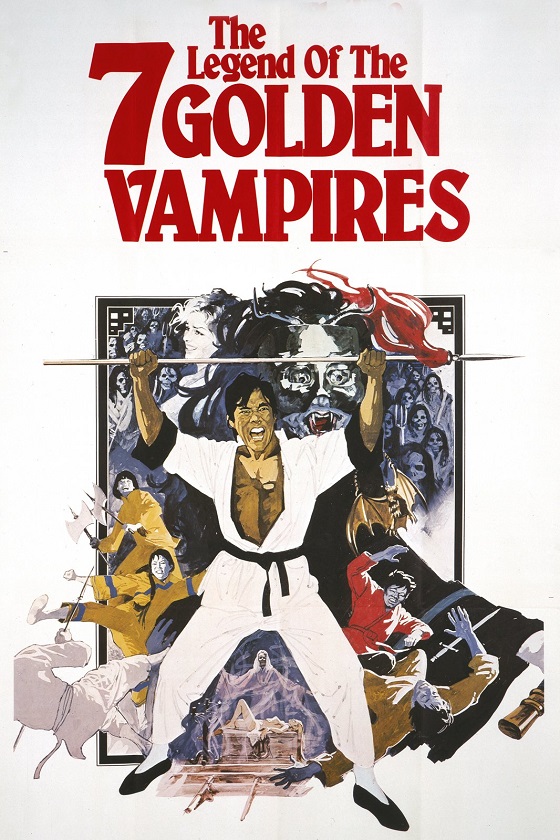
The Legend of The 7 Golden Vampires (1974)


In 1804, a wicked Chinese priest, Kah (Chan Sen), makes his way to Transylvania to ask Count Dracula (John Forbes-Robertson) to resurrect the "seven golden vampires" that Kah had previously employed to keep local peasants in order back home.

Dracula, however, has other ideas and steals Kah's physical form so that he can relocate to China and get back into the bloodsucking business for himself.

A century later and Professor Van Helsing (Peter Cushing) is lecturing at China's Chungking University on the dangers of vampires, while also seeking aid and co-operation to investigate local legends of the undead.

He is met with derision from all but one of his audience, Hsi Ching (David Chiang), whose village has been almost destroyed by attacks from The Seven Golden Vampires.

Meanwhile, Van Helsing's son, Leyland (Robin Stewart), has befriended the forthright, wealthy and attractive European widow Vanessa Buren (Julie Ege), who has caught the eye of a local tong boss.

Vanessa agrees to finance Val Helsing's expedition to the isolated village, on the condition that she can join the party, and Ching introduces his seven kung-fu trained siblings who will provide protection on the journey.

Soon after setting out, the group is ambushed by tong thugs and Van Helsing gets his first taste of Chinese martial arts.

Later on, they make camp in a cave and find themselves under attack from several of the gold mask-adorned vampires and an army of skipping zombies.

From there, the next stop for our heroes is their besieged village, where they organise the remaining villagers into a defensive force and await the assault of the vampires and their legion of the undead.

One of the vampires kidnaps Leyland's girlfriend, Ching's sister Mai Kwei (Shih Szu), leading the surviving heroes to pursue him to Kah's temple, where Van Helsing discovers that Kah is actually his archenemy: Count Dracula.

After this final conflict, like a good many films of its era, the movie abruptly ends without showing any interest in exploring the high cost our heroes had to pay to get through the climactic confrontation between good and evil.

A joint production of Hammer Films and The Shaw Brothers, The Legend of The 7 Golden Vampires is surprisingly good for what it is, but could have been so much better.

From the moment they are introduced, the protagonists are stuck on a narrative railroad, travelling from point A to point B on a linear journey, broken up by impressive fight scenes... and culminating in a massive fight scene.

You get the impression that the Hammer crew were so delighted to be able to blend their tried-and-tested horror formula with Chinese martial arts that they couldn't really think of anything else to do with their Chinese cast or exotic scenery (it was shot on location).

While there's no denying the film is a lot of fun, there is so little to actual story that beyond its martial arts "gimmick" it is largely ephemeral. 

The golden vampires aren't even the classic Chinese jiangshi ('hopping vampires'), which would have brought something a bit unusual to a '70s Hammer flick, but are instead a strange mix of Western vampires and Eastern martial artists.

It also pays not to think too hard about the 100 year time jump from the prologue to the main story and the havoc that plays with Van Helsing's timeline if he's coming off the back of his (many) fights with Dracula in, and around, Transylvania.

Are we supposed to assume that Dracula was doing all this - and dying frequently - at the same time he was in China running The Cult of The Seven Golden Vampires?

Or is this a different Dracula? 

Although he is reduced to a largely supporting role, John Forbes-Robertson's take on Count Dracula is oddly camp, with his make-up bearing a more than passing resemblance to Cesar Romero's Joker in the Adam West Batman show.

Long out of print and pretty rare in these parts, I watched the 86 minute DVD version of The Legend of The 7 Golden Vampires, having finally tracked it down on eBay for a reasonable price, but I understand there's a 110 minute Eastern version that I'd love to see one day.

Ultimately, The Legend of The 7 Golden Vampires comes across as a massive missed opportunity.
My pop culture Odyssey: a slice of super-powered geek life with heavy emphasis on pulp adventure, horror, comic books, westerns, superheroes, sci-fi, giant monsters, zombies etc