Showing posts with label Dracula. Show all posts

Saturday, February 7, 2026

The Unsettling Nature of Quatermass


I have three movies I call my "comfort films" that I will try and watch whenever I see them listed on the TV schedules or can turn to (via blu-rays, dvd, or streaming) whenever I'm feeling a bit down and need an escape hatch.

These are Raiders of The Lost Ark, George Pal's The Time Machine, and Quatermass and The Pit.

To me, these are perfect, review-proof works of genius that I can never tire of watching, all with deeper meanings and impacts on my life than what is shown on screen.

Today, we're thinking about the "adventures" of Professor Bernard Quatermass.

My first exposure to the world of Quatermass was the apocalyptic 1979 sci-fi thriller series known simply as Quatermass.

This bleak, four-part miniseries had a major impact on its 13-year-old viewer when first screened; implanting in me a fascination not just for adventure stories set amongst urban decay but the heroic futility of standing up to alien creatures of unimaginable power and destructive capabilities.

I am sure there is some synchronicity between my first viewing of this televisual tale and my discovery - not long afterwards - and immediate love for, the works of HP Lovecraft.

From Cthulhu to Galactus, all these cosmic entities can trace their influence on me back to watching Quatermass on ITV in the late 70s.

So inspired by this series was I that I also clearly remember creating (but never playing) a Quatermass role-playing game system and, once we started playing the comic book RPG Villains & Vigilantes, I named an alien race after the "enemy" in Quatermass - The Harvesters... although they were nowhere near as powerful as that entity!

Set at the end of the 20th Century (the future when this was made), Quatermass sees the return to London of Bernard Quatermass (Sir John Mills), founder of the British Rocket Group which pioneered space travel in the UK (see The Quatermass Experiment of 1953 and its cinematic remake).

He's been living in seclusion in Scotland and is unaware of the anarchy spreading through England, with gangs roaming the streets, power cuts and the general collapse of society. He is looking for his runaway granddaughter and instead meets up with a fellow scientist (Simon MacCorkindale).

Also roaming the land are a group known as The Planet People - hippies who gather at stone circles, prophesying a mass transmigration of those who "believe" to a Utopian alien planet.

Then the beams of light start coming from the sky, hitting the places where people have gathered and seemingly disintegrating them; although the Planet People believe they have been "taken to The Planet".

Seen now Quatermass can seem slightly melodramatic in places, but it can still deliver an incredible impact with its portrayal of a very British Apocalypse, complete with polite graffiti, a plate of sandwiches and a thermos of tea.

It faces themes of science versus belief, youthful enthusiasm versus the experience of age and the human spirit's unwavering strength in the face of overwhelming odds.

If HP Lovecraft were alive in the 1970s, this is exactly what he would have been writing - man as an insignificant speck in the Universe, caught up in events way beyond his understanding and ability to comprehend.

Don't expect answers, explanations or convenient happy endings - there is no Deus Ex Machina in the world of Bernard Quatermass... it is that God In The Machine that is "harvesting" the human race!

Originally created by writer Nigel Kneale (who also penned The Stone Tape) in the paranoia-fuelled 1950s, Quatermass - an intellectual professor defending the Earth from extraterrestrial threats through the use of brains rather than brawn - is an obvious precursor of The Doctor (who shares many of the same traits and convictions, despite being an alien himself).

Kneale wrote three original Quatermass serials for television: The Quatermass Experiment (an astronaut returning to Earth unknowingly carrying an alien creature which is continually mutating); Quartermass II (aliens take over a research plant on the South Coast); and Quatermass And The Pit (workmen in London unearth an old, crashed spaceship and release 'psychic ghosts').

I discovered all three of these stories through Arrow's script books, published in the late '70s, almost certainly released to cash in on Quatermass.

Later would come the radio series The Quatermass Memoirs, first broadcast as part of a season about 'The Fifties' on Radio 3 in 1996, and while some of the old news clips are a bit scratchy, the whole drama-documentary is an informative, inspirational and terrifying reflection of a time when the world was gripped by fear of nuclear holocaust.

It is a five-part documentary about the origins of the character, intercut with genuine 1950s news broadcasts, exerpts from the original serials, recollections and anecdotes from Nigel Kneale and an original mini-play by Kneale, set in the 1970s, wherein Bernard Quatermass, having retired to the wilds of Scotland (as mentioned at the start of Quatermass), discusses his life with a young journalist.


Long before Space:1999, UFO, Thunderbirds and even Doctor Who, there was ... Quatermass.

Throughout most of the 1950s, Quatermass was a British science fiction institution which appeared both on TV and in the cinema. Yet perhaps more importantly, it was the first adult based, dramatic science fiction television show in the world.

Now, over 70 years later, Quatermass not only lives on through its devoted fan base, but is a name which continues to resonate with science fiction fans both young and old.

In this special retrospective study, we look back upon the history of this highly celebrated franchise, whilst not only addressing the positive aspects the series brought to the science fiction genre but also the many challenges it faced in doing so.

Thursday, December 18, 2025

Ready for Another Dracula?

When a 15th Century prince’s wife is brutally murdered, he renounces God and damns heaven itself.
Cursed with eternal life, he is reborn as Dracula – an immortal warlord who defies fate in a blood-soaked crusade to wrench his lost love back from death.
Directed by Luc Besson, with release date of February 6, this iteration of the undying Dracula saga appears to take as much inspiration from Francis Ford Coppola’s 1992 Bram Stoker's Dracula as from Bram Stoker's original 1897 novel.

Do we need another take on this tale? Let's wait and see, rather than jumping to conclusions.

Given that it's directed by the legendary Luc Besson, if nothing else, this Dracula should be a visual feast.

Thursday, November 27, 2025

The Last Voyage of The Demeter (2023)


If you know Bram Stoker's Dracula, then you know The Last Voyage of The Demeter.

Inspired by the book's single chapter that details the captain's log of the doomed voyage from Bulgaria to England, Bragi Schut Jr. and Zak Olkewicz's script, directed by Trollhunter's André Øvredal, extrapolates those few pages into a near-perfect 119-minute 'spam in a cabin' horror flick.

It's July 1897 and the merchant ship Demeter is carrying cargo bound for London, including - unknowingly - a number of boxes of Transylvanian soil and one holding the sleeping body of the vampire lord, Count Dracula (Javier Botet).

Once the ship is at sea, with the crew eager to get to England quickly to earn some bonus pay, the deaths begin.

First the livestock, which was to be the crew's food for their journey, is mysteriously butchered.

Then the crew start being killed off.

The Last Voyage of The Demeter is Alien on a nautical vessel rather than a space vessel, the ship's small crew trapped at sea, being hunted by a supernatural killing machine that dines on them as they bring him closer to his desired destination: the fresh feeding grounds of Victorian England.

Kong: Skull Island's Corey Hawkins is the new ships doctor, Clemens, a man of science to counter the superstitious crew, headed by the ever-excellent Liam Cunningham (aka Game of Thrones' Davos Seaworth, another sailor of note) as Captain Eliot: an almost unrecognisable David Dastmalchian as Wojchek, the quartermaster; and Jon Jon Briones (the genie from Sinbad; The Fifth Voyage) as Joseph, the highly religious ship's cook.

A young Romani stowaway, Anna (Aisling Franciosi) is found when one of the boxes of soil is accidentally opened by rough seas, and we later realise that she was Dracula's packed lunch for the voyage.

Captain "this is my last voyage, I'm going to retire" Eliot even has his eight-year-old grandson, Toby (Woody Norman), along with him and if you think "oh, they wouldn't hurt a child" you clearly haven't been paying attention.

The fate of the Demeter and its crew is inevitable, a foregone conclusion set down in the text of Stoker's game-changing vampire opus.

But that doesn't stop The Last Voyage of The Demeter being nail-bitingly tense and claustrophobic, with several good jump scares, oozing atmosphere from every frame, and featuring a genuinely monstrous depiction of Dracula.

The vampire is no suave British character actor, instead starting a gaunt, grey ghoul and evolving through the film into a giant, Nosferatuesque bat-creature, unsentimental in its brutal slayings.

What adds to the terror is the realisation - to a modern audience - that these people have no idea what a vampire is or how to kill it, they don't know its powers and weaknesses and there is no spoonfeeding of exposition to give them a clue.

All Clemens learns from Anna is that the beast is Dracula, it drinks blood and has kept her people in servitude through fear of its wrath.

Unfortunately, The Last Voyage of The Demeter falls down in its denouement, at the very last moments when it suddenly decides to try and give the tale a pointless "feel good/Hollywood" ending, when the source material's nihilistic resolution would have had a more lasting impact.

Thursday, November 13, 2025

Captain America (1990)


I'll admit upfront that I have a soft spot for the work of late B-movie director Albert Pyun. Having had a couple of interactions with him in my previous blogging life, he came across as a lovely, genuine person.

Following on from my reviews of the last couple of days, it thus felt like time to revisit Albert's 1990 extravaganza: Captain America, featuring Matt Salinger - son of author JD Salinger - in the titular role.

Despite what you may have heard over the years, this adaptation of one of Marvel Comic's core characters isn't actually too bad. Salinger does a pretty decent job as Steve Rogers and Captain America, the costume doesn't look too silly and the production values give it the feel of Lynda Carter's Wonder Woman.

There are some odd changes to Cap's established mythology, with the most bizarre being the transformation of his legendary Nazi nemesis The Red Skull (Scott Paulin) from a German to an Italian (hand-picked as a youth by Mussolini to take part in the Nazi 'super soldier' programme).

The scientist in charge of the experiment, Dr Maria Vaselli (Carla Cassola), clearly hadn't been reading the memos and is horrified to discover that the first test subject is a young boy and so flees the country.

Seven years later, at the height of the Second World War, Vaselli is working for the American Government on its own super-soldier programme with polio victim Steve Rogers selected as the first candidate.

There's flashing lights and sparking machinery - clearly borrowed from Dr Frankenstein - before a Nazi agent kills the professor.

This is quite familiar territory for Cap fans, with him soon finding himself strapped to a Nazi superbomb heading towards the White House (which he manages to redirect at the last moment, of course) that, instead, crash lands in Alaska.

He is discovered 50 years later and refuses, at first, to believe it's now the '90s - until he meets up again with his hometown sweetheart, Bernice, and - after her death - attaches himself to her daughter, Sharon (Kim Gillingham plays both mother and daughter), who he then proceeds to drag into all kinds of danger.

The President of The United States (Ronny Cox) is kidnapped by a cartel of evil industrialists - led by The Red Skull - who opposes his pro-Green stance (they intend to stick a mind-controlling implant in him!) and Cap heads off to Italy to rescue the President from The Red Skull's castle.

There are some nice touches: such as President Kimball having been a little kid who saw Cap save The White House and was inspired by him, and the fact that The Red Skull (whose accent swings from Mafia Don to Count Dracula) mocks Cap as "his brother" (as they were both created by the same experimental science).

The main flaws with Captain America come from the fact that it looks really dated and while there are some stunts and effects they are nothing spectacular. And the same can be said of the script, by Stephen Tolkin. It's very pedestrian and despite the odd moment of inspiration it really isn't much better than a cheap, Saturday afternoon television movie, peppered - for the most part - with clunky, corny dialogue and enormous plotholes.

It even introduces us to The Red Skull's daughter, but she's a total drip compared to Sin, from the Captain America comics, which was a major disappointment as well.

However, Captain America is only 97-minutes long and while great chunks of logic and believability are sacrificed to keep the pace up, it races through the story like a steam train and carries you along quickly to its blissfully cheesy ending.

Thursday, October 23, 2025

HALLOWEEN HORROR: Countess Dracula (1971)


In 17th Century Hungary, the elderly and recently widowed Countess Elisabeth Nádasdy (Ingrid Pitt) discovers she can temporarily restore her youth and libido by bathing in the blood of young virginal women.

Initially, her secret is only known to her castellan Captain Dobi (Nigel Green, a familiar face from such classics as Zulu and Jason & The Argonauts), who has loved the countess from afar for two decades and sees the death of her husband as making way for him, and her brainwashed nurse, Julie (Patience Collier).

At the reading of her husband's will, the Countess finds herself attracted to a new arrival, Lt. Imre Toth (Sandor Elès, who has an air of Jonathan Rhys Meyers about him), the son of her husband's wartime colleague and heir to the Count's stables and collection of valuable horses.

Unfortunately, the will divides the late Count's estate between the Countess and their daughter, Ilona (Lesley-Anne Down, of North and South, and Dallas), who has yet to arrive back from a stay of many years in Vienna.

Thus, the Countess instructs Dobi to kidnap Ilona on her return to the area, and she is bundled off as a prisoner of mute woodsman Janco (Peter May), who's not the sharpest tool in the box but still manages to thwart her multiple escape attempts.

In the absence of the real Ilona, the de-aged Countess assumes the role of her daughter and seduces cavalry officer Toth.

However, because her dark magic never lasts longer than about 48 hours, the Countess finds herself switching between the 'characters' she plays in the castle, while also charging Dobi with finding her fresh victims.

The wise old librarian Grand Master Fabio (Maurice Denham) quickly becomes suspicious and starts to investigate the goings-on in the castle, but this comes at a cost.  

However, his downfall opens the eyes of Toth, just as the castle is forced into "lockdown" by the Chief Bailiff, Captain Balogh (Peter Jeffrey), who concludes that the person responsible for the recent spate of murders could be among the Countess's staff.

Blackmailed into staying, Toth is forced to go through with the planned wedding to the fake Ilona, but the Countess needs another bath of blood to maintain her looks and energy for the honeymoon.

With no visitors coming to the castle, the jealous Dobi has to retrieve a virgin for exsanguination so his unrequited love can find some kind of happiness with a younger man.

Guess who he brings back?

A solid, if ultimately unremarkable, slice of Hammer Horror fare, with music from Harry Robertson of Hawk The Slayer fame, this is a creative compression of the legend of the real Hungarian Countess Elizabeth Báthory, a real 16th Century serial killer said to have bathed in the blood of her victims.

Of course, the Countess isn't a classic cinematic vampire - there are no fangs on display, and she doesn't drink the blood, but rather uses it as skin cream - so the title Countess Dracula (shoehorned into the dialogue right at the last moment) is a slight misnomer. 

Mainly enjoyable for the charms of Ingrid Pitt, the film certainly improves the closer it gets to its climax, but to modern eyes one can't help thinking that with some judicious trimming of the fat this could have made a really good hour-long shocker.

I went into Countess Dracula pretty certain I'd seen it before, but as the tale unfolded, the more convinced I became that it was actually 'new' to me and I'd simply conflated it with the many other 'boobs and blood' vampire films I've sought out over the years.

Tuesday, September 23, 2025

The Return of Dracula (1958)


Evading the European police, Count Dracula (Francis Lederer) kills Czech artist Bellac Gordal who is on his way to America to stay with his extended family.

Dracula assumes the artist's identity and turns up in the small, whitebread community of Carleton, California, to be met by Bellac's widowed cousin Cora Mayberry (Greta Granstedt), and her children, aspiring dress designer Rachel (Norma Eberhardt) and young Mickey (Jimmy Baird).

Their neighbour Rachel's boyfriend, the ill-mannered Tim (Ray Stricklyn), is also at the station to greet Bellac, and takes an instant to dislike to the charming European visitor.

You know with a manly heroic name like that, Tim's going to be Rachel's knight in shining armour, right?

Tim and Rachel... need I say more?

After he is moved into their spare room, the Mayberry's quickly learn that their European cousin is quite eccentric, keeping to himself, sleeping in, slipping out of the house unnoticed etc

When Mickey discovers his "beloved" kitten Nugget mutilated in an abandoned mineshaft in the hills, it becomes clear that Dracula is here to feed!

However, I'm not exactly sure how we're supposed to feel about the tearful Mickey at this point because he'd seen earlier that Nugget had fallen into a spike-filled pit trap in the mine... and just left him there, promising to come back the next day.

He did try to go back that evening, but was told it was getting too dark to be playing in an abandoned mineshaft. He never mentioned to anyone that that's where he'd seen Nugget!

So, I reckon Mickey is just as guilty as Dracula for the fate of his cat.

Bellac learns of a sickly blind girl, Jennie Blake (Virginia Vincent), that Rachel has been reading to at the parish house, where she helps out.

So Dracula pays Jennie a midnight call and gives her his trademark love bite.

The next day, Jennie is at death's door, and asking for Rachel.

Jennie just manages to rasp out a vague warning before dying.

Around the time of Jennie's funeral, the European police show up, initially in the form of private detective Mack Bryant (Charles Tannen), posing as an agent of the Department of Immigration.

He "wants to check Bellac's immigration paperwork" and manages to snap a sneaky picture of the Undercover Count with a spy-camera in his cigarette lighter.

Outside, he hands-off the film to professional Dracula hunter John Merriman (John Wengraf).

But Bryant's days are numbered. Heading to the train station, to wait for a train out of this kooky place, Bryant spots the supposedly dead Jennie on the other side of the railway tracks.

Lured over there, he is killed by a white German Shepherd dog (was this Dracula... or even Jennie, transformed into a killer dog?).

Undercover Dracula aka Cousin Bellac

Rachel is getting worried about Bellac, after having a nightmare in which he tried to hypnotise her into removing her crucifix (which she got from Jennie).

Then, while trying to find her cousin to convince him to come to a Halloween party at the parish house, she discovers a painting in his room, depicting her lying in a coffin. Why? Who knows, really?

Rachel telephones Tim, but is surprised by Bellac ... because he casts no reflection in the hall mirror and she didn't see him sneaking up behind her.

Tim turns up and whisks a slightly befuddled Rachel away to the Halloween party.

Meanwhile, in the graveyard, Merriman, a couple of random police officers, and local vicar Rev Dr Whitfield (Gage Clarke), discover that Jennie's coffin is empty, so wait for her return (I'm trying to resist using the term "stakeout", for reasons...).

She returns, they paralyse her in her coffin by placing a cross on her chest, there's a bit of a debate over whether she was actually buried alive, then Merriman drives an enormous stake through her heart.

Meanwhile, Rachel slips away from the Halloween party - before the winner of the costume contest is announced - and Tim follows her out to the abandoned mineshaft, where Dracula has set up camp.

Dracula tries to hypnotise Rachel into becoming his bride, but the staking of Jennie makes him weak at the knees and so Tim heroically (well, with a bit of effort) uses Rachel's crucifix to drive Dracula back into the spikey pit (see, foreshadowing!)

With a running time of 77-minutes, The Return of Dracula aka The Fantastic Disappearing Man is the very definition of a B-movie.

Clearly an unofficial sequel to both Bram Stoker's original book and Universal's Dracula franchise, it's not great (but also it's not that bad either), but it vanished from the public consciousness once Hammer's Horror of Dracula aka Dracula was released later the same year, and the iconic Christopher Lee became synonymous with The Count.

It's kind of a shame really because, despite the complete absence of any special effects, beyond the odd cloud of mist when a vampire manifests, Francis Lederer is quite a charismatic Dracula.

While fangless, he compensates with his Teddy Boy quiff.

As this was made in the 1950s, during The Cold War, there's a strong "beware outsiders" vibe to this piece, with All-American, rough-and-ready, Tim's instant distrust of the suave "foreigner" being proven right in the end.

The script, by Pat Fielder and directed by Paul Landres, is paper-thin, but still manages to wander all over the place, with the two - almost simultaneous - climatic showdowns happening with no established correlation, beyond Dracula's reaction to Jennie being staked miles away.

There was an odd moment in this black and white film, when Jennie was staked, a short, colour, shot of bright red blood bubbling up from an impaled corpse had been spliced into the action.

Checking IMDB, this was a deliberate tactic for the theatrical release of the movie, and was restored for cable TV when it was shown on Turner Classic Movies.

While there, I also learned while Lederer hated this making this film, he reprised the role of Count Dracula in a 1971 episode of Night Gallery, A Question of Fear/The Devil Is Not Mocked.

Had Christopher Lee not swept onto the scene, with his big swooshing cape, there's a possibility (albeit remote) that The Return of Dracula might have had a bigger impact on vampire culture, as - for all its shortcomings - there's a certain simple charm about it.

Saturday, August 30, 2025

Real Life Monster Hunters Are More Hardcore Than Fiction (Monstrum)

How did Van Helsing go from academic in Dracula to action hero icon? This episode explores his evolution from Victorian scholar to monster-hunting legend, unpacking his role in the novel, pop culture legacy, and why he remains the ultimate supernatural slayer.

Wednesday, July 23, 2025

Zoltan, Hound of Dracula (1977)


Pretty certain Zoltan, Hound Of Dracula was the first vampire film I ever saw as a kid, as it was a running joke in our cat-centric house when I was growing up that all "vicious" dogs were called "Zoltan, Hound Of Dracula".

A cheesy B-movie, with a novel central concept, a modicum of gore, and almost zero scares, no one will ever mistake Zoltan, Hound Of Dracula (aka Dracula's Dog) for high art, as ultimately the "idea" is better than the execution.

A unit of Cold War era Soviet soldiers unearth a "Dracula tomb" in Romania, accidentally releasing Zoltan, The Hound Of Dracula, and his handler, Veidt Smit (Reggie Nalder).

Police inspector - and vampire expert - Inspector Branco (José Ferrer) correctly deduces that Smit is heading to America to pledge his allegiance to Dracula's last living relative, psychiatrist Michael Drake (Michael Pataki).

Smit (or 'Smith') and Zoltan arrive in California ahead of Branco, but Drake, his family, and their dogs (two full-grown German Shepherds and three puppies) have already left for a two-week camping vacation at Clear (not Crystal!) Lake.

To be honest, I was horrified that this family took their new-born puppies on a wilderness camping trip. Horror compounded by the fact that one gets lost almost immediately, and eventually falls prey to Zoltan's fangs.

The Hound Of Dracula, and his handler, have followed the Drake family to the wilderness, and begin a campaign of harassment, with the eventual idea (I think) of letting Zoltan bite Michael and turn him into a vampire.

It's all a bit vague really, and I don't truly understand why they don't just storm in there on the first night and turn Michael lickety-split.

By drawing things out, they only allow time for Branco to roll up, from "The Old Country", fill Michael in on what's going on and formulate a defence strategy.

Drake is clearly au fait with his historical heritage as he takes everything that Branco tells him at face value and has no problems accepting the existence of vampires.

Of course, if everyone had listened to Drake's young daughter, Linda (Libby Chase), earlier - after she bumped into Smit and his rather on-the-nose hearse - matters might have been resolved quicker and more easily.

I did like the fact that neither Michael nor Branco actually actually knew about Zoltan until the climax of the final act.

Conversely, I didn't quite grasp Smit's obsession with Michael as the last blood relative of Dracula, when Drake had two kids: Linda and Steve (John Levin). Surely, THEY were Dracula's last descendants? And probably better targets for vampiric transformation?

There's an exciting siege in a wooden hut, when Michael and Branco are attacked by Zoltan and a couple of dogs he's converted to his cause, but otherwise this movie pretty much fails to live up to its potential.

Although everyone gets bloodied and bruised in the final fight, ultimately the good guys win way too easily.

However, the denouement is worthy of a wry chuckle.

Inescapable comparisons with Cujo exist, as this is another "people attacked by blood-hungry canines" yarn, but Zoltan - unsurprisinglypales in comparison.

An ill thought-out story, riddled with plot holes, pretty much sinks Zoltan, Hound Of Dracula, leaving us, simply, with the brilliant idea of the immortal count's pet having a cinematic un-life of its own.

Thursday, June 26, 2025

Never Sleep Again - The Elm Street Legacy (2010)


If you are at all 'into' the Nightmare On Elm Street series of horror films - as I am - then you owe it to yourself to seek out the incredible documentary Never Sleep Again - The Elm Street Legacy.

Although clearly a labour of love, this FOUR HOUR documentary isn't a straight lovefest for the franchise, but a proverbial 'warts-and-all' behind-the-scenes insight into the making of the series, chronicling the highs and lows, the conflicts, the cut corners etc offering an unrivalled insight into the world of low-budget movie making.

Running parallel to the main arc of the documentary is the story of how A Nightmare On Elm Street effectively 'made' New Line Cinema, the company that would eventually bring us Peter Jackson's magnificent Lord Of The Rings trilogy.

Each movie - from the original through to Freddy Vs Jason, and embracing the short-lived TV spin-off, Freddy's Nightmares - gets its own chapter, with a wonderful stop-motion animation bumper, and is packed to bursting point with talking heads of the majority of the main actors and movie crew, unseen footage and photographs etc

Unsurprisingly, Johnny Depp and Patricia Arquette (whose careers began in the franchise) are conspicuous by their absence, as is Peter Jackson (who wrote a draft of one of the later movies), but there are so many other - more than 100 - interesting interviewees with great things to say that you don't really mind (and didn't really expect them anyway).

For instance, I'm far more interested in Wes Craven's opinions of the sequels to his classic original or his insights into the post-modern brilliance of Wes Craven's New Nightmare, and Robert Englund (the one and only Freddy Krueger) is always good value for money.

Of particular interest are the revelations that several of the films were effectively 'made-up-as-they-went-along' as directors and crew raced to hit pre-determined release dates with unfinished scripts - which, I guess, explains the "dream-like" quality of some of the stories!

Narrated by Heather Langenkamp (aka Freddy's nemesis Nancy from the movies), the film also examines Freddy's transformation from child-murdering supervillain into cartoon cultural icon, and various attempts to reclaim the character as a genuine figure of fear.

The two-DVD set includes a disc of extras as fascinating as the main feature covering topics such as the Freddy Krueger comics and novels, hardcore fans (Fred Heads) and a tour of the movie locations used in the original Nightmare On Elm Street.

Insightful and entertaining, Never Sleep Again is the ultimate, definitive insight in to one of the truly iconic figures of horror cinema, who now ranks alongside Dracula, Frankenstein's Monster, The Mummy and The Wolfman in the psyche of horror-loving film fans.

Monday, June 16, 2025

Abraham's Boys: A Dracula Story With A Difference

Max and Rudy Van Helsing have spent their lives under the strict and overprotective rule of their father, Abraham.

Unaware of his dark past, they struggle to understand his paranoia and increasingly erratic behavior. But when they begin to uncover the violent truths behind their father’s history with Dracula, their world unravels, forcing them to confront the terrifying legacy they were never meant to inherit.

Based on the short story by Joe Hill.

Monday, April 14, 2025

Shadow Of The Vampire (2000)


The darkly humourous Shadow Of The Vampire is the perfect companion piece for Nosferatu. Its canny conceit is that the dangerously eccentric and driven director Frederich Wilhelm Murnau (John Malkovich) has made a devilish pact with a real vampire (an almost unrecognisable Willem Dafoe) to play the role of Count Orlok in his film, Nosferatu.

His payment? The chance to feed on the lead actress, Greta Schroeder (Catherine McCormack) during the climax of the movie.

Unfortunately for Murnau, things don't run smoothly as 'Max Schreck' aka Count Orlok starts killing off his crew.

Having been told that the actor 'Max Shreck' is a deep method actor, who always stays in character as the vampire, the cast and crew of Nosfesatu quickly find their location shoot in Czechoslovakia is anything but routine.

Suspicions arise, and producer Albin Grau (Udo Kier) and cinematographer Fritz Arno Wagner (Cary Elwes) conspire to unmask 'Shreck' and end his reign of terror.

Shadow Of The Vampire's (totally bogus) 'secret history' of the making of Nosferatu borders on slapstick with much of its camp delivery.

However, it then manages to slickly change gears for powerful moments such as Orlok's discussion of the inherent sadness of Bram Stoker's portrayal of Dracula (in the novel that Murnau couldn't get permission to officially adapt).

Watching the two films back-to-back allowed me to mentally place the scenes being created for Shadow's movie-within-the-movie in the real movie, but also - especially during the multiple murders in the final scene - to realise where it deviated dramatically from the actual Nosferatu.

As well as an amusing vampire film in its own right, Steven Katz's script - under the guidance of director E. Elias Merhige - gives us a fascinating insight into not only the silent movie making processes of the 1920s but also the lengths an 'inspired' director will go to to craft his masterpiece.

Ultimately Murnau is driven insane by the process and is willing to allow people to literally die, on camera, for his art (even as he is creating the first snuff movie).

Sunday, April 13, 2025

Nosferatu - A Symphony Of Horror (1922)


The first, albeit unofficial, cinematic adaptation of Bram Stoker's Dracula, F.W. Murnau's Nosferatu takes the novel's core elements, gives the characters new names, and delivers a chilling and iconic vampire tale.

Told in five delineated acts, the striking images we know so well come, primarily, from the climax of the movie when Count Orlok (Max Schreck) arrives, by boat, in the German city of Wisborg and stalks the maiden Ellen (Greta Schröder).

She's the wife of real-estate agent Thomas Hutter (Gustav von Wangenheim), who traveled to Transylvania, at the behest of his increasingly insane boss, Knock (Alexander Granach), to negotiate the purchase of a property in the city for the enigmatic Count Orlok... who happens to be a vampire.

Orlok spies a picture of Ellen in a locket of Hutter's and immediately knows where he's dining once he arrives to take up residence in Wisborg.

As a film that's almost a hundred years old, Nosferatu has a very different narrative structure to that which we are used to today. For instance, Hutter - the protagonist - has no involvement in Orlok's eventual demise, this is all down to Ellen, who takes it upon herself to act as bait for the vampire.

Nosferatu is a silent foreign-language film, meaning the intertitles (the cards that appear onscreen, between live-action shots, with dialogue or narrative) are written in German, with English sub-titles.

However, the result of this is that sometimes, when the intertitles contain a lot of text, the sub-titles clash with the text underneath, which is somewhat annoying.

I know the restoration of this movie for the Blu-Ray was striving for authenticity, but perhaps an option to view the film with English intertitles might have been an idea.

The print is tinted, alternating between, mainly, yellow and grey, but as far as I could tell there was no pattern, or meaning, to the changes of colour, it just helped make the film's imagery pop a bit more.

Of course, the main draw of Nosferatu is Max Shreck's incredible portrayal of the vampire count. With a single performance he encapsulated, and created, an entirely new vampire sub-species, with its own mannerisms and abilities that are, at once, similar but markedly different to the traditional (Hammer/Universal era) vampires we generally think of today.

Shreck's Orlok is not charming, suave, or romanticised, but an otherworldly beast that happens to have taken a human form. He is the living embodiment of plague - a theme echoed in The Strain television series (and books and comics), whose vampires bear more than a passing resemblance to Orlok.

Graf Orlok - portrayed by Max Schrek

Saturday, March 1, 2025

PULP PICTURE OF THE MONTH: The Terror of The Tongs (1961)


As I said last month in my review of 1959's The Stranglers of Bombay, Hammer recycled that film's plot for 1961's The Terror of The Tongs, simply relocating the action from 19th Century India to early 20th Century Hong Kong.

After his daughter (Barbara Brown) is slain by Tong gangsters searching for an incriminating list of their key members, British sea captain Jackson Sale (Geoffrey Toone) wages a one-man crusade against the secret organisation, punching his way through Hong Kong's underworld with the subtly and diplomacy of Robert E Howard's Sailor Steve Costigan.

There's no denying that this is an exciting thriller, but even with the appearance of an anti-Tong coalition among the Chinese community (who see Sale as a useful weapon to direct against their foes), the racism on display is inescapable.

In his first headlining role for Hammer, Christopher Lee - as Red Dragon Tong leader Chung King - gets to test-drive the problematic "Chinese" make-up he would later make famous in the Fu Manchu series of movies.

There are plenty of Asian actors in the large cast, although primarily as extras, but the bulk of the key Chinese roles have gone to Western performers in "yellow-face".

The death of Sale's daughter, Helena, is also pretty much the text book definition of "fridging" as she turns up purely to be killed off in the next scene and give Jackson his motivation for wanting to bring down the Tongs.

He channels his grief through his fists, and while occasionally Sale uses his wits, his main investigative tool is violence.

Coming in at just over an hour and a quarter running time, there's no hanging around in The Terror of The Tongs, so when Sale rescues the gorgeous half-Chinese/half-French Lee (the charismatic Yvonne Monlaur, probably best known for her lead role in The Brides of Dracula) random romance is clearly on the cards.

However (slight spoilers for a 60-year-old film), her ultimate character arc was both unexpected and slightly gratuitous. 

Not only does The Terror of The Tongs reuse the plot of The Stranglers of Bombay, but Doctor Who's Roger Delgado is also back, this time as Chung King's number two, essentially the same role he played in the earlier movie.

Shot in vibrant colour, in contrast to the crisp black and white footage of The StranglersThe Terror of The Tongs is also available as part of Powerhouse's high-end Indicator range of Blu-Rays.

The use of colour means director Anthony Bushell is able to splash around plenty of bright, red blood, but the most horrific scene - a sequence where Sale falls into the hands of Chung King and is ritually tortured - is so well framed that it made me squirm without actually showing any graphic details of the "bone-scraping" needles that were being used.

A two-fisted pulp adventure, with unfortunate casual racism throughout, the central story of The Terror of The Tongs remains engaging (if simplistic), providing you can acknowledge the uncomfortable casting decisions of the time when it was shot.

Friday, February 14, 2025

TALES FROM MY SPINNER RACK: Marvel Romance Comics of the late ‘60s!

Tales From My Spinner Rack! returns with Episode 16, a special Valentine’s Day episode featuring a look back at Marvel’s Romance titles from the late 1960s, titled “What’s Love Got to Do With It?

At the end of the Silver Age, Marvel had a brand new distributor who didn’t care how many books it put out each month. Stan Lee and company introduced two new horror/mystery titles with Tower of Shadows and Chamber of Darkness and two new romance titles, My Love and Our Love Story, in the summer of 1969. All but forgotten today, these romance titles featured incredible art by the likes of John Romita, John Buscema, Gene Colan, and even Jim Steranko on one memorable story, My Heart Broke in Hollywood!. And all the stories were written by - or “as told to” - Stan Lee!

Tales From My Spinner Rack Episode 16 takes an in-depth look at some of these issues featuring new romance stories by some of Marvel’s greatest artists of the Silver Age. Even if romance comics aren’t your thing, you’ll want to see this artwork-filled new episode, which also features a look back at the surprising origin of the genre.

Visit www.innocent-bystander.com for over 35 Tales From My Spinner Rack! posts featuring nostalgic essays loaded with art and info about the comics I loved growing up in the 1960s and ‘70s!

Please like, comment, subscribe, and turn on notifications for more Tales From My Spinner Rack! videos here on YouTube!
Thanks to Gary Sassaman for this fascinating deep dive, part of his excellent on-going series of comic book history documentary features.

Wednesday, January 29, 2025

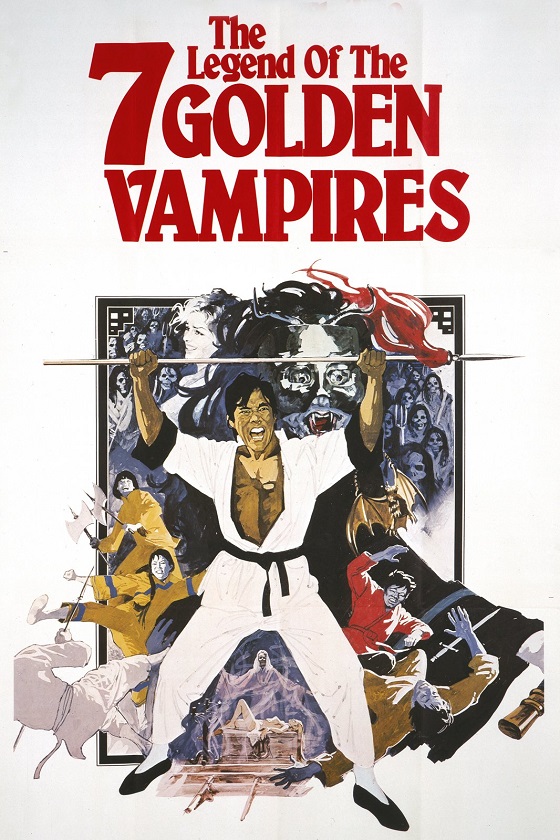
The Legend of The 7 Golden Vampires (1974)


In 1804, a wicked Chinese priest, Kah (Chan Sen), makes his way to Transylvania to ask Count Dracula (John Forbes-Robertson) to resurrect the "seven golden vampires" that Kah had previously employed to keep local peasants in order back home.

Dracula, however, has other ideas and steals Kah's physical form so that he can relocate to China and get back into the bloodsucking business for himself.

A century later and Professor Van Helsing (Peter Cushing) is lecturing at China's Chungking University on the dangers of vampires, while also seeking aid and co-operation to investigate local legends of the undead.

He is met with derision from all but one of his audience, Hsi Ching (David Chiang), whose village has been almost destroyed by attacks from The Seven Golden Vampires.

Meanwhile, Van Helsing's son, Leyland (Robin Stewart), has befriended the forthright, wealthy and attractive European widow Vanessa Buren (Julie Ege), who has caught the eye of a local tong boss.

Vanessa agrees to finance Val Helsing's expedition to the isolated village, on the condition that she can join the party, and Ching introduces his seven kung-fu trained siblings who will provide protection on the journey.

Soon after setting out, the group is ambushed by tong thugs and Van Helsing gets his first taste of Chinese martial arts.

Later on, they make camp in a cave and find themselves under attack from several of the gold mask-adorned vampires and an army of skipping zombies.

From there, the next stop for our heroes is their besieged village, where they organise the remaining villagers into a defensive force and await the assault of the vampires and their legion of the undead.

One of the vampires kidnaps Leyland's girlfriend, Ching's sister Mai Kwei (Shih Szu), leading the surviving heroes to pursue him to Kah's temple, where Van Helsing discovers that Kah is actually his archenemy: Count Dracula.

After this final conflict, like a good many films of its era, the movie abruptly ends without showing any interest in exploring the high cost our heroes had to pay to get through the climactic confrontation between good and evil.

A joint production of Hammer Films and The Shaw Brothers, The Legend of The 7 Golden Vampires is surprisingly good for what it is, but could have been so much better.

From the moment they are introduced, the protagonists are stuck on a narrative railroad, travelling from point A to point B on a linear journey, broken up by impressive fight scenes... and culminating in a massive fight scene.

You get the impression that the Hammer crew were so delighted to be able to blend their tried-and-tested horror formula with Chinese martial arts that they couldn't really think of anything else to do with their Chinese cast or exotic scenery (it was shot on location).

While there's no denying the film is a lot of fun, there is so little to actual story that beyond its martial arts "gimmick" it is largely ephemeral. 

The golden vampires aren't even the classic Chinese jiangshi ('hopping vampires'), which would have brought something a bit unusual to a '70s Hammer flick, but are instead a strange mix of Western vampires and Eastern martial artists.

It also pays not to think too hard about the 100 year time jump from the prologue to the main story and the havoc that plays with Van Helsing's timeline if he's coming off the back of his (many) fights with Dracula in, and around, Transylvania.

Are we supposed to assume that Dracula was doing all this - and dying frequently - at the same time he was in China running The Cult of The Seven Golden Vampires?

Or is this a different Dracula? 

Although he is reduced to a largely supporting role, John Forbes-Robertson's take on Count Dracula is oddly camp, with his make-up bearing a more than passing resemblance to Cesar Romero's Joker in the Adam West Batman show.

Long out of print and pretty rare in these parts, I watched the 86 minute DVD version of The Legend of The 7 Golden Vampires, having finally tracked it down on eBay for a reasonable price, but I understand there's a 110 minute Eastern version that I'd love to see one day.

Ultimately, The Legend of The 7 Golden Vampires comes across as a massive missed opportunity.
My pop culture Odyssey: a slice of super-powered geek life with heavy emphasis on pulp adventure, superheroes, comic books, westerns, horror, sci-fi, giant monsters, zombies etc