Showing posts with label quatermass. Show all posts

Saturday, February 7, 2026

The Unsettling Nature of Quatermass


I have three movies I call my "comfort films" that I will try and watch whenever I see them listed on the TV schedules or can turn to (via blu-rays, dvd, or streaming) whenever I'm feeling a bit down and need an escape hatch.

These are Raiders of The Lost Ark, George Pal's The Time Machine, and Quatermass and The Pit.

To me, these are perfect, review-proof works of genius that I can never tire of watching, all with deeper meanings and impacts on my life than what is shown on screen.

Today, we're thinking about the "adventures" of Professor Bernard Quatermass.

My first exposure to the world of Quatermass was the apocalyptic 1979 sci-fi thriller series known simply as Quatermass.

This bleak, four-part miniseries had a major impact on its 13-year-old viewer when first screened; implanting in me a fascination not just for adventure stories set amongst urban decay but the heroic futility of standing up to alien creatures of unimaginable power and destructive capabilities.

I am sure there is some synchronicity between my first viewing of this televisual tale and my discovery - not long afterwards - and immediate love for, the works of HP Lovecraft.

From Cthulhu to Galactus, all these cosmic entities can trace their influence on me back to watching Quatermass on ITV in the late 70s.

So inspired by this series was I that I also clearly remember creating (but never playing) a Quatermass role-playing game system and, once we started playing the comic book RPG Villains & Vigilantes, I named an alien race after the "enemy" in Quatermass - The Harvesters... although they were nowhere near as powerful as that entity!

Set at the end of the 20th Century (the future when this was made), Quatermass sees the return to London of Bernard Quatermass (Sir John Mills), founder of the British Rocket Group which pioneered space travel in the UK (see The Quatermass Experiment of 1953 and its cinematic remake).

He's been living in seclusion in Scotland and is unaware of the anarchy spreading through England, with gangs roaming the streets, power cuts and the general collapse of society. He is looking for his runaway granddaughter and instead meets up with a fellow scientist (Simon MacCorkindale).

Also roaming the land are a group known as The Planet People - hippies who gather at stone circles, prophesying a mass transmigration of those who "believe" to a Utopian alien planet.

Then the beams of light start coming from the sky, hitting the places where people have gathered and seemingly disintegrating them; although the Planet People believe they have been "taken to The Planet".

Seen now Quatermass can seem slightly melodramatic in places, but it can still deliver an incredible impact with its portrayal of a very British Apocalypse, complete with polite graffiti, a plate of sandwiches and a thermos of tea.

It faces themes of science versus belief, youthful enthusiasm versus the experience of age and the human spirit's unwavering strength in the face of overwhelming odds.

If HP Lovecraft were alive in the 1970s, this is exactly what he would have been writing - man as an insignificant speck in the Universe, caught up in events way beyond his understanding and ability to comprehend.

Don't expect answers, explanations or convenient happy endings - there is no Deus Ex Machina in the world of Bernard Quatermass... it is that God In The Machine that is "harvesting" the human race!

Originally created by writer Nigel Kneale (who also penned The Stone Tape) in the paranoia-fuelled 1950s, Quatermass - an intellectual professor defending the Earth from extraterrestrial threats through the use of brains rather than brawn - is an obvious precursor of The Doctor (who shares many of the same traits and convictions, despite being an alien himself).

Kneale wrote three original Quatermass serials for television: The Quatermass Experiment (an astronaut returning to Earth unknowingly carrying an alien creature which is continually mutating); Quartermass II (aliens take over a research plant on the South Coast); and Quatermass And The Pit (workmen in London unearth an old, crashed spaceship and release 'psychic ghosts').

I discovered all three of these stories through Arrow's script books, published in the late '70s, almost certainly released to cash in on Quatermass.

Later would come the radio series The Quatermass Memoirs, first broadcast as part of a season about 'The Fifties' on Radio 3 in 1996, and while some of the old news clips are a bit scratchy, the whole drama-documentary is an informative, inspirational and terrifying reflection of a time when the world was gripped by fear of nuclear holocaust.

It is a five-part documentary about the origins of the character, intercut with genuine 1950s news broadcasts, exerpts from the original serials, recollections and anecdotes from Nigel Kneale and an original mini-play by Kneale, set in the 1970s, wherein Bernard Quatermass, having retired to the wilds of Scotland (as mentioned at the start of Quatermass), discusses his life with a young journalist.


Long before Space:1999, UFO, Thunderbirds and even Doctor Who, there was ... Quatermass.

Throughout most of the 1950s, Quatermass was a British science fiction institution which appeared both on TV and in the cinema. Yet perhaps more importantly, it was the first adult based, dramatic science fiction television show in the world.

Now, over 70 years later, Quatermass not only lives on through its devoted fan base, but is a name which continues to resonate with science fiction fans both young and old.

In this special retrospective study, we look back upon the history of this highly celebrated franchise, whilst not only addressing the positive aspects the series brought to the science fiction genre but also the many challenges it faced in doing so.

Saturday, January 24, 2026

The Trollenberg Terror (1958)

In a small Swiss village near Trollenberg Mountain, a series of climbers are found decapitated. Alan Brooks, a UN investigator, is sent to the area to look into unusual radiation levels, and he helps with the investigation. While investigating he meets Anne Pilgrim, a psychic who experiences visions of the deaths and is drawn to the mountain.
Thank you to Film Masters
for making The Trollenberg Terror aka The Crawling Eye available online.

Part Quatermass, part The Thing From Another World and based on a 1956 ITV Saturday Serial  television programme, The Trollenberg Terror (or The Crawling Eye) by the legendary Hammer horror writer Jimmy Sangster, is the story of scientist Alan Brooks (Forrest Tucker) summoned to the Swiss Alps to investigate some mysterious goings-on.

On the way, he meets up with the Pilgrim Sisters, Sarah (Jennifer Jayne) and Anne (Janet Munro), a theatrical mind-reading act, heading to Geneva. Only Anne is actually truly psychic and feels compelled to disembark at the same train station as Brooks... that is, Trollenberg, where there have been a number of unexplained climbing accidents.

Visiting the mountainside observatory, Brooks is also informed of an unnatural cloud that has been hanging around the mountain and giving off radiation. This reminds him - and the observatory's Professor Crevett (Warren Mitchell) - of a similar mysterious incident they investigated in the Andes and that Crevett had attributed to extraterrestrials.

In the meantime, Anne has received a physic summons to the mountain and after she is prevented from going, a climber - presumed missing - returns from the mountain and attempts to kill her.

The Trollenberg Terror is a pot-boiler, slowly building to its dramatic climax (perhaps too slowly for modern audiences), when the true face of the monster on the mountain shows itself out of the fog.

Before that though we get a couple of decapitations and a surprising "head in a rucksack" shot that I wasn't expecting.

As well as playing out like a high-altitude reworking of The Thing, withholding the big reveal until the final act adds a layer of Lovecraftian paranoia to The Trollenberg Terror as well.

The film doesn't so much create a sense of tension as one of scientific enquiry, a desire to know what's going on and, as long as you love giant monsters, then you're not going to be disappointed by this atmospheric slice of '50s schlock horror.

    Saturday, November 29, 2025

    A Celebration of "Underrated" British Science Fiction Cinema

    British sci-fi has always felt different: quieter, stranger, and often more human.In this video, we’re looking at some of the most fascinating and underrated British science fiction films from different decades — movies that deserve far more attention and, in many ways, outshine Hollywood’s biggest productions.

    Friday, November 28, 2025

    Black Friday! (2021)


    It's the dreaded Black Friday at We Love Toys and the work force are not looking forward to the hordes of shoppers about to pour in, seeking those "once in a lifetime" bargains.

    However, what makes matters worse this year is a meteor shower bringing an alien virus that turns the infected into hideous, angry, monsters seeking to both 'spread the love' and construct a 'nest' for each of the initial meteors to achieve their "final form".

    Black Friday! is a fun blend of rage zombie horror, Lovecraftian alien invasion, kaiju action, The BlobClerks, and old Quatermass movies.

    Leaning into its weird fiction inspirations not everything mentioned in the story is explained, adding to the occasionally unnerving strangeness of what the extra-terrestrial entities are up to and what their ultimate objective may be.

    There's plenty of body horror in Black Friday!, with the practical make-up effects on the transformed infected being particularly striking as they evolve into piranha-toothed ghouls, oddly reminiscent of the beast in The Unnameable duology 

    Written by Andy Greskoviak and directed by Casey Tebo, the 84-minute flick is a runaway train that doesn't hang around, getting to the meat of its set-up almost immediately and not wasting any time establishing deep backstories for the central characters (these are filled in during the unfolding chaos).

    While the film is a satire of corporate America, it is  primarily an apocalyptic splatterfest romp that doesn't take itself at all seriously.

    If you're looking for a "people trapped in a store during the end of the world" film, but aren't in the mood for the heart-breaking buzzkill of The Mist, then you could do worse than check out the more light-hearted Black Friday!

    Bruce Campbell is in there as the store manager, playing a bigger role than I expected but still a supporting character, while the leads are Final Destination/Chucky's Devon Sawa, Super 8's Ryan Lee, and Pan's Labyrinth's Ivana Baquero, as three undervalued workers in the soulless toy store.

    Other familiar faces that pop up include Michael Jai White, while Seth Green provides the voice of a malfunctioning animatronic bear (who might just be a parody of Ted).

    Friday, August 15, 2025

    In The Earth (2021)

    Why, oh why, do I keep doing this to myself? After the pretentious nonsense of 2013's A Field In England, I thought I was done with the oeuvre of auteur Ben Wheatley... but then I saw that he had made a new rural horror film that the trailers managed to make look quite intriguing.

    While the world is consumed by the latest pandemic, scientist and city boy Martin Lowery (Game of Thrones' Joel Fry) and park ranger Alma (Ellora Torchia) head into a quarantined area of forest outside of Bristol to deliver equipment to researcher Olivia Wendle (Hayley Squires), who has set up camp deep in the woods.

    During their second night of camping on the long journey through difficult terrain, Alma and Martin are attacked in their sleep, their radio is destroyed, and their shoes are stolen.

    The following day Martin cuts his foot badly while continuing on barefoot, but they soon run into an apparent homeless man, Zach (The League of Gentleman's Reece Shearsmith) who takes them to his camp.

    Very quickly it becomes clear that Zach is up to no good, and is actually trying to make contact with a woodland entity - Parnag Fegg - through symbolism and sacrifice.

    Eventually, our protagonists escape his clutches and stumble into Wendle's encampment, only to realise that the scientist is as barmy as Zach.

    While, he was using ritual, she using science, but heavily influenced by an old, occult tome that mentions the nearby standing stone around which all this weirdness seems to revolve.

    As with A Field in England, In The Earth is largely a pompous, po-faced, mess of style over substance, but peppered with moments of pseudo torture porn and squirm-inducing injury detail, almost entirely inflicted on Martin.

    For some reason, this film is allowed to run for 107 minutes, and, boy, does it feel it. When Wheatley isn't bombarding our senses with strobe lighting or flickering subliminal images (which I wouldn't object to if I felt they had some meaning), he's allowing his antagonists to monologue incessantly. 

    I guess the writer-director believes he has an ear for dialogue, but more often than not it comes across as peculiarly mannered and stilted, akin to a poor student film.

    Echoing 2018's Annihilation, the underlying story of In The Earth suggests that nature is 'fighting back' against mankind (and is possibly responsible for creating the unspecified plague affecting the globe... but I might be giving the plot too much credit there).

    Both Zach and Olivia are taking different paths to opening a dialogue with an anthropomorphic avatar of nature, the mycrrhizal mat, a network connecting all the plant life in the area, to, essentially, negotiate a peace treaty.

    And this core idea is interesting and worthy of investigation, but In The Earth doesn't do it justice.

    I'm of an age where I don't need everything explained in a horror movie to get that its conceit is frightening, as long as there is the suggestion of an intelligent design behind it all.

    However, Wheatley's "throw everything at the wall and see what sticks" approach actually undermines the uneasiness of the scenario.

    There was a moment, in the final act, when Olivia was fine tuning her son et lumière communication devices, that I thought this drivel was about to be salvaged by some Quatermass-level fringe science, but sadly the plot opted to devolve into a psychedelic, early Pink Floyd music video (but without the great tunes).

    What should have been terrifying was simply annoying.

    Clearly Wheatley has enough fans that he can continue to gain funding for these arthouse horror projects, but I definitely don't count myself among their number.

    Friday, February 7, 2025

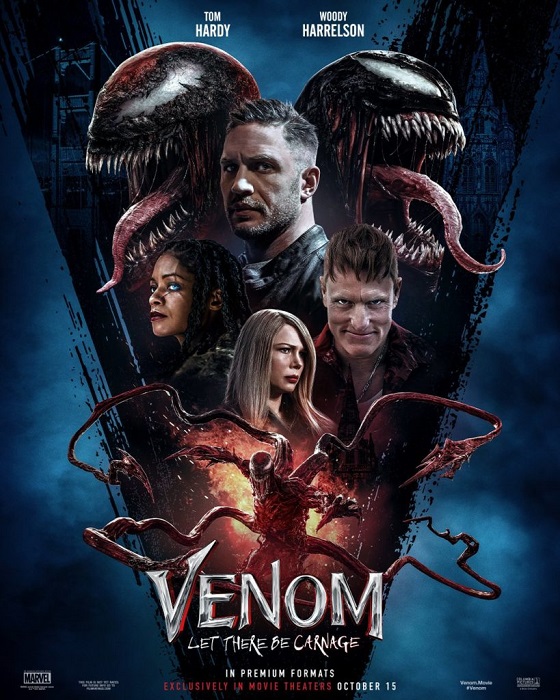
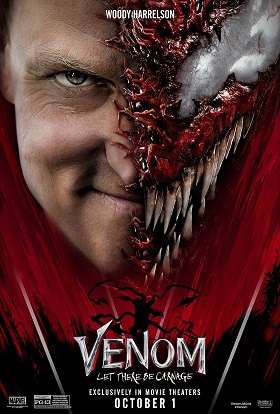
    Venom - Let There Be Carnage (2021)

    We first met serial killer Cletus Kasady (Woody Harrelson) in the mid-credit scene of 2018's Venom, but he steps into the spotlight for the sequel, Venom: Let There Be Carnage.

    The imprisoned killer, now shorn of his fright wig hairdo from Venom, has a fascination with washed-up journalist Eddie Brock (Tom Hardy), little realising that Brock is host to the alien symbiote known as Venom.

    However, Venom manages to unearth a clue in Kasady's cell that leads to the buried remains of many of his victims.

    This development cements Kasady's fate and propels Brock's career back to its previous heights.

    When Brock pays a final visit to Kasady in San Quentin, the killer manages to take a bite out of him... accidentally ingesting part of the alien symbiote.

    Kasady's execution by lethal injection then stimulates the creature in his blood, transforming him into the brutal, tentacled monstrosity Carnage.

    They break out of the prison in a grand set-piece of mass destruction and murder, and set about tracking down Kasady's childhood sweetheart, Frances, as part of a deal that would see them ultimately killing Carnage's "father", Venom.

    Frances Barrison (Naomie Harris) is a mutant codenamed Shriek, with powerful sonic abilities, who is being held in a secret research facility, but Kasady makes short work of its defences and the couple slip away into the night.

    However, the seeds of romantic disharmony are sown quite early on as symbiotes are extremely vulnerable to loud noises and so Carnage isn't at all impressed by his host's paramour.

    Frances and Kasady immediately plan a wedding, which involves kidnapping police detective Mulligan (Stephen Graham), who cost Frances her eye during an earlier escape attempt, Eddie, and Venom.

    To get to Eddie, the bad guys grab his former fiancée, Anne Weyling (Michelle Williams), who is now engaged to Dr Dan Lewis (Reid Scott).

    Directed by Andy Serkis, from a script by Kelly Marcel and Tom Hardy, Venom: Let There Be Carnage tries to temper the potentially brutal reality of a character like Kasady bonding with an almost omnipotent creature like Carnage with a tsunami of screwball comedy antics and bizarre attempts at black humour.

    In all honesty, it shouldn't work... but somehow it does, thanks in no small part of the hard-boiled charisma of Tom Hardy.

    There are echoes of Woody Harrelson's earlier performance in the divisive Natural Born Killers in the romance between Kletus and Frances, but these characters, drawn with broad, pulpy, brushstrokes are nowhere near as well-developed as Mickey and Mallory Knox.

    Upon first viewing the original Venom movie was a disaster, and yet there was something about it that drew me back to it on its home video release and I've not only found myself enjoying it more on repeat viewings, but have been drawn into the world of Venom in Marvel Comics as well.

    This is something I never thought would happen, as the whole idea of a murderous anti-hero really turned me off the character.

    But thanks to Tom Hardy's performance in that first movie and then Donny Cates's phenomenal run on the comics in recent years has really won be round to both the character and its potential... in the right hands.

    An overview of the plot makes you realise that Venom: Let There Be Carnage is actually a surprisingly small, and contained, film with the antagonists only being free to sow chaos in the wider world for, seemingly, less than 24 hours.

    There is no great hunt for Carnage and Shriek, as they tell Eddie where to find them soon after they've torched the abandoned reform school they were both held in as juvenile delinquents.

    The grand finale in the cathedral where Kasady and Frances are getting married, is reminiscent of many similarly-staged climactic confrontations, from the Quatermass Experiment to 2003's Daredevil, but this has the added cachet of battling Lovecraftian abominations... and a surprise cameo by the League of Gentleman's Reece Shearsmith.

    Talking of cameos, though, the biggest 'shock' and dollop of fanservice comes - once again - in the mid-credit scene, which sets up Venom's potential appearances going forward with a most exciting development.

    This 'squee' moment is almost worth the price of admission alone.

    Friday, January 10, 2025

    The Beach House (2019)

    In an attempt to patch up their relationship, opinionated, deadbeat, college dropout - and runner-up in a Skeet Ulrich-lookalike competition - Randall (Noah Le Gros) takes his supersmart girlfriend, Emily (Liana Liberato) to his family's beach house.

    As it's out of season, they're expecting to have the place to themselves.

    However, due to a breakdown in communication with Randall's dad, they instead find a couple of old family friends - Mitch (Hell on Wheels and Dawn of The Dead's Jake Weber) and his sick wife, Jane (Maryann Nagel) - are already staying there.

    As the house is big enough to accommodate everyone, after a few awkward moments, they agree to "get to know you" meal that, having exhausted the alcohol supply, ends with the consumption of some edible marijuana.

    Senses heightened by the drugs everyone is awed by a blue luminesce that clings to everything around the beach.

    And the next morning, things start to get even weirder as people start to feel violently ill.

    Having witnessed an apparent suicide, Emily - the only real candidate for the title of 'final girl' - stumbles across something vile and gelatinous on the beach, and soon finds herself trying to escape an unnatural fog that's rolling in as well.

    For all intents and purposes, The Beach House is another reimagining of HP Lovecraft's Color Out Of Space, only this time the alien infestation is coming from the bottom of the ocean, rather than the cold depths of the cosmos.

    Mixed in for good measure is a flavouring of Stephen King's The Mist and John Carpenter's The Fog, and maybe a soupçon of Quatermass.

    There's no denying that all the ingredients are there for a quality horror film, and it was trailers for The Beach House that originally got me thinking about subscribing to the Shudder streaming service.

    If you're coming to this cold, you should be aware that it's a really slow burn. Pretty much nothing  really happens for the first half of this 88-minute movie, except Mitch and Jane being a bit odd.

    But then, suddenly, the body horror cranks up and we're off to the races.

    There are some deliciously gross-out moments around this time when you can't help wondering if this is going to be "the greatest film of all time", but sadly it isn't.

    Like Emily herself, the plot stumbles all over the place, trying to figure out what's going on.

    Having a lead character's obscure area of study - and interests - corollate almost exactly with the nature of the random, apocalyptic, scenario  that she has fallen into is rather heavy-handed, even if Emily doesn't really call upon her area of expertise once everything starts to hit the fan. 

    Instead, it is simply sown in as ominous exposition during the meal with Mitch and Jane, and like a lot of the set-up is more or less a red herring. 

    That said, I have no problems with stories - horror ones, in particular - where the audience isn't spoon-fed an explanation of what's occurring (if nothing else, it helps you sympathise with the struggles of the central characters), but I'm not sure writer/director Jeffrey A Brown's script gave us as much information as he thought it did.

    But, perhaps, my biggest bugbear - which kept pulling me out of the moment - was the total absence of mobile phones.

    There was no indication that The Beach House was a 'period piece', but nobody had a mobile phone (which, of course, would have been very useful and would have almost certainly changed the direction of the story). Nobody even mentioned the idea of finding one.

    Communication-wise, all we saw were a couple of disconnected landlines and a CB radio.

    Where were the mobile phones? I'm annoyed at myself over how much this bugged me, but mobiles are ubiquitous in modern society and their absence was as big a mystery as what was actually causing the water-borne infection.

    My pop culture Odyssey: a slice of super-powered geek life with heavy emphasis on pulp adventure, superheroes, comic books, westerns, horror, sci-fi, giant monsters, zombies etc