Friday, April 10, 2026
SINBAD WEEK: Sinbad of The Seven Seas (1989)
As the original 1947 Sinbad The Sailor movie proved, you can make an excellent Sinbad film without Harryhausen effects as long as you have a great cast and script - Sinbad Of The Seven Seas has none of these.
I guess my spidey-sense should have been tingling by the mere sight of Lou 'Incredible Hulk' Ferrigno grinning on the cover of the DVD case.
And if not then, by the fact that the film opens with a contemporary framing device of an annoying mother (Daria Nicolodi) reading her equally annoying daughter (Giada Cozzi), Edgar Allan Poe's The Thousand-and-Second Tale of Scheherazade (although Poe's story bears no similarity to this sorry affair).
So far, so Princess Bride. But the narration continues, even as the scene shifts to Sinbad and his multi-racial crew, and then it continues some more and it pretty much never stops throughout the whole movie!
And if that wasn't bad enough, all the dialogue by the main characters has been rerecorded and dubbed over - quite badly and quite obviously.
Not that the actors are that good anyway, nor do they have quality material to work with and little apparent direction from Enzo Castellari, master of the spaghetti western and director of the original Inglorious Bastards.
From start to finish, Sinbad Of The Seven Seas is a dreadful script performed by dreadful actors, with the only comparison I can make being the distinctly British tradition of pantomime. And like pantomime, unless you are under six, Sinbad The Sailor is - in equal parts - likely to bore you to distraction and have you laughing out loud at its awfulness.
The only performer to come out of this with any kudos is John Steiner as villainous vizier Jaffar, clearly the only one in on the joke, who is gloriously over-the-top and arch, switching between delightful smugness and being his own worse enemy. Not only does he tell Sinbad where he has hidden the magic crystals that Sinbad must track down but then, having summoned a magical storm to batter Sinbad's ship, he runs it ashore on one of the islands where some of the crystals are hidden!
Inexplicably Sinbad is joined on his adventures by a Viking (Ennio Girolami), a Chinese soldier of fortune called Samurai (!!!) (Hal Yamanouchi), effete prince Ali (Roland Wybenga) - who is to marry the caliph of Basra's cute daughter, Alina (Alessandra Martines) - as well as a bald chef and a cowardly dwarf called Poochie (Cork Hubbert).
While chasing after the magic jewels that Jaffar has scattered - like a pointless video game - they encounter a number of ludicrous obstacles, most of which are overcome by very bad fight sequences (Sinbad has an odd habit of throwing his sword away and simply wrestling whatever he is facing).
The only scenario that shows a bit of initiative is Sinbad's seduction by Amazon Queen Farida (Melonee Rodgers) and her ultimate comeuppance.
I can't even bring myself to discuss the surreal cameo by bodybuilder Teagan Clive as Jaffar's co-conspirator, Soukra, the S&M dominatrix witch, except to say, like the rest of the film, it will leave you perplexed, bemused and possibly in need of counselling.
Unless you are in a particularly masochistic mood, really love ultra-low budget bad movies or are aged under six, Sinbad Of The Seven Seas is best steered clear of.
Thursday, October 23, 2025
THROWBACK THURSDAY: Whatever Happened to Spontaneous Human Combustion?
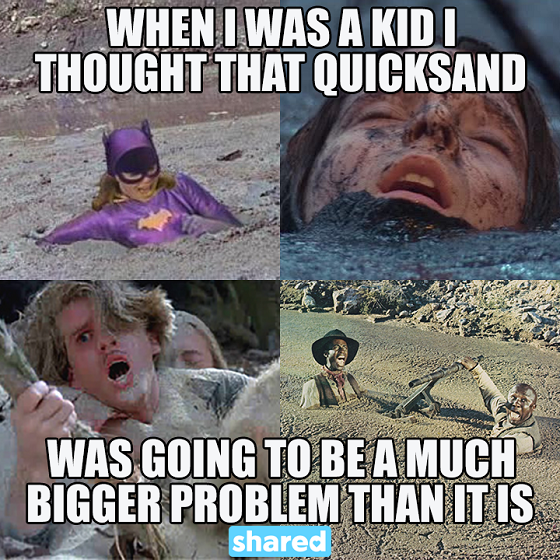
While I remember this trope - and have employed it in adventures I've written for games of Dungeons & Dragons - that's not the 'great danger' I remember most clearly from my youth that now doesn't seem to get a look-in.
That would be: spontaneous human combustion.
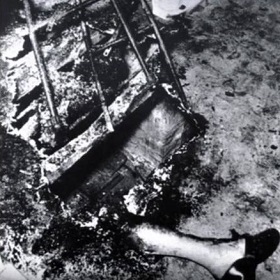
I have vivid recollections of reading about this phenomena in multiple Fortean Times-like publications (such as The Unexplained, from the early '80s) and books that I pored over as a youngling, every one seemingly running the same picture of the charred leg of a supposed victim of spontaneous human combustion.
It turns out this case dates back to 1951 and involved the discovery of Mary Reeser's limb (pictured left) in her Florida home, with signs of a very localised fire that had left the majority of the room untouched.
Although the case remains a mystery, the pseudoscience of spontaneous human combustion has been ruled out as a cause.
But when I was a wee bairn (already blighted with an easily-triggered fear of fire because of an early exposure to The Amazing Mr Blunden at the cinema), this image seared itself into my brain.
Don't get me wrong, I wasn't directly afraid of spontaneous human combustion, but for the longest time I was really convinced it was both a real thing and happening all the time around the world.
And yet since, probably, the 1990s I haven't heard mention of it.
However, in this age of idiotic conspiracy theories and science-denial, I'm expecting spontaneous human combustion to explode into our psyche once more.
Wednesday, October 8, 2025
SAW WEEK: Saw (2004)

Liberal use of the derogatory term "torture porn" is often used to throw Saw under the bus, lumping it in with lesser works of lower quality.
However, in truth, director James Wan has managed to pull off some Texas Chain Saw Massacre level sleight of hand that makes people remember seeing something that was far more gruesome than is actually shown on screen.
Sure, there's some nasty torture devices shown in Saw, creations of the enigmatic Jigsaw Killer, but the terror invariably comes from the suggestion of what the devices could do to their victims rather than graphically depicting it.
Saw is really a dark police procedural, striking a similar vein to Seven.
Here the mysterious antagonist is imprisoning people he believes are wasting their lives and, in his own sick way, is trying to make them appreciate what they have... or die trying.
Even the police's nom de guerre for the antagonist is a misnomer, as Jigsaw doesn't kill people in the film, rather he puts them in situations where they often end up killing themselves.
The bulk of the contemporary action in Saw centres around a pair of strangers - Adam (Saw scriptwriter Leigh Wannell) and Dr Lawrence Gordon (The Princess Bride's Cary Elwes) - waking up in a seedy bathroom with no idea of how they got there or how to escape.
Both are chained to strong pipes on opposite sides of the room and there's the corpse of a man, who appears to have blown his brains out, on the floor between them.
They soon realise they will have to work together to try and solve the puzzle they are trapped in.
As the story begins to introduce flashbacks into the men's lives, we are also drawn into the second main plot thread, that of the hunt by driven cop David Tapp (Danny Glover) to unmask the Jigsaw Killer... and his increasingly obsessive belief that Dr Gordon is his man.
Events culminate in one of the most memorable twists in modern horror since M. Night Shyamalan's The Sixth Sense.
You can only fully appreciate this the first time you experience it, but it's a masterstroke from director Wan and writer Wannell in both simultaneously laying out all the clues and totally misdirecting their audience.
Revisiting the film, you will then see all the Easter Eggs.
Definitely not the faint-hearted, Saw is as much a mystery movie as a game-changing horror.
Taking the maxim 'less is more' to heart, James Wan - in his first mainstream directing gig - gives viewers just enough for their imaginations to fill in the rest, cutting away before actually showing anything truly gruesome.
Those films that followed and sought to emulate its style often focussed too much on realising the suggested brutality and not enough on the mystery angle, but Saw still stands up 17 years later as a powerfully engaging crime thriller.