Sunday, September 7, 2025

HEALTH UPDATE: Still Little To Report

Photo by David Travis on Unsplash
The most progressive thing that happened to me health-wise this week was my annual eye test, which seemed to go better than expected.

The poor optician must have been bored rigid by my incessant blathering on about my current state of affairs, but hopefully my new prescription will improve my eyesight and get me reading more again.

My eyes have been a tad blurry in recent months, generally when I'm tired or the light isn't bright sunshine, but - even though I showed up in a wheelchair and had to helped around the room to the different test zones - it felt as though everything was generally okay (expect for the fact that I'm very short-sighted, especially in my right eye).

I'm going back in a couple of weeks for further photography of my eyeballs, but with eye drops in so they can get a clearer view of the back of my eye.

Otherwise, I had a few strenuous "Biscuit Club" (my weekly exercise class for people with stability issues), as I was the only one who could make it this week. This meant I got very focussed and personal attention, but also meant there was nowhere to hide - I had to give it my all. It was a very satisfying hour of intense training... and took a good couple of days to recover from.

My referral from The Pain Clinic came through very quickly, but initially it will be a telephone consultation with the head of the department. What cheered me up about this was it turns out to be the excellent doctor I saw in 2017.

Hopefully then he will agree that I need some injections in my spine to ease the pain - even if he, too, has no idea what's causing the malfunction in my legs.

The trouble, for me, is that the pain in my back from the prolapsed disc seems - according to several experts who've studied my MRI - to be unconnected with the sudden loss of full use of my legs.

My mobility issues are immensely frustrating (not only physically, but also mental health-wise) and I keep pushing myself "too far", resulting in falls and getting wedged in odd places around the house.

I keep thinking of sweeping changes I want to make to the gamesroom, the office etc but am unable to do them because of my disability.

Rachel, very kindly, says she'll help but I know she's already overworked, holding down a fulltime job and looking after me (as well as picking up the minimal chores that I used to do, such as taking out the bins, filling the dishwasher etc), that I can't put these extra burdens on her.

Saturday, September 6, 2025

MORE THAN JUST A GAME, IT'S THE GAME!

With its rich storytelling, elaborate campaigns and characters, and immersive fantasy worlds, Dungeons & Dragons is the ultimate tabletop role-playing game.
In 1982, at just 14 years old, Dungeon Master Robert Wardhaugh began a campaign that’s still running many years later.
Based out of his basement in London, Canada, players from across the country gather to take part in one of the longest-running D&D campaigns in history. But how do you play it? And most importantly, how do you play it well?
In this episode, Great Big Story returns to Robert’s legendary game to explore its evolution, the secrets to a campaign’s longevity, and what it takes to play (and master) D&D for life.
Except, of course, it isn't really Dungeons & Dragons per se, as Robert Wardhaugh has replaced pretty much every rule from Advanced Dungeons & Dragons - ship of Theseus-style - with his own personalised houserules.

Not that that, in any way, detracts from the brilliance, and enduring appeal, of this campaign - I'm immensely envious of pretty much every aspect of the group's set-up!

The Game, as Robert's campaign is known, now has its own website (here) and Patreon (here).

This latest episode of Great Big Story is an update on its first visit to Robert's world in 2017, which you can watch here:


History professor Robert Wardhaugh has been continually running this campaign for more than four decades - almost certainly the longest continuous roleplaying campaign.

He began at a teenager in 1982 with his schoolfriends and now, four decades later, has a pool of around 50 players to call upon, both around his native Canada and in the UK.

The adventures, which so far have covered more than 600 years of in-game history, take place on an alternate Earth that includes multiple real-world pre-gunpowder civilisations, as well as Robert E Howard's Hyboria in place of South America, and Tolkien's Middle-Earth (400 years after the destruction of The One Ring) as a bonus continent.

The game has been houseruled from its beginning, and now only bears a passing mechanical resemblance to modern Dungeons & Dragons (I get the impression Robert has been, forever, cherry-picking bits from all kinds of rules systems as he discovers them over the years).

In an interview with the official Dungeons & Dragons podcast in 2016 (see below), Robert revealed an interesting ruling that has shaped the nature of the campaign: death means death.

If a character is killed, the player leaves the game... unless the character has a family member who can inherit the dead player-character's mantle.

This has seen some player-character lineages extend to 20 generations so far!

(Note: there are other ways round this 'harsh' ruling - such as taking over a member of another player's family).

Averaging one or two sessions a week, usually of four or five hours, Robert has pledged to run this campaign for as long as he is physically able.

As well as mountains of custom terrain, he has a tens of thousands of miniatures to help bring his obviously prodigious storytelling to life for his lucky players.


Gamesmaster Robert Wardhaugh discusses his campaign - aka The Game - with Dragon Talk hosts Greg Tito and Shelly Mazzanoble.

You can watch The Twitch videos Robert mentions in the interview here:


Wired produced another mini-documentary about The Game (above).

Friday, September 5, 2025

The Empty Man (2020)

Even though it stumbled a bit in its closing moments, The Empty Man surprised me in ways no other film has managed recently.

Available to stream on Disney Plus, the trailer I'd seen beforehand (see below) suggested this was going to be a totally serviceable "teens discover local urban legend actually exists" monster movie, which I was totally okay with.

But what I got was so much more.


Opening with a 20-minute, pre-titles, atmospheric flashback to a group of backpackers in snowy Bhutan, who stumble upon a weird skeleton in a hidden cave, the film then shifts more towards what I was expecting as its focus jumps forward to a small town in Missouri in 2018.

Grizzled, former police officer James Lasombra (James Badge Dale) offers to help his widowed neighbour Nora Quail (Marin Ireland) - with whom he shares an unspoken secret - find her runaway daughter, Amanda (Sasha Frolova).

Taking on a Nordic noir/True Detective tone, this stage of the story unfolds like a police procedural, as James discovers that almost all Amanda's close friends have also disappeared after playing a "child's game" on a local bridge.

The night before, they'd found an empty bottle on the bridge and dared each other to blow into it... to summon "The Empty Man", a local urban legend.

Eventually, after some shocking revelations, James is led towards a bizarre self-help "cult", The Pontifex Institute, fronted by the charming Arthur Parsons (Stephen Root).

After being caught sneaking around the cult's headquarters, James gets a lead that sends him out to a seemingly abandoned Pontifax Institute facility in the wilderness, where things start to get really bizarre.

Initially, believing The Empty Man to be a "simple" teen horror, I couldn't understand how it could justify a two hour 20 minute running time.

However, once I realised I was in for something rather special the time seemed inconsequential as the story kept reinventing itself as it developed.

A key aspect of this very well made movie that I really appreciated was the conviction with which the characters approached the increasingly odd and distressing situations they were coming up against, giving the whole film a real sense of believability and verisimilitude.

Much like In The Mouth of Madness, with the The Empty Man you suddenly realise you're knee-deep in an incredible, mind-blowing, apocalyptic, nihilistic, Lovecraftian horror, and can't quite remember when you turned down this dark pathway.

Even though The Empty Man isn't overtly based upon any specific story by HP Lovecraft, I'm pretty sure I heard chants of 'Nyarlathotep' at one stage (which certainly makes sense in the context of this tale).

Lovecraft much?

Even a single viewing of The Empty Man requires a degree of concentration to stay on track, but I'm certain that this is a film that would reward a second, closer, examination as I'm sure there were many occult Easter Eggs I missed while on the initial journey.

As the narrative danced towards its final act, it became clear that The Empty Man was borrowing tropes from some of my other favourite horror movies, but it still managed to take a wild swing at putting a fresh lick of paint on its big twist.

Based on a Cullen Bunn comic book series, published by BOOM! Studios, The Empty Man was written and directed by David Prior and was one of the last films produced by Fox before it was brought out by Disney.

Apparently, The Empty Man got a low-key cinematic release, making so little money that even a home DVD release was ruled out as unprofitable.

All that said, The Empty Man is a strange and cerebral horror film so I realise it's not going to appeal to everyone, but I reckon in a few years it may well have spawned its own cult following.

Thursday, September 4, 2025

THROWBACK THURSDAY: Conan and The Fox


Last week I wrote about how I encountered Conan The Barbarian in comic books (courtesy of the wonderful, old digest releases), but I reckon this must have also been around the same time I discovered him in literature as well.

This literary retrospection reminded me of the first Robert E Howard books I ever owned.

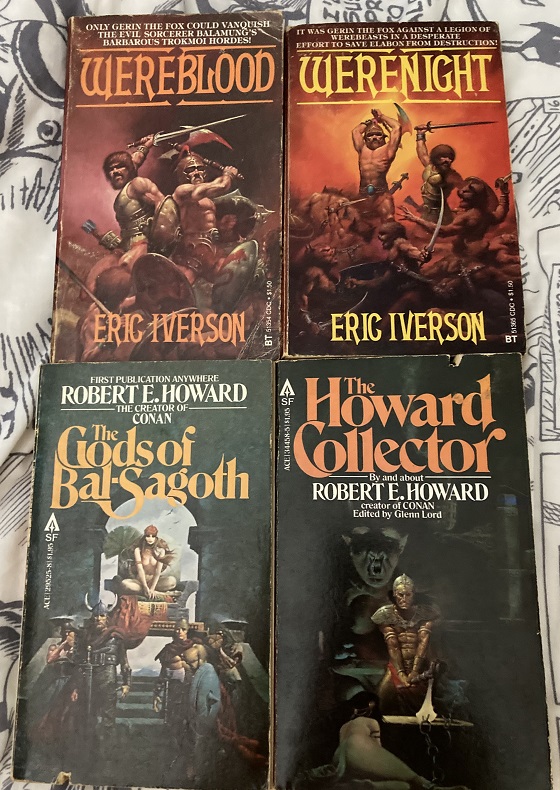
It must have been the very early 1980s when I found myself, during a shopping trip to Maidstone with my parents, as a young teenager in a discount book store (I seem to recall it was one of those shops that sold remaindered titles and craft bits and bobs, kind of a forerunner to today's The Works) and my eye was immediately drawn to the exciting covers of The Howard Collector and The Gods of Bel-Sagoth, which turned out to be anthology titles focusing on the output of Robert E Howard, father of Conan.

I also acquired Wereblood and Werenight, which would turn out to be game-changing sword-and-sorcery titles for me.

These short and pacy novels had an air of Fafhrd and The Gray Mouser about them, and I strongly suspect Fritz Leiber's dynamic duo were a major influence on author 'Eric Iverson'.

At that time, I was deep, deep, deep in the early bloom of my love of Dungeons & Dragons and all things RPG and those two novels were a major influence on me.

But then I could never find anything else written by Eric Iverson. I always hoped he'd continue the adventures of Gerin The Fox, the protagonist of Wereblood and Werenight.

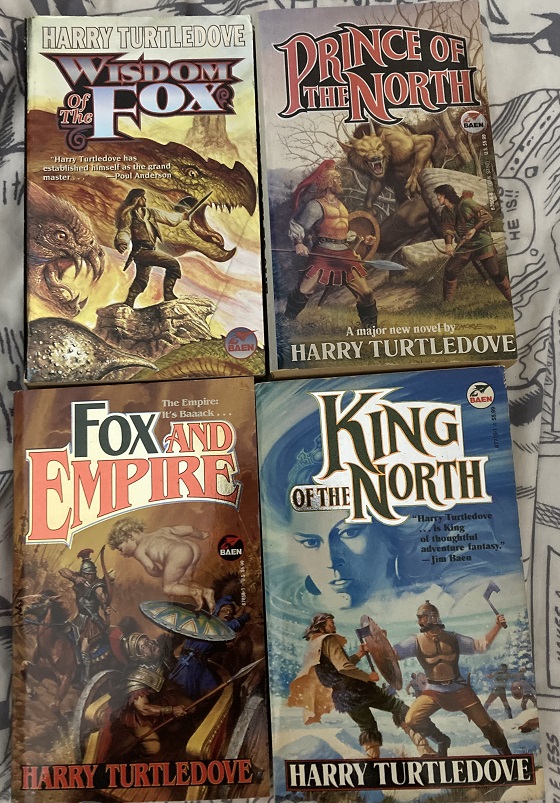
It was only about a decade or so ago that, thanks to the creation of the Internet, I discovered that Eric Iverson was actually just a pen name of alternate history aficionado Harry Turtledove... and that there were more Gerin The Fox tales.

They turned out to be reasonably easy to track down at the time, on Amazon and eBay, but given how much I loved the original duology as a teenager I still haven't cracked open these later books for fear they can't recapture that magic.

It's probably about time I tried though...  

The Whisperer In Darkness (2011)


It should be written into American law that if ever a Hollywood suit has the cockamamie idea of trying to do a big budget adaptation of an HP Lovecraft horror story they should be forced (possibly at gunpoint) to first watch the HP Lovecraft Historical Society's Call Of Cthulhu and The Whisperer in Darkness to see how it can be done well and with due respect to the source material.

The Whisperer In Darkness was 2011's cinematic offering from the foremost producers of Lovecraftian replicas and gaming props, The HP Lovecraft Historical Society, and like its predecessor retains its verisimilitude through the use of black and white film - although unlike Call Of Cthulhu this one is a talkie!

Taking Lovecraft's tale as its base, the movie expands the set-up and adds in an entirely original finale to give the story a classic three act structure, rather than ending on the shock revelation of the short story. It also attempts to humanise Lovecraft's protagonist more, giving him an emotional investment and a more 'traditional' Hollywood style ending - while still managing to neatly stitch in a suitably Lovecraftian twist.

The Whisperer In Darkness tells of Miskatonic University folklore professor Albert Wilmarth (Matt Foyer) and his sceptical investigations into supposed 'monster' sightings in the most remote hills of Vermont after some particularly violent flooding.

His search for the truth begins with footprints around the property of the isolated home of Henry Akeley (Barry Lynch) and quickly spirals into madness as he unearths more than he was bargaining for and discovers the future of mankind is at stake.

Like their inspiration, film-makers Sean Branney and Andrew Leman rely primarily on suggestion and atmosphere and it's only really when the true face of the central creatures are revealed in the final act that the excellence of the tale wobbles slightly.

Saving both time and (more importantly) money, the team went with CGI animation for the alien Mi-go instead of the costlier and more time-consuming stop motion (which I get the impression a lot of fans would have preferred).

By no means a deal breaker, but there is no escaping the truth right in front of your eyes when you watch the movie that the CGI Mi-go, especially in close-up, really stand apart from the rest of the film (and not in a good way).

We'd waited a long time for this movie to appear (more than two years I believe since the original announcements and teasers) and I'd have gladly waited longer, but I totally understand the HPLHS's desire to get the film done and for a decent budget (as it is Sandy Petersen, creator of the Call Of Cthulhu RPG had to step in and help with the funding to get the movie finished).

They also, rather cheekily, added in a new, most 'unLovecraftian' character in the form of a little girl, Hannah (Autumn Wendel), whose life is in jeopardy because of the alien creatures in the hills, and Wilmarth takes her under his wing and attempts to protect her from a possible fate worse than death.

Whether he succeeds is for you to find out when you purchase the movie directly from the HPLHS. The two-disc DVD set includes a disc chock full of extra features including a bevy of informative behind-the-scenes documentaries, trailers and deleted scenes.

You won't regret the purchase. This ranks as one of the strongest adaptations of Lovecraft's stories of indescribable monsters and things man was not supposed to know.

Outside of HPLHS's own productions, the only live-action Lovecraftiana  at that time that came close to getting under my skin - as Lovecraft's words have the power to do - were John Carpenter's In the Mouth of Madness and Cigarette Burns (from the TV series Masters Of Horror), even though neither of these are actually Lovecraft stories, and Stuart Gordon's Dagon and Dreams In The Witch-House, the latter also from Masters of Horror.

Thus John Carpenter and Stuart Gordon would be exempt from my proposed law above; everyone else - watch these movies before you dare even contemplate trying to bring Lovecraft to the big, or small, screen yourself.

Wednesday, September 3, 2025

How Does This Grab You?

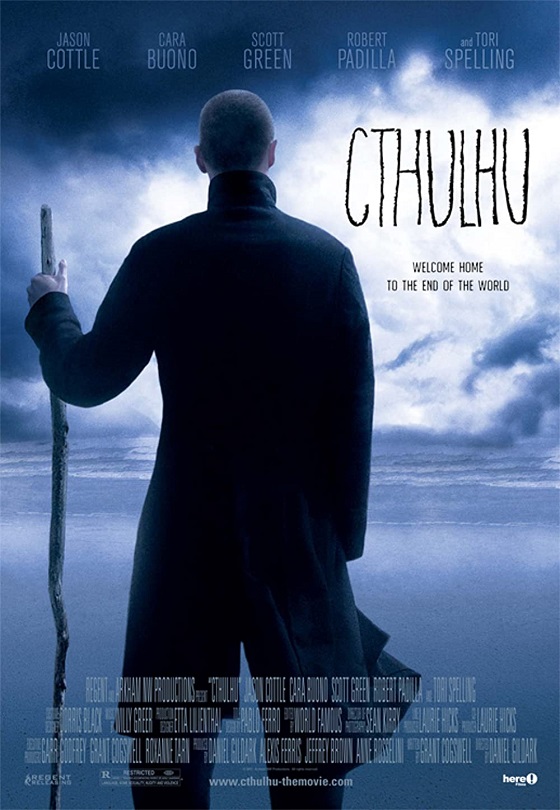
Cthulhu (2007)


Learning of his mother's death, Seattle college professor Russel Marsh (Jason Cottle) returns to his isolated hometown on the coast to act as executor of her will.

Estranged from his family since he came out as gay, he is reunited at his mother's wake with his disapproving father (Dennis Kleinsmith), the head of a New Age cult called The Esoteric Order of Dagon.

Very quickly Russ begins to realise that there are strange things going on in the town, from discovering an odd totem in his hotel bed, through learning of the area's history of "mysterious disappearances", to the apocalyptic ravings of a deranged old fisherman, Zadok (Richard Garfield)... who namedrops "shoggoths".

There's also Russel's aunt in the mental institution, the terrified liquor store clerk with a missing brother, the strange list of names scrawled on the floor and walls of the old net hut, and so on.

It's as though every red flag possible is being waved at the increasingly paranoid and isolated Russ, but the unsettling, dream-like Kafkaesque nature of the events he finds himself trapped in means he can never quite escape the town again.

Ever the outsider, Russ is sceptical when a friend of his sister, a woman called Susan (Beverly Hills 90210's Tori Spelling),  tells him he has a great destiny connected to the future of the town ... which is why she later drugs and rapes him!

The only solace Russ finds is with his childhood friend, tow truck driver Mike (Scott Green), their youthful intimacy now blossoming into something possibly deeper.

All of this is set against a backdrop - shared through brief radio and television snippets - of accelerating global collapse.

It's only looking back at Cthulhu after the final credits have rolled that you realise how much was squeezed into a mere 100 minute runtime.

But a lot of that was achieved by the immersive fever dream-logic flow of scenic non sequiturs, so that much of the time the audience can't be one hundred percent certain whether what they are watching on screen is real or an hallucination. 

HP Lovecraft famously drew on his own dreams for ideas for his weird fiction, and in Cthulhu writer/director Dan Gildark has delivered a disorientating, nightmarish adaptation of Lovecraft's The Shadow Over Innsmouth.

I suspect the use of the name Cthulhu, and seemingly conflating it with Dagon in the story, is primarily for name recognition with the broader public.

But this isn't really a film for the masses, as I can't help feeling that a knowledge of Lovecraft's work - and particularly the story this is based upon - would help an audience member navigate the choppy and oft confusing highways and byways this movie wanders down.

Admittedly, some of the vagaries and narrative confusion is compounded by the variable audio quality, and the tendency of certain actors - particularly Scott Green - to mumble their dialogue.

A low-budget indie flick with almost no special effects, much horror is achieved in Cthulhu by what we don't see, by what is suggested, with only glimpses of the giant, pale salamander creatures living in the tunnels, or the shadowy sea creatures walking out of the waves at the climax of the piece.

Having skimmed a few reviews beforehand, I'll confess I went into Cthulhu with very low expectations.  Instead, I think I unearthed a flawed gem. 

It's far from perfect, but in many ways its imperfections add to the unnerving nature of the protagonist's predicament. 

While it's no In The Mouth of Madness, I think Dan Gildark, and co-writer Grant Cogswell, did an impressive job of capturing the spirit and atmosphere of Lovecraftian fiction, especially as it deals with identity and not feeling comfortable in your own skin.

By not spoon-feeding their audience answers, you are drawn into the mystery and horror of the scenario, as confused and befuddled as Russ by much of the goings-on. 
  • Having imported a DVD of Cthulhu from the States, I later found that it's available on YouTube (thanks to Mr Gildark).

Tuesday, September 2, 2025

H.P. Lovecraft's Re-Animator (1985)


The mid-'80s were a Golden Age for schlock horror, with the boom in the home video market providing a hungry audience for low-budget thrills.

One of the many diamonds in a mostly rough field was Stuart Gordon's liberal re-imagining of one of H.P. Lovecraft's lesser works (Lovecraft is on record as saying he hated his stories of Herbert West as they were written for money; "drivel written for the masses").

Re-Animator updates Lovecraft's original to modern times (well, the 1980s) and turns a Frankenstein parody into a darkly, darkly funny Grand Guignol farce.

The simple plot follows the arrival of Herbert West (Jeffrey Combs) at Miskatonic University in Arkham, after an "incident" in Switzerland, where he rooms with fellow student Dan Cain (Bruce Abbott), who is dating the dean's daughter, Meg (Barbara Crampton).

Unbeknownst to all, Meg is also an object of lust for creepy neuroscientist Dr Hill (David Gale), who eventually discovers that West - with the reluctant help of Cain - has been experimenting with a revolutionary re-agent that can give a form of zombie-life to recently deceased bodies.

Events spiral out of control, as they always do, leading to a crazy, climatic, gory zombipalooza in the University hospital's morgue.

As well as a quality script that brings a surprising amount of character to a blood-soaked B-movie, the effects are very inventive - as are some of sicker elements of humour: no one will ever forget the reverse-necrophilia scene where a re-animated corpse tries to get down with blonde-bobbed Meg.

There's also, thanks to Meg, a lot more female flesh on display in this 86-minute film than I recall seeing in the sequels.

Of course, I can't really pass comment on this film without singing the praises of Jeffrey Combs.

This was the film that made him a B-movie star and while he may not have the same instant name recognition as Bruce Campbell I'd put them on very similar levels as comedy horror legends.

While Campbell has the square-jawed hero role down pat, Combs is the man to call if you want a single-minded, amoral, mad scientist.

Monday, September 1, 2025

PULP PICTURE OF THE MONTH: March Or Die (1977)

In the months following the end of The Great War, a detachment of French Foreign Legion guarding an archaeological dig in Morocco are massacred and two curators from the Louvre, working at the site, are kidnapped by Arab tribesmen.

Archaeologist Francois Marneau (Max von Sydow) persuades the French military to send another division of the Legion to provide security for him on his resumption of the dig.

Commanding these soldiers is the slightly-shell-shocked Major William Sherman Foster (Gene Hackman), a tough, no-nonsense officer who makes no bones about his dislike for Marneau's ambitions, dismissing it as "grave-robbing" and pointing out that not only the treasures believed to be hidden at Erfoud rightly belong to the locals, but that the lives of his men are more valuable than anything that can be dug out of the ground.

Among Foster's force are a number of new recruits, including roguish jewel thief Marco "The Gypsy" Segrain (Terence Hill) and giant White Russian Ivan (Jack O'Halloran aka Non from Superman II).

Accompanying Marneau is the daughter of one of the kidnapped curators, Simone Picard (Catherine Deneuve), who soon falls for the charming Marco, even though she tries to keep him at arm's length because of her past experience with a solider during the war.

The site at Erfoud is the final resting place of a Berber saint, The Angel of the Desert, which Bedouin warlord El Krim (Ian Holm) is using as a catalyst to unite the various tribes of the region in a holy war against the foreign invaders.

The bulk of March Or Die focuses on the hard training regime and merciless discipline of the French Foreign Legion, and these are the most compelling parts of the story as it builds towards its blood-soaked climax that is more Alamo than Zulu.

The romantic sub-plot between Mme Picard and Marco - although it adds emotional impact to the film's coda - feels slightly superfluous to modern sensibilities. There is an attempt to create a love triangle by playing on Foster's attraction to Picard, but it doesn't really go anywhere.

Also the casting of Ian Holm as El Krim, while de rigeur when this film was shot, now undermines the charisma of the Bedouin leader, making him more akin to a character in Michael Bentine's Potty Time than a fearsome warrior.

While Marco is the nominal hero of March Or Die - looking after his friends as they struggle with the training, wooing the female lead, standing up to authority and learning to respect it etc - Gene Hackman steals the show because he's Gene Hackman.
My pop culture Odyssey: a slice of super-powered geek life with heavy emphasis on pulp adventure, horror, comic books, westerns, superheroes, sci-fi, giant monsters, zombies etc